Israel - My Love

Israel Flag

Quotes About "Palestine"


Remember: Israel is bad! Its existence keeps reminding Muslims what a bunch of losers they are. ~~~~~~~~~~~~~~~~~~~~~~~~~~~~~~
"There will be no peace until they will love their children more than they hate us."

-Golda Meir-
~~~~~~~~~~~~~~~~~~~~~~~~~~~~~~
'If the Arabs put down their weapons today, there would be no more ‎violence. If the Jews put ‎down their weapons ‎today, there would be no ‎more Israel'‎

~Benjamin Netanyahu~
~~~~~~~~~~~~~~~~~~~~~~~~~~~~~~~
"Peace of us means the destruction of Israel. We are preparing for an all out war, a war which will last for generations.

~Yasser Arafat~
~~~~~~~~~~~~~~~~~~~~~~~~~~~~~~
"The Palestinian people have no national identity. I, Yasser Arafat, man of destiny, will give them that identity through conflict with Israel."

~ Yasser Arafat ~
~~~~~~~~~~~~~~~~~~~~~~~
"The Palestinian people does not exist. The creation of a Palestinian state is only a means for continuing our struggle against the state of Israel. For our Arab unity. In reality today there is no difference between Jordanians, Palestinians, Syrians and Lebanese. Only for political and tactical reasons do we speak today about the existence of Palestinian people, since Arab national interest demand that we posit the existence of a distinct 'Palestinian people' to oppose Zionism".

~ Zahir Muhse'in ~
Showing posts with label Temple Mount. Show all posts

Monday, September 20, 2010

Tips on the Temple-Building

I will bring thy seed from the east, and gather thee from the west; I will say to the north: Give up, and to the south: Keep not back, bring My sons from far, and My daughters from the end of the earth. Isaiah 43:5-6.

Jewish emigration from the countries east and west of Israel was relatively free, but very hard from Russia (north) and Ethiopia (south)

Do you think that was a coincidence?

I will bring them from a northern country,(Jeremiah 31:7)At the time of Jeremiah, there was no Jewish Diaspora worthy of note north of Israel.

When? “With fury poured out, will I be king over you… and I will purge out from among you the rebels, and them that transgress against Me; I will bring them forth out of the land where they sojourn, but they shall not enter into the land of Israel… and I will bring you out from the peoples, and will gather you out of the countries wherein you are scattered, with a mighty hand. Ezekiel 20:33-38. Holocaust, then the creation of Israel.

Some corroborating details, perhaps? Sanhedrin 97a, In the generation of messiah, Torah scholars will meet in brothels [as happens routinely in Tel Aviv slums], Galilee will be no more [Arab, off-limits to Jews]. border residents will move from town to town, met with disapproval [Sderot, Kiryat Shmona evacuees]: God-fearers [haredim] will be despised. The face of the generation will be a dog's face, and truth will be lost. More details: Wine will be expensive despite plentiful harvest, and the entire government will fall into apostasy.”

I the LORD will hasten it in its time, Isa 60:22. Sanhedrin 98a explains that if Israel deserves it the salvation will come fast; otherwise it will come in its own time. Such a reading is divorced from Isaiah's text, which promises to hasten the events without qualification. This can only mean that the time will run faster at the end of days, as in the Mayan concept of time.

The rabbinical doctrine of the supernatural messiah was meant to dissuade Jews from running after every savior. That approach might have saved the nation, but perhaps, on the contrary, it prevented us from liberating our land long ago, when Jews were more numerous than Palestinian Muslims. Rabbis laboriously explained absurdities or metaphors such as the Danielic promise of messiah as someone “like a son of man”flying on the clouds (Sanhedrin 98a), instead of concentrating on much more sensible earlier prophecy where the messiah is said to ride a donkey, meaning that he’s a common person. But you don't expect a Temple to descend from heaven at the call of someone who rides a donkey—or even a BMW—and rabbis, averse to building the Temple in mundane ways, wait for the heavenly figure subject to Shas approval.

The concept of heavenly salvation is a perversion of Judaism. God doesn't act in the world directly. Even the Flood was a completely natural event. Everywhere the Scripture says that God did this or that, it's a metaphor for Israel: God discomfited Sisera,(Judges 4:15)means merely that Jews defeated him. So it is with the heavenly Temple and messianic wars: God wages wars by enabling us to do so.

Support for any political agenda can be found in Tanakh's fanciful prophecies and their even more fanciful interpretations. This childish game is silly. I have no doubt about God’s existence, commandments, etc., but I cannot make myself believe the nonsense of heavenly son of man or, for that matter, urim and tummim. It is written rightly that God doesn't perform miracles by violating the laws of nature. The high priest didn't speak with God in the holy of holies; he did not consult the magic amulets; the Ark, if it's so immensely holy, won't have fallen into the hands of heathens and disappeared. And no, I don't believe it is hidden below the Temple Mount.

The end is near. The time runs faster, Israel is gathered from all corners of the earth, Zechariah's two-thirds are lost in Holocaust and assimilation, and Jews returned to Zion with force and miracles. Stop wasting time on theological nonsense. Recognize that the Temple won't descend from heaven. Go build it yourself.


Samson Blinded

Friday, September 10, 2010

The Western Wall - Then and Now

What we see today is only a small portion of the actual Wall.

By Rabbi Shraga Simmons

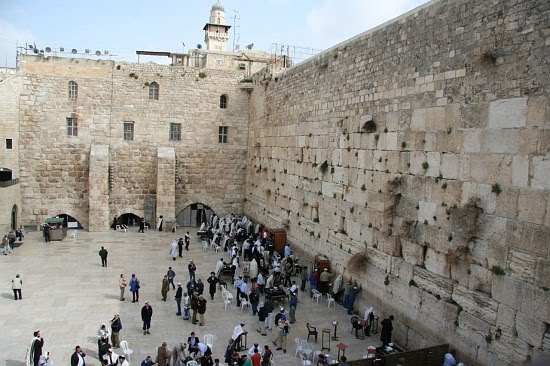
The Western Wall was built as a retaining wall to support the western side of the Temple Mount. It stretches some 200 meters ― the length of the Temple Mount (to the left as you look at the Wall). Most of it is obscured behind the structures of the Muslim Quarter.

From the onset of the Middle Ages, the area in front of the Wall had been used as a garbage dump. (That is why the gate nearby the Wall is called "Dung Gate.") In the 16th century, the Sultan Suleiman discovered the location of the Wall and had the area cleaned out.

In the early 20th century, Arab homes had been built up to 15 feet from the Wall, leaving just a narrow alleyway ― a space of about fifteen feet in front of the Wall ― for Jews to come and pray.
Following the Israeli War of Independence in 1948, the armistice line between Israel and Jordan ran through the middle of the city, dividing Jerusalem. Jordan occupied the Old City, including the Temple Mount, the Jewish Quarter, and the Western Wall. The Jewish population of the Old City was forced out of the area, all the synagogues in the Old City were destroyed ― and Jews were forbidden by Jordanian law to visit the Western Wall.

On June 7, 1967 ― the third day of the Six-Day War ― Israeli forces recaptured the Old City of Jerusalem, including the Western Wall. (Read two emotional accounts of Israeli paratroopers who liberated the Wall.)

During the war, most of the residents of the Magreb Quarter (the buildings in front of the Wall) had left the area when Israeli forces began to surround the Old City on the first day of the war. Those who were left were relocated by the Israeli government to a new community. The buildings were then removed, enabling construction of the large Western Wall Plaza which accommodates thousands of visitors to the Wall daily.

The Western Wall Tunnels
Beneath the Muslim Quarter, archeologists have spent the last decade digging deeper and farther to discover the true extent of the Western Wall. It has been found that the Wall is more than 200 meters long and stretches down to the bedrock of the Temple Mount. Within the past few years, it has become possible to travel through the "Western Wall Tunnels," the archeological excavation which runs underneath the Muslim Quarter along the entire length of the Temple Mount.
The entrance to these tunnels is off the left side of the Western Wall Plaza, about halfway between the Wall itself and the stairs leading up to the Jewish Quarter. These tunnels exit onto the Via Dolorossa at the north end of the Temple Mount.

The Stones
The Western Wall is constructed of limestone. The edges of the stones are etched to form a border around each one. This design is typical of Herod, the Roman-appointed king of Judea (circa first century BCE) who built the wall as a retaining wall for the Temple Mount. As you look farther up the wall, the stones get smaller. This is because the wall was originally not as tall as it is now, but was added to over the centuries. The base of the wall is actually about twenty feet below the current floor of the prayer area.

One of the stones in the Wall measures more than 40 feet long, and weighs 400 tons. This is the largest stone ever quarried by man ― nothing near its size exists in Greece, in the pyramids, or in Manhattan. No crane today can even lift such a stone. How it got there is an engineering marvel. Others stones are over 100 tons. These stones can be viewed in the archeological tunnels that have been opened in the past few years.

Many people have the custom of placing small pieces of paper containing prayers between the stones of the Wall. Jewish tradition teaches that the Temple Mount is the holiest site on Earth, and that the presence of God constantly rests on this site. Jewish mystical tradition teaches that all prayers from around the world ascend to the Wall, from where they then ascend to heaven.

Flora and Fauna
There are a number of species of plants growing out of the stones in the Wall:
1. Henbane. This is the most common plant in the Wall. The Hebrew name for this plant is Shikaron, which is a form of the word for drunkenness. The name is possibly derived from the poisonous, intoxicating substance contained in the plant.
2. Podosnoma. This is the second most common plant in the Wall. It is a typical rock plant, and is able to penetrate stone with its roots in order to extract water.
3. Sicialian Snapdragon. These plants are found mostly on the higher sections of the Wall. It often takes root in cracks between the stones of a wall, and on fences.
4. Horsetail Knotgrass. The Talmud (Shabbos 14:13) mentions that an antidote for snake bite was prepared from this plant.
5. Thorny Caper. This plant produces flower buds that were used in ancient times as a spice after marination. In the summer, buds open every day to produce flowers and fruits.
6. Phagnalon. This smaller plant is found scattered throughout the Wall.
Birds, such as swallows, sparrows, and doves, as well as small lizards, have been known to nest in the cracks and between the stones of the Wall.

based on "The Western Wall," published by the Israeli Ministry of Defense


You Might Also Like to Read:
The Western Wall Information

Aish.Com

Saturday, August 14, 2010

Who Owns Jerusalem

One of the world's leading experts on Jerusalem, Dr. Jaques Gautier discusses his twenty-five years of study on the subject, "Who Owns Jerusalem?"

Dr. Gauthier, is a non-Jewish Canadian Lawyer who received his PhD after twenty years of research on the legal status of Jerusalem. His dissertation comprises some 1300 pages with 3000 footnotes.

Part 1:


Part 2:


Part 3:


Part 4:


Part 5:


The Dome of the Rock built exactly on the place of the Jewish Temple:


Tuesday, August 3, 2010

The Temple Mount

THE TEMPLE MOUNT - EYE ON REALITY

Below are portions of an article written in WorldNetDaily by Joseph Farah

"B-E-T-W-E-E-N T-H-E L-I-N-E-S"
Myths of the Middle East by Joseph Farah

If you believe what you read in most news sources, Palestinians want a homeland and Muslims want control over sites they consider holy. Simple, right? Well, as an Arab-American journalist who has spent some time in the Middle East dodging more than my share of rocks and mortar shells, I've got to tell you that these are just phony excuses for the rioting, trouble-making and land-grabbing.

What about Islam's holy sites? There are none in Jerusalem. Shocked? You should be. I don't expect you will ever hear this brutal truth from anyone else in the international media. It's just not politically correct.

I know what you're going to say: "Farah, the Al Aqsa Mosque and the Dome of the Rock in Jerusalem represent Islam's third most holy sites." Not true. In fact, the Koran says nothing about Jerusalem. It mentions Mecca hundreds of times. It mentions Medina countless times. It never mentions Jerusalem! With good reason. There is no historical evidence to suggest Mohammed ever visited Jerusalem. So how did Jerusalem become the third holiest site of Islam?

Muslims today cite a vague passage in the Koran, the seventeenth Sura, entitled "The Night Journey." It relates that in a dream or a vision Mohammed was carried by night "from the sacred temple to the temple that is most remote, whose precinct we have blessed, that we might show him our signs." In the seventh century, some Muslims identified the two temples mentioned in this verse as being in Mecca and Jerusalem. And that's as close as Islam's connection with Jerusalem gets -- myth, fantasy, wishful thinking. Meanwhile, Jews can trace their roots in Jerusalem back to the days of Abraham.

Ariel SharonThe latest round of violence in Israel erupted when Likud Party leader Ariel Sharon tried to visit the Temple Mount, the foundation of the Temple built by Solomon.* It is the holiest site for Jews. Sharon and his entourage were met with stones and threats. I know what it's like. I've been there. Can you imagine what it is like for Jews to be threatened, stoned and physically kept out of the holiest site in Judaism?

So what's the solution to the Middle East mayhem? Well, frankly, I don't think there is a man-made solution to the violence. But, if there is one, it needs to begin with truth. Pretending will only lead to more chaos. Treating a 5,000-year-old birthright backed by overwhelming historical and archaeological evidence equally with illegitimate claims, wishes and wants gives diplomacy and peacekeeping a bad name.

* Note:
We beg to differ with Joseph Farah on this one point. The violence started the day BEFORE Sharon went up to the Temple Mount. In fact, the Arab Violence was planned months before after the failed Camp David. Sharon didn't just go to the temple mount. He applied for a permit from the waqf. The Arabs knew he was coming and planned the intafada accordingly!

There was nothing spontaneous about the Arab violence!

We appreciate Joseph Farah's honesty and only wish more Arab-Americans would come forward
with the same courage and honesty. Talk about the proverbial "Needle in the Haystack!"

Joseph Farah, a Christian Arab-American journalist, is the editor and chief executive officer
of WorldNetDaily.com, a leading independent news site.


Masada 2000

Jerusalem and the Temple Mount

East and West Jerusalem and the Old City

For over 3,300 years of history, Jerusalem has been a capital city for only the Jewish People. Jews have always lived in Jerusalem, except when they were massacred or driven out. There has, however, been a nearly unbroken Jewish presence in Jerusalem for the past 1,600 years. And since the early 1800's, the population of Jerusalem has been predominantly Jewish. Even when the Jordanians captured and occupied Jerusalem from 1948-67, they (the Jordanians) never sought to change it to their capital (replacing Amman) nor make it the capital of all Arab-"Palestinian" people. Even during the 19 years Jordan "occupied" most of Jerusalem, Arab leaders from other Arab countries hardly ever bothered to visit this city! Only to the Jews has Jerusalem ever held special meaning! The reality is that Jerusalem was never an Arab capital and that it never was, until the Jews revitalized it, a dusty provincial city that hardly played and economic, social or political role.

Another myth deals with the issue of Jerusalem and its Temple Mount. The myth is that Jerusalem is really an Arab city and that it is a central focus of Islam. The truth is that the Arabs expressed very limited interest in the Temple Mount before 1967 after the Six-Day War. Besides, Mecca and Medina (both in Saudi Arabia) are Islam's holiest cities!

Islam's Holy(?) Koran mentions Mecca 2 or 3 (implied, but not actually written) times. It mentions Medina 5 times. It never mentions Jerusalem and with good reason. There is no historical evidence to suggest Mohammad ever visited Jerusalem! And if he did visit Jerusalem, it could not have been until 6 years after his death. Therefore, the notion that Mohammed ascended to Heaven from a rock in Jerusalem (today's Dome of the Rock) is even more ridiculous!

One more thing about Jerusalem in general and its Temple Mount in particular. Jerusalem appears in the Jewish Bible 669 times and Zion (which usually means Jerusalem, sometimes the Land of Israel) 154 times, or 823 times in all. The Christian Bible mentions Jerusalem 154 times and Zion 7 times. All told, in the Old Testament (the Hebrew Bible) and the New Testament, the terms "Judah" or "Judea" appear 877 times, and "Samaria" is used on 123 occasions.

Hold on to your hats, everybody. It gets even better. Upon closer look at their Holy Koran, we have uncovered something quite amazing. These Muslims may actually be more Jewish than Muslim! Get this... the Koran mentions "Israel" [or "Israelites"] 47 times, "Jew" or "Jewish" 26 times! Even "Christian" or "Christians" gets 15 mentions!

OK, so maybe Mohammed just forget to mention "Jerusalem". Maybe he also forgot to mention the Haram-esh-Sharif, their name for Judaism's Temple Mount. Perhaps it was an honest oversight. That desert heat can do strange things to one's brain. But surely "Palestine" is mentioned all through the Koran. After all, the poo' poo' ancient "Palestinians" go way back, right? WRONG. "Palestine" and "Palestinian" are nowhere to be found. Perhaps that's because these so-called Arab "Palestinians" have ancient historical roots going ALL THE WAY back to June 1967! So much for the Arab, Muslim or "Palestinian" ancient religious or physical connections to a single ounce of turf in the so-called "occupied" territories!

From 1948 to 1967, when East Jerusalem and the Temple Mount were "occupied" by Jordanian Forces following the 1948-9 Arab-Israeli War, Jerusalem itself was ignored by the Arab world. No Arab leader ever paid a visit, not even to pray at the al-Aqsa Mosque or the Dome of the Rock (both located on the JEWISH Temple Mount). Also noteworthy during this 19 year period of Jordanian occupation' no Jews were allowed there... not that there was much for them to see since the Arabs destroyed 58 of Jerusalem's Jewish synagogues! Even the Arabs of "Palestine" placed so low a priority on Jerusalem that the PLO's founding charter, the 1964 Palestinian National Covenant, made no reference whatsoever to it. Only when the Jews recaptured it after the 1967 "Six Day War" (initiated by the Arabs) did the Arab world SUDDENLY grow very passionate about Jerusalem!

Can any Muslim in the world produce any credible evidence for their connection to this holy site, other than Mohammed's dream? Believe it or not, the one and only source for the Muslim's claim to Jerusalem and the site of the Holy Temple, is a mention in the Koran of a dream that Mohammed had about an unknown "place far away". Perhaps this "place far away" is the site of the White House in Washington DC or a Nevada "chicken ranch?"

In truth, the Dome of the Rock and the Al-Aqsa mosques are just but two of hundreds of thousands of Muslim mosques around the world. Except for these two minor mosques, Jerusalem itself has no major Islamic significance. In fact, far more Christian shrines are in Jerusalem than Muslim ones!

When a Jew prays from anywhere in the world, he faces the Temple Mount in Jerusalem. When a Moslem prays, even while IN Jerusalem, he faces Mecca, Saudi Arabia (1,300 miles away due east!). So in many cases, even when a Moslem is in Jerusalem, his "hind quarters" are facing these two Jerusalem mosques! What does THIS tell you! And when Islamic suicide bombers try to take apart Jerusalem piece by piece, what does THAT tell you!


By:Masada 2000

Wednesday, July 21, 2010

Western Wall Jerusalem (HaKotel HaMaaravi)

The Western Wall, known to non-Jews as the Wailing Wall, is a 488-metre (1601-foot) stretch of wall which is all that remains of the Second Temple of Jerusalem. The most sacred Jewish place in the world, it attracts thousands of devout Jews every year who come to pray, and push prayer notes and messages of goodwill into the cracks of the wall. The wall was built more than two thousand years ago under King Herod, and has been under Israeli control since 1967. It is also sacred to Muslims who believe that the wall marks the place where the prophet Mohammed tied up his winged horse, al-Burak, before ascending to heaven. It has been divided into two sections of prayer, the left for men and the right for women, and forms part of a larger wall surrounding the Dome of the Rock and Al Aqsa Mosque.

The holiest Jewish site in the world and a renowned symbol of Jerusalem's Old City, the Western Wall is a remnant of the retaining wall built by Herod the Great in the 1st century BC, to encompass the Second Temple enclosure.

As the only remainder of their sacred, destroyed Temple, Jewish people from all over the world, throughout two thousands years of exile, have faced the direction of the Western Wall on their prayers.

It is a Jewish belief that the Holy Presence has never left the Western Wall, thus it became the most significant site of Jewish pilgrimage, where Jews came to mourn the ruin of the Temple. This is how the Wall, "Ha'kotel" in Hebrew, has gained the name - the "Wailing Wall".

The big plaza in front of the Wall is divided into two sections - one for women and one for men. Here you can observe different kinds of Jewish activities and prayers, from orthodox Jews dressed in black reading their bible, to Israeli soldiers and groups of Jewish tourists. Leaning against the Wall and kissing the stones, the prayers' most famous custom is to insert a note with a prayer to God between the Wall's bricks, believing in its priority to be answered.

The Western Wall serves as a favorite location for Jewish traditional celebrations, and gets amazingly alive on Friday eve (the arrival of Sabbath) and on Jewish holidays. While visiting the Kotel you may see a Bar Mitzvah kid holding the Torah on his traditional ceremony, or an excited bride & groom being photographed before their wedding.

Photobucket

Information:
The Western Wall is open 24 hours, and requires a modest dress for women and a head cover for the men. Admission is free. The closest gate to enter the Old City directly to the Wall is the Dung Gate. Buses No. 1 and 2 reach inside the Old City to the area of the Wall.

Photobucket

Air: Ben-Gurion International Airport. Road: Bus: Public services. Car: Hwy-1 to central Jerusalem (from Tel Aviv).
Contact Addresses: Western Wall Heritage Foundation, 2 HaOmer Street, Old City, Jerusalem 97500, Israel
Tel: (02) 627 1333
Website: www.hakotel.org.il

Photobucket


You Might Also Like to Read:
The Western Wall - Then & Now

Tuesday, July 20, 2010

Solomon Temple


David's first action as king of Israel was to conquer Jerusalem and declare it the capital of his kingdom. David conquered Jerusalem in approximately 1004 BCE and made it a center of his government. He brought the Ark of the Covenant to the city and asked the prophet Natan for permission to build a Temple to house it. Natan was told by God that David would not be able to build a Temple, because he was a warrior and had blood on his hands, but that his son, Solomon, would be able to build a Temple after David's death.

According to Jewish tradition, Mount Moriah in Jerusalem is an important place where Abraham offered Isaac and thus the Temple was to be built there.

The temple of Solomon was constructed based on specific plans given to King David, by God. Before his death King David had provided materials and financing (gold 100,000 talents), silver (1,000,000 talents) in great abundance for the building of the temple on the summit of Mount Moriah (1 Chr. 22:14; 29:4; 2 Chr. 3:1), where he had purchased a threshing floor (barn) from Araunah the Jebusite (2 Sam. 24:21), on which he offered sacrifice. The Bible states that in the beginning of his reign, King Solomon of the united Kingdom of Israel, set about giving effect to the ideas of his father, and prepared additional materials for the building. From subterranean quarries at Jerusalem he obtained huge blocks of stone for the foundations and walls of the temple. These stones were prepared for their places in the building under the eye of Tyrian master-builders. According to this account, Solomon also entered into a pact with Hiram I, king of Tyre, for the supply of whatever else was needed for the work, particularly timber from the forests of Lebanon, which was brought in great rafts by the sea to Joppa, whence it was dragged to Jerusalem (1 Kings 5).

Solomon also provided for a sufficient water supply for the temple by hewing in the rocky hill vast cisterns, into which water was conveyed by channels from the "Solomon Pools" near Bethlehem. One of these cisterns, the "great sea," was capable of containing three million gallons.

The First Temple was built by King Solomon in seven years in the 10th century BCE, completed in 957 BCE. It was the center of ancient Judaism and has remained a focal point for Jewish services over the millennia. Moreover, the concentration of religious ritual at the Temple made Jerusalem a place of pilgrimage and an important commercial center. The temple was designed to house the Ark of the Covenant and to replaced the Tabernacle of Moses at Shiloh, Nov, and Givon, and to serve the Hebrew nation of Israel as a place where any man could worship their God and to serve as the central focus of Jewish faith.

During the First Temple Era, It was in Jerusalem where most of the great prophets were writing, articulating spiritual and ethical principles that would transcend the city's narrow confines to become pillars of the Jewish spirit. Jerusalem became the political and spiritual nexus of the Jewish people.

The construction of the Temple by Solomon is described in the Book of Kings: The preparatory undertakings for the construction took about three years. The process of the erection of the great building began, under the direction of architects, Levites, and skilled Phoenician builders and workmen, in the fourth year of Solomon's reign. Many, especially woodden materials came from the king of Zor, Chiram, who hailed the Jewish god. One of the most important architects was Chiram, a Jew from Zor (Kings 1, 7, 13-14). The building followed the model of Moses' Tabernacle. Traditional Judaism regards the dimensions and proportions of both the Tabernacle and Temple, prescribed by the Bible, as matters of Halakha, religious Law.

Many thousands of labourers and skilled artisans were employed in the work. Some of them were non-Israelite slaves—survivors of the wars of conquest in Canaan (I Kings 9:15-22).

At length, in the Autumn of the eleventh year of Solomon's reign, seven and a half years after it had been begun, the temple was completed.

According to biblical tradition, the Ark of the Covenant was solemnly brought from the tent in which David had deposited it to the place prepared for it in the temple. Then Solomon ascended a platform which had been erected for him, in the sight of all the people, and lifting up his hands to heaven poured out his heart to God in prayer (1 Kings 8; 2 Chr. 6, 7). The feast of dedication, which lasted seven days, followed by the feast of tabernacles, marked a new era in the history of Israel. On the eighth day of the feast of tabernacles, Solomon dismissed the vast assemblage of the people. The Ark of the Covenant was kept in a room called the sanctuary where could only be seen by the high priest once a year.

No remains of the First Temple have been found. The only remains from the relevant period known are the recently discovered remains taken from refuse from an extensive construction project performed on the Temple Mount by the Islamic Wakf in November of 1999. It is not, however, clear whether these remains contain evidence of a Temple structure from this period.[1][2] The detailed descriptions provided in the Tanakh (Hebrew Bible / Old Testament) and educated guesses based on the remains of other temples in the region are the sources for reconstructions of its appearance. Technical details are lacking, since the scribes who wrote the books were not architects or engineers.[3]

The biblical descriptions of the temple are are mainly scattered throughout 1 Kings and 2 Chronicles.

This First Temple was destroyed by the Babylonians in 586 BCE, and was rebuilt seventy years later, c. 516 BCE (Second Temple). Centuries later, it was renovated by Herod in about 20 BCE, and this Second Temple was subsequently destroyed by the Romans in 70 CE. All of the outer walls still stand, although the Temple itself has long since been destroyed, and for many years it was believed that the western wall of the complex was the only wall standing.

An Islamic shrine, the Dome of the Rock, has stood on the site of the Temple since the late 7th Century CE, and the al-Aqsa Mosque, from roughly the same period, also stands on the Temple courtyard.

Jewish eschatology envisions the construction of The Third Temple in Jerusalem prior to the coming of The Messiah, and thus, adherents of Orthodox and Conservative Judaism anticipate a Third Temple.

Ancient Influences
The Temple has recognizable similarities to other temples of its time and region. Syro-Phoenician, Egyptian, and Mesopotamian influences are visible. A plaza or courtyard surrounding the sacred residence of the god, marked with stones, is a feature common throughout ancient Semitic religions. Earlier evidence of this practice among the Hebrews survives in the twelve stones that Joshua placed at Gilgal (Joshua 4:20) and the marking of Mount Sinai by Moses (Ex. 19:12), and in the forbidden zone surrounding the tent which was the predecessor of the Temple.

The Biblical text makes it clear that Solomon received aid from Hiram, the King of Tyre, in the construction of his buildings. This aid involved not only material (cedar-wood, etc.), but architectural direction and skilled craftsmen. Amongst them was the coppersmith Hiram (the son of a Tyrian father and Israelite mother, not to be confused with the king). The temple's tripartite division (vestibule - Greater House - Holy of Holies, see image) is similar to that found in 13th century BCE temples at Alalakh in Syria and Hazor in the upper Galilee; a 9th century BCE temple at Tell Tayinat also follows this plan.[3] Phoenician temples varied somewhat in form, but were similarly surrounded by courts.

Among the details which were probably copied from Tyre were the two pillars Jachin and Boaz (1 Kings 7:21; 2 Kings 11:14; 23:3). Herodotus (ii. 44) says that the temple at Tyre contained two such, one of emerald and the other of fine gold. In the same way the ornamentation of palm trees and cherubim (on the Ark were two cherubim (Lev. 16:2; Num. 7:89) - angels) were probably derived from Tyre, for Ezekiel (28:13, 14) represents the King of Tyre, who was high priest also, as being in the "garden of God." Probably both at Tyre and at Jerusalem the cherubim and palm-tree ornaments were survivals of an earlier conception—that the abode of God was a "garden of Eden." The Tyrians, therefore, in their temple imitated to some extent the primitive garden, and Solomon borrowed these features.

Several temples in Mesopotamia, many in Egypt, and some of the Phoenicians are now known. In Babylonia the characteristic feature was a ziggurat, or terraced tower, evidently intended to imitate the mountains on which the gods resided. The chamber for the divine dwelling was at its top. The early Egyptian temples consisted of buildings containing two or three rooms, the innermost of which was the abode of the deity. A good example is the granite temple near the sphinx at Giza. The Middle Kingdom (12th dynasty) added obelisks and pylons, and the New Kingdom (18th dynasty) hypostyle halls (a flat ceiling which is supported by columns). Solomon's Temple was not a copy of any of these, nor of the Phoenician buildings, but embodied features derived from all of them. It was on the summit of a hill, like the altar of Ba'al on Mount Carmel and the sanctuaries of Mount Hermon, and like the Babylonian idea of the divine abode. It was surrounded by courts, like the Phoenician temples and the splendid temple of Der al-Bakri at Thebes. Its general form reminds one of Egyptian sanctuaries and closely matches that of other temples in the region, as described above.

The two pillars Jachin and Boaz had their parallel not only at Tyre but at Byblos, Paphos, and Telloh. In Egypt the obelisks expressed the same idea.

The chambers which surrounded the Holy Place in Solomon's Temple are said in 1 Chr. 28:12 to have been storehouses for the sacred treasure. These are paralleled in Babylonian and Egyptian temples by similar chambers, which surrounded the naos, or hypostyle hall, and were used for similar purposes.

http://www.juliantrubin.com/encyclopedia/bible/first_temple.html
Related Posts Plugin for WordPress, Blogger...

My Videos Bar

Breaking News