'If the Arabs put down their weapons today, there would be no more violence. If the Jews put down their weapons today, there would be no more Israel'
~Benjamin Netanyahu~
Israel - My Love
Quotes About "Palestine"
Remember:
Israel is bad!
Its existence keeps reminding Muslims what a bunch of losers they are.
~~~~~~~~~~~~~~~~~~~~~~~~~~~~~~
"There will be no peace until they will love their children more than they hate us."
-Golda Meir-
~~~~~~~~~~~~~~~~~~~~~~~~~~~~~~
'If the Arabs put down their weapons today, there would be no more violence. If the Jews put down their weapons today, there would be no more Israel'
~Benjamin Netanyahu~
~~~~~~~~~~~~~~~~~~~~~~~~~~~~~~~
"Peace of us means the destruction of Israel.
We are preparing for an all out war, a war which will last for generations.
~Yasser Arafat~
~~~~~~~~~~~~~~~~~~~~~~~~~~~~~~
"The Palestinian people have no national identity.
I, Yasser Arafat, man of destiny, will give them that identity through conflict with Israel."
~ Yasser Arafat ~
~~~~~~~~~~~~~~~~~~~~~~~
"The Palestinian people does not exist. The creation of a Palestinian state is only a means for continuing our struggle against the state of Israel. For our Arab unity. In reality today there is no difference between Jordanians, Palestinians, Syrians and Lebanese. Only for political and tactical reasons do we speak today about the existence of Palestinian people, since Arab national interest demand that we posit the existence of a distinct 'Palestinian people' to oppose Zionism".
General Description: Marva is an IDF program that allows young Jews to learn and experience the basics of IDF and Israeli life. The program lasts between seven to eight weeks and each week, students are stationed at a different base.
Program Outline: This program is open to participants from all over the world. The program is conducted in simple Hebrew, allowing for significant improvement of Hebrew skills. Activities range from camp craft, navigation, and topography to hikes, lectures, seminars and walking tours, participation in training exercises, and being in the field. Emphasis is placed on Israel’s security situation during lectures on specific social and political issues. The program is based in the Southern Negev on a Gadna base, but participants will spend considerable time in various other parts of the country, including Jerusalem, the Golan Heights, the Galilee, and more.
General Information Category: General Long Term Programs
Organizer: Tnuat Aliyah
Dates Information: This program runs more than once a year. Contact the organizer for further details.
Length: 8 weeks
Requirements: Minimum Age: 18 Maximum Age: 28
Target Population: Jewish Tourists
Special Requirements: *Excellent physical condition. *High motivation. *Minimum of aleph level Hebrew. There is no ulpan as part of the program. If your Hebrew is not sufficient, we suggest you do an ulpan prior to the program.
Acceptance Criteria: Applicants should be Jewish tourists between the ages of 18-28. A working knowledge of Hebrew is required (must complete ulpan level aleph). Marva is a physically and mentally demanding program. Applicants are expected to be in excellent physical health and must be highly motivated. It is necessary to undergo a personal interview prior to acceptance.
Marva - Frequently Asked Questions(FAQ): Q: What is Marva and how did it come about? A: Marva began in 1982 as an advanced gadna (the educational youth branch of the IDF) style program. It originally started on a base called Marva (Sage) in the Gallil.
Q: What is the goal of the program? A: One of the great forces in the Israeli experience is the army. It is one great leveler and probably the best tool for absorption of new immigrants. Yet in most western countries the word Army bring out negative connotations. The goal of Marva is to expose foreign students to the complexities of the problems and challenges facing the Israeli Army, and the role of the IDF within the framework of Israeli society. It must be emphasized that one who does Marva is not doing army service and is no way part of the IDF. The course is open to any Jew who is interested in learning about the IDF. You do not have to think about Aliyah or army service. During the course participants will have to deal with army disipline, the challenge of the mind will be harder than the challenge of the body.
Q: Do I need to speak Hebrew? A: Since the program is given in Hebrew the more Hebrew you know the more you will gain out of the program. There is a Hebrew test as part of the application procedure. You need to be able to carry a conversation, even if it's only on a "street level."
Q: Do I have to be especially fit? A: You must be physically healthy and have documentation. Beyond that you do not need physical strength but you do need determination and stamina.
Q: What is the application procedure? A: If you are applying from abroad, see your local Aliyah representative. If you do not know how to contact your representative abroad, or you are in Israel, contact Tnuat Aliyah.
Q: Where is the program located? A: Today's main base is the Gadna base at Sde Boker however during the program participants travel all over the country.
Q: What are the living conditions like? A: Army accommodations. Be aware that it is located in the Negev and the heat in the summer is very dry and the winter nights can be quite cold.
Q: How many people, on an average, do the program? A: There are approximately 40 people in each session from all over the world.
Q: What will I learn there? A: You will learn, topography, campcraft, history, celestial navigation, as well as current events and their effect on the army and riflery. You will visit army bases and see army projects with other sectors of Israeli society. For around 6 weeks of the program you will be "on the road," including one week at the Wingate Institute for physical fitness training. Most of all you will learn how to act as a group and how to help others in your unit to achieve a common goal - as such you will learn the true secret of the Israeli army moral and team cooperation. For more information, contact your local Shaliach or call or write to:
Marva Program Tnuat Aliyah Shmuel Hanagid 7 POB 92 Jerusalem 91000 Phone:(972)2-620-4407
Quotes by previous program participants: "Marva is a chance to see a side of Israel that only Israeli soldiers get to see. On one occasion we stood on a runway as six f-16’s taxied by. Wow. We met many soldiers and spoke to them. We were considered soldiers and for a short time at least experienced a little bit of what it is like to be a soldier in a country in which the army is survival itself. Marva is not only about what we get out of it. It is also about what we can give to others. Our presence can help boost the morale of soldiers and provide pride for Israelis. In short Marva is a great way that Diaspora Jews can at least show how much we love and appreciate Israel, and how much we appreciate the sacrifice that real Israeli soldiers make so that we can have a country of our own." Anthony Herman, Melbourne
Israel Experience (Marva Program)Zach Goelman I’ve made the trip to Israel several times in my life, and I used to notice the same thing when I first climbed off the jet. I always stared at the soldiers, everywhere, in packs of olive green and khaki. Young Israelis, my age, carrying their guns, black and shiny, slung casually over their shoulders. Between the uniforms and the guns, I never thought about the actual people wearing the heavy leather boots, or how it felt to wear them. I simply stood and stared, imagining fighter pilots and romantic one-eyed generals. I was never so bold as to ask one of them to pose in a picture, but I was fascinated.
I spent a year in Israel in 2000-2001, in between high school and university. It was an incredible year, and was made drastically more intense by the explosive Intifadah that flared up. Traveling alone and constantly feeling the violence that was gripping the country, being a young Jew in Israel forced me to look at the concept of Zionism, and what it meant to me. It was on a program called Marva that I got a completely new look at the State of Israel and its history. I spent ten weeks in a pair of black leather boots that carried me through mud, dust and water. I had a new bed mate, a long black rifle that hogged the sleeping bag. I started to forget about relaxing when I began averaging about four hours of sleep a night and I realized that often it is better to agree with a commanding officer rather than do another set of push-ups.
Marva is a program organized by the Educational & Youth Corp. of the IDF, designed for Diaspora Jews to salute, march, and otherwise pretend to be soldiers in the IDF. On a simple level, it was basic training, stressing physical fitness, discipline, military history, and firing ranges. We learned skills such as field navigation, radio operation, combat first aid, squad tactics and camouflage. We ran alarm drills, simulated a base under attack, combat in urban areas and a uniquely Israeli form of unarmed combat, Krav Maga.
On a higher level, a large part of the program was to show us new ways of looking at the State of Israel. We reenacted the 1967 Battle of Ammunition Hill. We went to the Memorial Day Ceremony at Yad VaShem, where speakers included Prime Minister Ariel Sharon and President Moshe Katsav. We went on long hikes, off the beaten path to see those still-rugged areas of Israel denied to tourists but ideal for training. We had a full day trek up Mount Ardon in the Ramon Crater, carrying full gear and extra food. By the end of the hike, full of outward-bound camaraderie we felt like we actually had earned the mountain. It was ours, we conquered it with our sweat and our determination.
But the most meaningful part of the ten weeks was not the muscle I built, not even the "chavura" I formed with the others in my unit but rather it was the reaction of Israelis around me. It was the old woman who brought me to the front of the line to buy a train ticket one Friday afternoon. It was the Ben Yehuda shop owner who refused to charge me for the falafel I ordered. It was the rabbi who gave me a blessing, calling me, .Magen Yisrael. Those are the moments that I think of when I’m asked about my time in the Israeli Army. I even chuckle when I think about the tourists who asked to take a picture with me at the Knesset, and I, faking a Sabra dialect, obliged.
A full profile of the State of Israel including information concerning government and administration, geography and economy
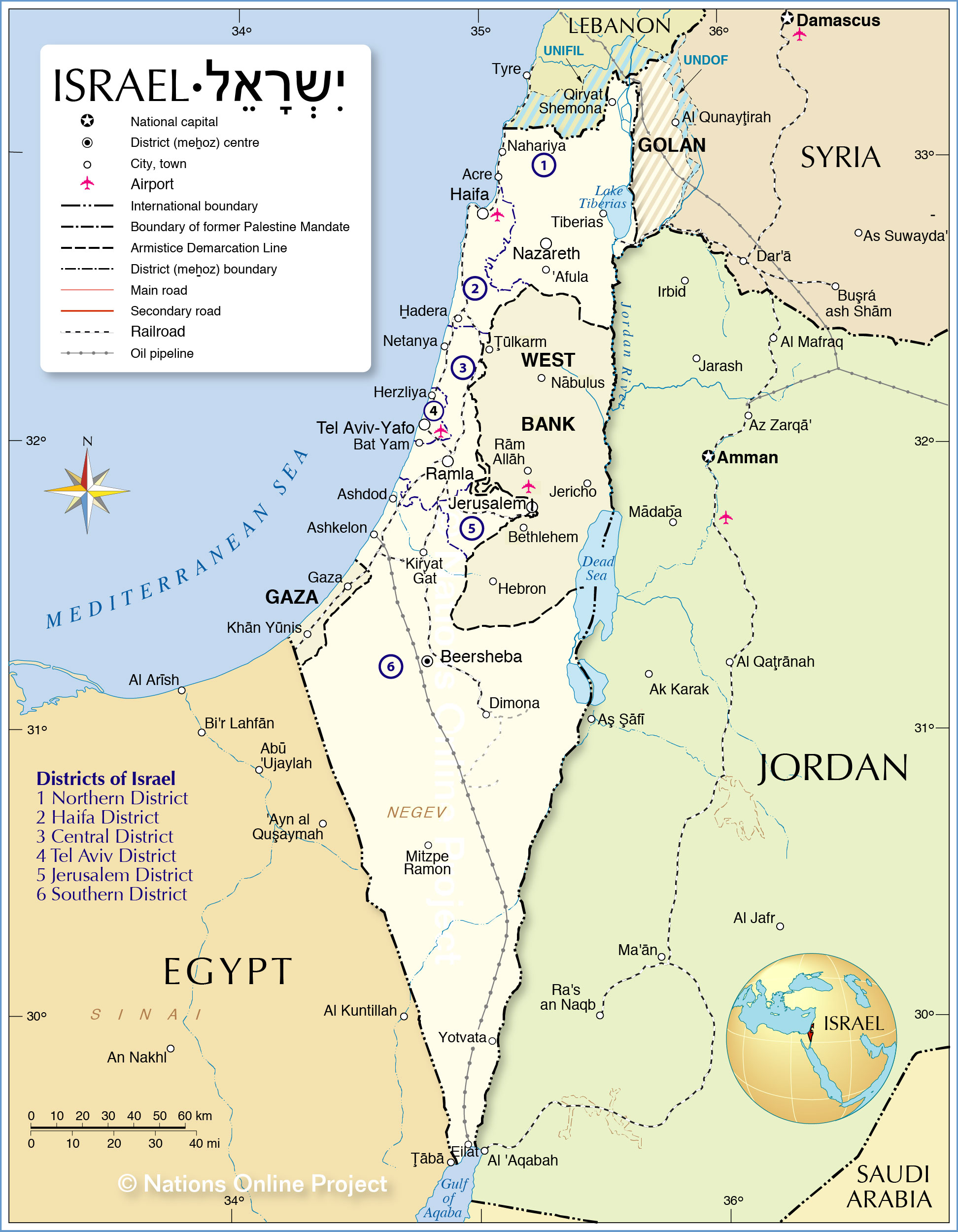
Israel's Borders In the West – the Mediterranean Sea and the Gaza Strip; in the North – Lebanon and Syria; in the East – Jordon and Palestinian Authority autonomous territories; in the South – Egypt and the Red Sea. Israel holds territories that it captured in 1967 from Syria (the Golan Heights), Jordan (the West Bank) and Egypt (Gaza). In certain sections of the West Bank, an autonomous Palestinian Authority was established.
Government and Administration The state of Israel is republic, defined as a parliamentary democracy with proportional representation. The legislative authority is the Knesset and the executive authority is the government. Since the country's inception, no political party has achieved an absolute majority, and thus, all of Israel's governments have been coalition governments. Israel has a president who is chosen by the Knesset once every seven years. His role is symbolic, having only the power to appoint the specific member of Knesset who determines the make-up of the government and to grant pardons.
Israel is administratively divided into 6 districts and 14 provinces. Judea, Samaria and Gaza have a separate administration. Regional authorities – municipalities and local or regional councils – have legal jurisdiction in their area, as well as responsibility for legal services.
The country has a mandatory education law, which states that all Israeli children are entitled to eleven free years of education, from kindergarten to grade ten. For higher learning, Israel has universities, colleges and institutions of religious instruction (yeshivot, midrashot).
The state of Israel has general health care, which provides a medical services package for every citizen. Enforcement of this is split between the Ministry of Health and the health maintenance organizations. Citizens pay a health tax to national insurance.
Official name: State of Israel GPI: 22,145 square km Population: 7,047,0001 Population growth rate: 1.39 percent Demographics - Ethnicity Jewish 80.1 percent (32.1 percent born in Europe/North America, 20.8 percent born in Israel, 14.6 percent born in Africa, 12.6 percent born in Asia). Non-Jewish (primarily Arab) 19.9 percent Demographics - Religion Jewish 79 percent, Muslim 17.3 percent, Christian 2.1 percent, Druze 1.6 percent Official languages: Hebrew, Arabic Capital: Jerusalem Government: Democratic republic GDP: 523.852 billion NIS (as of 2004) Estimated GDP growth rate: 3.9 percent (as of 2004) Population under poverty line: 23.6 percent (as of 2004) Inflation rate: 1.4 percent (as of 2004) Unemployment rate: 10.7 percent (as of 2004) Major industries: Software, telecommunications, weapons, phosphates, diamonds, agriculture Imports: 34.41 billion dollars (as of 2004) Exports: 36.84 billion dollars (as of 2004)
State of Israel: History The State of Israel was established in 1948, amidst clashes with British Mandatory forces, Arab residents, and the Arab states which declared war on the nascent state on the very day of its founding.
The struggle for Israeli independence In the wake of the Holocaust, the Jewish community in the Land of Israel, as well as the worldwide Zionist Movement, became increasingly cognizant of the fact that an independent and sovereign Jewish state was necessary to provide haven for the decimated Jewish nation.
The struggle was conducted on two fronts: an armed and political battle against the British Mandatory forces and a worldwide diplomatic and explanatory campaign, especially in the United States. Concurrently, much effort was invested in the Ha’apalah, the so-called “illegal” Jewish immigration to the Land of Israel, which was, in effect, an attack against British Mandatory policies.
Although Britain emerged victorious from World War II, the country was heavily hit in economic and social terms. Then, during the post-war years, the British Empire began to unravel. Once the British Raj ended in India, the Land of Israel lost much of its strategic importance, as the British no longer required a foothold adjacent to the Suez Canal.
In 1947, Britain requested that the UN retract the Mandate granted to Britain by the League of Nations. The UN appointed a special committee (UNESCOP), which recommended that the land west of the Jordan River be partitioned into two states: one Jewish and one Arab. On November 29, 1947, the General Assembly voted in favor of partition, which became known as Resolution 181. The Jewish community rejoiced, but the Arabs rejected the decision and began fighting the very next day.
According to Resolution 181, the British Mandate was set to expire on May 15, 1948. Since the 15th came out on Shabbat that year, the National Council convened on Friday, May 14, and declared the establishment of the State of Israel. The Declaration of Independence surveyed the historical connection between Am Yisrael (the nation of Israel) and its land and laid out the new state’s founding principles, but specific borders were not mentioned.
In addition, the Declaration of Independence introduced the name of the Jewish State: “We hereby declare that as from the termination of the Mandate… the present National Council shall act as the provisional administration and… shall constitute the Provisional Government of the Jewish State, to be called Israel.” The name was derived from the Land of Israel, the historic name of the Jewish national homeland.
Both the US and the USSR immediately recognized Israel, and additional countries followed suit. However, the Arab League was determined to destroy the new state, and on May 15, the Egyptian, Jordanian (then called Trans-Jordanian), Syrian, Iraqi and Lebanese armies, together with irregular forces from other Arab nations, invaded Israel.
The War of Independence thus evolved from a conflict between two resident populations to a full-fledged war between organized armies. Following a year and a half of fighting, an Armistice Agreement was reached between Israel and most of the Arab countries. Iraq, which continued to maintain a state of war with Israel, remained the lone exception.
From this point on, Israeli history was punctuated by wars with its Arab neighbors. Each war left a unique and lasting impact on Israel’s foreign affairs, economy, and social fabric.
From the War of Independence until the Sinai War (1948-1956) Even as the war raged, the new state’s institutions were organized. For example, the Assembly of Representatives became the Knesset, and the National Council became the government, under the leadership of David Ben-Gurion. The government assumed the Mandatory Government’s authorities, but since the British left without arranging for an orderly transfer of power, the process was complex and difficult.
War of Independence: Hagana troops practicing Meanwhile, large immigration waves reached Israeli shores. Between 1948 and 1951, approximately 700,000 Jews arrived; entire communities came from Libya, Yemen, Bulgaria, and Iraq. In 1950, the Law of Return, which granted full Israeli citizenship to every Jewish immigrant, was enacted. More immigrants arrived during 1955-1957, including around 160,000 North African and Eastern European Jews.
As a result of the economic costs of the war and absorbing the immigrants, an austerity program (1949-1952), which involved much rationing, was instituted. In 1952, the government signed a controversial reparations agreement with Germany. Despite the resulting political and public storm, the agreement increased the market’s momentum.
Arab infiltrations began almost immediately following the Armistice. Palestinian refugees would clandestinely cross Israel’s borders, in order to commit crimes and, later, also sabotage. Israel responded with reprisal attacks. Although the process escalated gradually, some historians cite the Black Arrow attack of February 28, 1955, as a key turning point. On that night, the IDF attacked an Egyptian army installation in the Gaza Strip; previously, most of the operations had been directed at Palestinian targets. The Egyptians began organizing bands of Palestinian infiltrators called “fedayeen”, which, in essence, comprised the first Palestinian terror organization.
In September 1955, Egypt signed an arms deal with Czechoslovakia. (In fact, Czechoslovakia, as a Soviet satellite, would be passing on weapons supplied by the USSR.) The huge amount of weaponry involved was unprecedented in the Middle East. Syria signed a similar deal, albeit on a smaller scale. Israelis sensed that “Round Two”, between Israel and its Arab neighbors, was fast approaching.
Israel began strengthening its military ties with France, since Ben-Gurion had insisted that Israel not go to war without the support of at least one major power. France was amenable to Israeli overtures, because the French blamed Egyptian leader Gamal Abed an-Nasser for much of their Algerian troubles. After Nasser nationalized the Suez Canal on July 26, 1956, Britain joined the conflict. On October 22, senior representatives of France, Britain and Israel met in Sèvres, outside of Paris, and agreed to go to war against Egypt. The Sinai War began on October 29.
From the Sinai War until the Six Day War (1957-1967) The Sinai War ended on November 6, 1956, and, to Israel’s chagrin, the world’s superpowers soon forced Israel to relinquish all its territorial achievements. The IDF pulled back from the Sinai and the Gaza Strip in March 1957, and a UN Emergency Force was mobilized along the border.
A period of relative quiet ensued, and Israel strengthened its economy and developed the national infrastructure during the interlude. Also, the Eichmann Trial, which occurred during this time, increased Israeli sensitivity to the Holocaust. Meanwhile, by 1966, another 300,000 immigrants had arrived. However, in the wake of a severe recession in 1965, immigration rates dropped. Several scandals rocked the political establishment; in particular, the infamous “Lavon Affair” sent shockwaves up to the highest echelons. David Ben-Gurion resigned and left the Mapai party; Levi Eshkol became the next prime minister. Finally, Israel sent out diplomatic feelers to a number of newly independent Asian and African nations, as well as to several South American countries.
In 1964, neighboring Arabs began infiltrating the country again, after ceasing the phenomenon in the wake of the Sinai War. In addition, the Palestinians established the al-Fatah organization, and terrorists entered Israeli territory. The Palestine Liberation Organization (PLO), with al-Fatah at its core, was founded at the end of 1964. Nevertheless, the number of attacks was lower that during 1954-1956, and there were fewer reprisal raids.
A more serious problem was meanwhile developing on the northern border. Following the completion of the National Water Carrier, both Syria and Lebanon repeatedly attempted to divert the sources of the Jordan River; Israel responded with fire. The situation quickly deteriorated, and the IDF and Syrian army were involved in heavy fighting, referred to as “the War for Water”.
At the same time, Egypt expressed concern over the nuclear reactor that Israel was allegedly building near Dimona. After an air battle over the Golan Heights on April 7, 1967, during which six Syrian aircraft were downed, Egypt announced that it was allying itself with Syria. Thus, on May 15, Egyptian forces entered the Sinai, in violation of the agreement signed in 1957, in the wake of the Sinai War. In addition, Egypt closed the Straits of Tiran to Israeli ships and ordered UN forces to withdraw from their positions along the border.
IDF Chief Rabbi, Goren, at the Kotel Israel realized that a war was imminent, and the mood throughout the country was somber and grave. The IDF called up the reserves, and Prime Minister Eshkol, aware that he had not managed to inspire confidence, transferred the defense portfolio to Moshe Dayan. A historical first was achieved when the Herut party joined the newly formed national unity government.
On June 6, the Six Day War broke out, as the IDF went to war against Egypt, Syria, and Jordan.
From the Six Day War until the Yom Kippur War (1967-1973) In the wake of Israel’s stunning victory in the Six Day War, unbridled euphoria swept through the country. The IDF had acquired the Golan Heights, Judea, Samaria, the Gaza Strip, and the entire Sinai Peninsula up to the Suez Canal (which had been closed to shipping). But most significantly, Jerusalem had been reunified, and for the first time since 1948, Jews were able to pray at the Western Wall. Israel immediately annexed the eastern portion of Jerusalem but declared that other territories were being held in the hope of a peace treaty. “We are waiting for a telephone call from the Arabs,” Dayan asserted.
Yet, despite Dayan’s declaration, Jewish communities were built in the territories. The government officially authorized settlement of the Golan Heights, the Jordan Valley, southern Sinai, and, eventually, also the area around Rafah. However, official policy was more ambiguous in Judea and Samaria, where the government preferred that Jews not move into areas heavily populated by Arabs. Nevertheless, many such settlements were established, with considerable support from numerous government ministers as well as Knesset members. In addition, a construction wave was initiated in eastern Jerusalem, which the Arabs and much of the world insisted on calling “occupied territory”.
In November 1967, the UN Security Council accepted Resolution 242, which included the concept of “land for peace”, but the vote had no practical significance. US Secretary of State William Rogers introduced another peace initiative, which also never took effect but led to the unraveling of the Israeli national unity government. Previously, in February 1969, Prime Minister Eshkol passed away, and Golda Meir took his place.
The PLO built bases in the eastern Jordan Valley and dispatched terrorists into Israeli territory. Several pursuits were launched in the valley (which became known as “pursuit land”) during 1968-1970, until Jordan expelled the terrorists following the “Black September” riots of 1970. Most Palestinian organizations relocated to southern Lebanon and Syria.
Arab terrorism also concentrated on Israeli civilian aviation and targets throughout the world, and high profile attacks were committed in Israel itself, sometimes with the help and support of foreign terror organizations. Several glaring examples included the hijacking of an El Al airplane to Algeria on July 23, 1968, which was the first of its kind; the massacre at Lod Airport on May 30, 1972, which was committed by Japanese terrorists masquerading as passengers; and the abduction and subsequent murder of 11 Israeli Olympians in Munich on September 5, 1972.
In March 1969, Egyptian President Nasser instructed his army on the Suez Canal front to open fire on all exposed targets. Thus began the War of Attrition, which mainly comprised heavy exchanges of fire across the canal, as well as several raids behind enemy lines (on both sides)and Israeli air attacks deep into Egyptian territory. The US was forced to intervene and impose the above mentioned Rogers plan. In August 1970, the war ended, and Nasser died a few weeks later.
In spite of the fighting along the borders, many Israelis felt safe and secure. The country had complete confidence in the IDF’s ability to protect the nation. In fact, for the first time since the establishment of the state, the public believed that Israel’s existence was guaranteed. The severe recession of the prewar period made way for an era of economic growth, and many citizens trusted that the situation would only continue.
From the Yom Kippur War until the Political Upset (1973-1977) Disillusionment was exceptionally painful. Egypt and Syria clandestinely planned a full-fledged surprise attack on Israel, hoping to retrieve the territories they had lost during the Six Day War. The working assumption was that even if the Egyptian and Syrian armies were unable to regain the land themselves, Israel would be forced to give up the territories, due to the international pressure which would surely result from the war. On Yom Kippur 5733, October 6, 1973, the Yom Kippur War broke out.
The IDF was not prepared. Even though the army soon recovered, – the territory lost on the Golan Heights was regained within three days, and ten days after the fighting began, IDF forces penetrated Egyptian territory, although Egyptian forces were not yet pushed out of the Sinai – nevertheless, the sense of defeat, which had characterized the first few days of fighting, did not abate even once the war had ended.
In the aftermath of the war, an investigative committee, headed by Chief Justice Shimon Agranat, was appointed. The so-called Agranat Commission made several recommendations concerning high-ranking military leaders, including Chief of Staff David Elazar, but refrained from discussing the political echelon.
A number of Arab countries sent troops to fight alongside Egypt and Syria. (Jordan notably stayed away.) In addition, the oil-rich Arab nations, collectively known as OAPEC, announced that they were decreasing production and placing an oil embargo on the US and Holland, due to their support of Israel. Shockwaves raced around the world; the so-called “first energy crisis” had begun. The Organization of Petroleum Exporting Countries (OPEC), which included all the OAPEC members, took advantage of the Arab embargo. Crude oil prices quadrupled within just a few months.
The energy crisis threatened most of the world’s non-OPEC members, many of whom blamed Israel. As a result of the war, which was perceived in some circles as an Arab victory, and the deteriorating global economy, Israel lost much of its international standing. Furthermore, the rising oil prices directly affected Israel’s economy, which was largely dependent on oil imports.
Nonetheless, Israel managed to weather the war’s economic fallout, mainly due to unprecedented American aid. Since 1974, American foreign aid to Israel, comprised of both military and economic aid, has equaled several billion dollars a year. Still, the economic upswing of the prewar period was considerably overturned.
The settlement enterprise continued, occasionally accompanied by clashes with the government in places such as Kedumim. Terror persisted as well, including the infamous hijacking of an Air France plane to Entebbe, Uganda. The subsequent IDF rescue mission on July 4, 1976, made headlines throughout the world. On June 7, 1981, Israel conducted another daring raid and destroyed Iraq’s nuclear reactor a short while before it was scheduled to go live.
The Alignment Party won a proportional majority in Israeli elections held shortly after the war. However, the public no longer trusted the party’s veteran leadership, and Prime Minister Meir and Defense Minister Dayan were forced to resign. Yitzchak Rabin became the next prime minister.
From the Political Upset until the Lebanon War (1977-1982) The elections of 1977 have been described as a dramatic upset; for the first time in Israeli history, a group of center/right parties, collectively known as the Likud, formed a government. Menachem Begin, who had led the opposition since the state’s founding, became the prime minister. Although the upset can be attributed to the aftershocks of the Yom Kippur War, other factors also contributed to the political turnaround. Wide swaths of the public felt disenfranchised, and great rifts were becoming apparent throughout Israeli society.
Israeli PM Begin with Egyptian President, Saadat in Camp David A radical turnabout in Israeli-Arab relations occurred towards the end of 1977. Following clandestine talks between Israeli and Egyptian officials, Egyptian President Anwar Sadat publicly announced that he intended to visit Jerusalem, address the Knesset, and discuss peace. Sadat arrived in Israel on November 19, and Egypt and Israel launched peace talks, under American auspices. Two years later, in 1979, the two countries signed the Camp David Accords. Virulent public storms arose in the wake of the subsequent Israeli withdrawal from the Sinai and the evacuation of Yamit in 1982. A series of governmental countermeasures included the enactment of the Jerusalem Law of 1980 and the declaration of Israeli sovereignty over the Golan Heights in 1981.
One major social development at that time was the growing strength of the hared sector. Prior to 1977, this closed community had been elatively insignificant; although the Haredim always enjoyed Knesset representation, Haredi involvement in the nation’s political life was minimal. However, in 1977, Begin invited Agudat Yisrael, a Haredi party, to join his coalition, even though the Dash party, comprised of former Alignment members, was larger. As a result, the Haredi public’s ranks swelled, and its members became more politically and economically active.
The Lebanese civil war, which had begun in 1975, grew steadily worse, and the northern terrorists became bolder. Israel’s anti-terrorist activities included establishing the South Lebanese Army (SLA) under Saad Hadad’s command and opening the so-called “Good Fence”. Nevertheless, the terror continued, and on March 14, 1978, the IDF entered Lebanese territory as part of Operation Litani. Israel retreated approximately three months later, after a UN peacekeeping force was stationed as a buffer between the Israeli border and PLO positions throughout southern Lebanon. (In effect, the buffer became an SLA-controlled security zone.)
The arrangement soon proved ineffective, and on June 6, 1982, following an assassination attempt on the Israeli ambassador to Britain, the Lebanon War began.
From the Lebanon War until the Oslo Accords (1982-1995) As opposed to the previous Arab-Israeli wars, the Lebanon War did not end with either a ceasefire or an armistice agreement. In fact, Israel’s objectives were not fully achieved. Although the IDF controlled about half of Lebanon’s territory, Israel had not managed to either destroy the PLO or impose a “new order” on Lebanon. Prior to the war, Israel had envisioned a sovereign Christian-controlled Lebanon which would sign a peace treaty with Israel and conduct full diplomatic relations. However, Lebanese Phalangist leader Bashir Gamayel’s assassination on September 14 shattered all Israeli illusions.
In the wake of the assassination, Christian forces massacred Palestinian residents of the Sabra and Shatila refugee camps, thus igniting a storm of protests in Israel and throughout the world. The Israeli government and the IDF leadership were accused of ignoring the massacre, and the Kahan Commission, appointed to investigate the killings, recommended that Defense Minister Ariel Sharon be dismissed.
IDF forces in Lebanon came under continuous fire and were the targets of terror attacks committed by the assorted paramilitary organizations then operating in Lebanon, including those that had initially welcomed the IDF with flowers. In 1985, the IDF began slowly retreating southward, and a “security zone”, under joint IDF-SLA control, was established in southern Lebanon. Relative quiet prevailed on Israel’s northern border, but flare-ups persisted within the security zone.
Socially and economically, this was a tempestuous period in Israeli history. The Likud government, which adhered to a liberal worldview, oversaw certain economic steps which quickly led to a galloping inflation, which had reached 400% by 1983. During that same year, bank shares collapsed, and the Israeli economy was in chaos. Strikes were rampant, and emigration increased. In August 1983, the Lebanese quagmire and the country’s desperate economic straits caused Begin to resign, citing “personal reasons”. Yitzchak Shamir became the next prime minister.
The 1984 general elections resulted in a “hung” Knesset, and a national unity government was formed on a rotation basis. Shimon Peres was the prime minister for the first two years, and then Shamir, maintaining the same coalition, replaced him in October 1986. In order to stabilize the economy, the national unity government took a number of drastic steps, including the implementation of a comprehensive price freeze, and managed to curb the inflation. Nevertheless, the economy did not immediately rebound. During the 1988 elections, the Likud achieved a very narrow margin of victory. As a result, another unity government was formed, but this time, there was to be no rotation. In March 1990, Peres, seeking to regain power, tried to cause the Shamir government to fall. However, the so-called “stinking maneuver” failed, and the Labor party found itself back in the opposition.
Although some Palestinian Arabs had become members of terror organizations and a small number had committed terror attacks, most refrained from protesting Israeli rule. In December 1987, however, everything changed. A wave of uprisings, called the Intifada, broke out in Judea, Samaria and the Gaza Strip. Israel proved unable to quell the riots. Shamir even agreed to participate in the Madrid Conference, an international peace conference which included Palestinian representatives, albeit as part of the Jordanian delegation. However, the Palestinian uprising continued unabated.
In early 1991, Israel became an unwilling participant in the First Gulf War. Iraq responded to Coalition attacks by launching Scud missiles into Israel. Although there were few casualities and property damage was relatively minimal, the constant fear of unconventional weapons led to widespread panic. Nonetheless, life quickly returned to normal once the war had ended.
Rabin replaced Peres as Labor party chairman and garnered a majority in the 1992 elections, largely as a result of the optimism generated by the collapse of the Soviet Union and the ensuing large immigration wave which began in late 1989. The economy flourished, and the government’s primary concern was the Intifada.
Clandestine talks between Israeli and Palestinian officials in Oslo, Norway, climaxed in the Oslo Accords. As part of the controversial agreement, Israel accepted the PLO as the official representative of the Palestinians and granted it autonomy over a large portion of Judea, Samaria, and the Gaza Strip. In return, the Palestinians promised to recognize Israel’s existence, to refrain from further terrorist activities, and to end the Intifada. The Accords were signed in Washington on the White House lawn on September 13, 1993, accompanied by a much-hyped handshake between Rabin and PLO leader Yasser Arafat.
From the Oslo Accords (1993) until Today The Oslo Accords significantly impacted Israel. As per the agreement, the Palestinian Authority (PA) was founded. Shortly thereafter, in October 1994, Israel signed an historic peace treaty with Jordan, and tentative peace talks were initiated with Syria. Israel’s international standing improved dramatically, and immigration continued to soar. In the period between 1990 and 1995, over 500,000 immigrants arrived from Eastern Europe and other locations. In addition, the economy boomed.
Yet, Israel paid dearly for the Accords. The Palestinian attacks continued unabated, and Israel accused Arafat and the PA of not preventing the terror. In addition, the PA established military or paramilitary armies in excess of their Oslo mandate. The Palestinians, meanwhile, claimed that new Israeli settlements violated Oslo “in spirit”.
On November 4, 1995, the so-called “peace process” exploded when Rabin was shot by an Israeli Jew. Peres, who took his place as prime minister, advanced the elections to the beginning of 1996 (direct prime ministerial elections had been introduced in the meantime) and was defeated by the Likud’s Binyamin Netanyahu, whose political views were diametrically opposed to Rabin’s and Peres’. The peace process advanced sporadically at best, and many more Israelis began to vociferously oppose the Oslo Accords. The new government did not last, and Netanyahu resigned in 1999. In May of that year, Ehud Barak was elected as the next prime minister.
Barak was unable to get the peace process back on track. However, he did keep his election promise of an Israeli withdrawal from Lebanon. In May 2000, the last IDF soldiers retreated to the Israeli border; the SLA collapsed; and an uneasy quiet reigned along the northern border. Although the Syrian talks resumed, no breakthrough was achieved. US President Bill Clinton attempted to jumpstart the peace process and, modeling himself after his predecessor Jimmy Carter in 1978, invited Barak and Arafat to Camp David in July 2000. However, the talks failed, and shortly thereafter, in September, the Intifada resumed with a vengeance. Barak resigned at the end of the year, and new elections were held in early 2001. In the meantime, the direct election law had been revoked. The Likud, headed by Ariel Sharon, returned to power.
The renewed Intifada hit Israel hard. Seemingly overnight, the economy plummeted from accelerated growth into a recession (which was further exacerbated by the global dot-com crash); immigration decreased; and Israeli society became more fractured. Sharon’s Likud garnered a large majority in the 2003 elections, and he remained prime minister. Meanwhile, the so-called “Al-Aksa Intifada” raged on, and Israeli efforts to decrease the terror (such as “targeted killing”, a euphemism for assassinating terrorists) had little to no effect.
The Oslo Accord: Rabin, Arafat and Clinton In March 2003, Mahmoud Abbas, also known as Abu Mazen, became PA prime minister under Arafat, and many were optimistic that change was in the air. By that time, the Israeli government had declared that Arafat was “irrelevant”. The Palestinians declared a “hudna” (a temporary ceasefire of sorts) and claimed that they were refraining from terror attacks. At the same time, Israel pulled back some of its forces from PA-controlled territory. However, the hudna led nowhere; within a very short while, the Palestinians were once again committing terror attacks, and the Israelis were forced to respond.
Israeli Society: Jewish-Arab Relations After the War of Independence and the signing of the Armistice Agreement in 1949, officials noted that approximately 500,000 Arabs had fled from the area which was now included within Israeli borders.
The reasons for the Arab flight are sharply disputed. Israel supports the accepted Zionist position that most, if not all, of the Arabs left on their own volition, in order to distance themselves from the fighting and so as to avoid remaining under Jewish rule. In fact, the Arab leadership has been quoted as urging the refugees to flee (and promising them that they would be able to quickly return). Nevertheless, others claim that the Arabs were either forcefully removed or left after being threatened. Some even go so far as to allege incidents of violence against the refugees (including the now-widely debunked Dir Yassin incident).
In any event, the refugee problem was created in the wake of the war. Very few refugees, specifically the wealthy and those with close relatives in the neighboring countries, managed to integrate in their host nations. The rest of them were herded into refugee camps in Judea, Samaria, the Gaza Strip, southern Lebanon and Jordan.
The United Nations Relief and Works Agency for Palestine Refugees in the Near East (UNRWA), which was established to take care of the refugees’ needs, still operates today. Some Arab villagers, such as the residents of Ikrit and Biram, were controversially evacuated by Israeli security forces; the Ikrit and Biram villagers continue in their decades-long attempt to return to their former homes. Approximately 150,000 Arabs, who were left without their social, political and economic leaders, remained within Israeli borders and instantaneously became a minority.
Demography Israel’s non-Jewish citizens are not all cut from the same cloth. Most notably, they divide along religious lines; at the end of 2001, 15.4 percent of the total population was Moslem, 1.7 percent was Christian, and 1.6 percent was Druze. Moreover, although most of the Moslems are Sunnis, there are also fewer than 5000 Circassians. Similarly, the Christian population is split between the Greek Orthodox (33 percent of all Christians), Greek Catholics (25 percent), Roman Catholics (20 percent), Maronites (around 5 percent, including many former SLA fighters who fled to Israel in 2000), and others such as Protestants, Armenians, Ethiopian Copts and more. Also, the non-Jewish citizens include city-dwellers, villagers and Bedouins.
Most Israeli Arabs reside in the Galil, the Nahal Iron area, the northern plain (the so-called “little triangle”), the Jerusalem corridor, and the Negev. In addition, some Arabs live in mixed cities, such as Haifa, Jaffa, Ramle, Acre, and others. Most Bedouin tribes can be found in the northern Negev and the Lower Galilee. The Druze are concentrated in the Carmel, the Galilee, and several Golan Heights villages.
Unequal citizens In the Declaration of Independence, Israel called out to Arab residents of the state to keep the peace and to take part in building the state. Arab residents were offered full and equal citizenship and relative representation in all state institutions, both temporary and permanent. Furthermore, the State of Israel, established as a Jewish state, recognized the right of the Arab minority to religious autonomy. In 1952, the Citizenship Law guaranteed the rights of Arabs who had resided in Israel at the time of the state’s establishment. Israeli Arabs are officially considered full citizens, and they may vote and be elected to the Knesset and local governments.
Nevertheless, historical enmity and political-security considerations ensured that Israeli Arabs would remain under constant suspicion and be treated, upon occasion, with inequality. Thus, for example, when the Arabs parties garnered eight seats in the 1951 elections for the second Knesset, David Ben-Gurion insisted that he would not form a government based on Arab votes. In fact, the policies of most subsequent Israeli governments largely reflected Ben-Gurion’s declaration.
Until 1966, Israeli Arabs lived under military rule, which oversaw their every move and action and impinged on their basic rights. Moreover, starting from the 1950’s, the government began systematically expropriating Arab lands under the Absentee Property Law. Dozens of Jewish settlements later arose on these lands.
Israeli Arabs’ sense of grievance only grew in the wake of the so-called Kfar Kassem massacre on the first day of the Sinai War in 1956. 49 villagers, who remained outdoors after curfew, were shot, and Israeli Arabs were enraged by the light sentences imposed on those responsible for the killings. Furthermore, Israeli Arabs felt that their culture was marginalized and that they were discriminated against in terms of funding, infrastructure development and employment.
The Six Day War The late 1960’s and early 1970’s marked a significant improvement in Israeli-Arab life. First of all, military rule was abolished. Also, in the wake of the Six Day War, Judea, Samaria and the Gaza Strip became accessible, and Israeli Arabs were able to renew their familial and economic ties with the Palestinians. In addition, as a result of the Mandatory Education Law, Arab illiteracy rates dropped dramatically from almost 50 percent in the 1960’s to 35 percent during the 1970’s and then to about 10 percent in the 1990’s. Moreover, the healthcare system in the Arab sector was considerably upgraded, and other parameters indicated that Arab quality of life had indeed noticeably improved
However, a new crisis arose with the advent of the so-called Land Day events in 1976. Following a series of governmental decisions regarding Arab land expropriation, Israeli Arabs rioted violently, and several protestors were killed during the disturbances. Since then, the annual Land Day commemorations have become a yearly violent flash point between Israeli Arabs and police and defense officials. Also, these events are considered to be a fairly accurate gauge of Arab-state relations.
Palestinian identification By the early 1980’s, Israeli Arabs had become ever increasingly segregated from the rest of the nation. The Lebanon War in general, and the Sabra and Shatila episode in particular, stimulated Israeli-Arab empathy for the Palestinian cause. During the so-called first Intifada, which broke out in 1987, Israeli Arabs expressed solidarity with their brethren in Judea and Samaria and began to identify themselves as Palestinians.
The Oslo Accords of 1993 had two major impacts on Israeli Arabs. On one hand, the founding of the Palestinian Authority (PA) further increased Israeli Arabs’ sense of Palestinian national identification. On the other hand, Israeli Arabs realized that they were being essentially ignored by the Palestinian leadership and that Israeli-Arab interests were not addressed during the Oslo process negotiations. As a result, a considerable number of organizations were established to handle Israeli-Arab needs and to bring attention to their minority rights as Israeli citizens.
The October riots Jewish-Arab relations deteriorated rapidly during the bloody riots of October 2000. Then-opposition chairman Ariel Sharon’s controversial visit to the Temple Mount (which either triggered or was used as an excuse for a raging Palestinian uprising) enraged the Arab sector.
Shortly thereafter, thousands of Israeli Arabs participated in violent disturbances. Efforts were made to attack Jewish communities; major highways were closed to Jewish traffic; numerous structures were destroyed; and a Jew was killed when a rock was thrown at his vehicle.
Israeli police attempts to quell the riots led to the deaths of 13 Arab citizens; many more were wounded. Meanwhile, some angry Jews demonstrated against their Arab neighbors. Meanwhile, Palestinians in Judea, Samaria and the Gaza Strip continued to clash with Israeli forces (in the so-called “Al-Aksa Intifada”), and Israeli Arabs evidenced unprecedented levels of cooperation and identification with their brethren on the other side of the Green Line. As a result, suspicions and hostility between Israeli Jews and Arabs dramatically increased.
Israeli Arabs expressed their feelings by largely boycotting the 2001 prime ministerial elections, thus emphasizing their sense of alienation from the Jewish establishment. Then-Prime Minister Ehud Barak set up the Or Commission to investigate the circumstances of the riots and as well as the governmental response, including police behavior, which led to the death of 13 Israeli citizens.
In 2003, the Or Commission publicized its findings, which included a review of Jewish-Arab relations:
“Minority-majority relationships are problematic in every place, and especially in a state that defines itself according to the majority’s nationality… In any event, establishing reasonable harmony in majority-minority relations is a difficult task imposed on every societal sector. This task requires a particular effort from state institutions which express the majority’s hegemony… Refraining from such an effort, or only partially attempting it, creates a sense of neglect and a reality of neglect among the minority, which are likely to become more severe with the passage of time. These phenomena also characterize the Arab minority in the State of Israel, which, in many respects, is the victim of discrimination.”
Arab leaders were skeptical about the report and asserted that the commission was too lenient with those responsible for causing the demonstrators’ deaths. Meanwhile, Israeli Arabs claim that they still suffer from discrimination in terms of public office advancement, employment opportunities, and limited budgets. They cite 2003 statistics which indicate that every other Arab child lives below the poverty line and note that Arab sector unemployment rates are much higher than the national average.
Israeli Arabs also complain about their treatment with respect to construction and urban expansion. According to Arab claims, the government is discriminatory when issuing building permits and does not allow Arabs to either build homes or expand existing structures in order to accommodate natural growth. As a result, Arabs say, they are forced to construct illegally; the authorities, in turn, are then required to tear down these structures. In 2003, over 30,000 houses were built without a permit.
Concurrently, there has been a worrisome increase in the number of Arab citizens of Israel who have participated or indicate that they are willing to participate in terror attacks against Jewish targets. The first Israeli-Arab suicide bomber acted in September 2001, and during 2002 alone, thirty-two terror attempts by Israeli Arabs were uncovered. In addition, Islamism is making significant inroads within Israeli-Arab society. This development can be attributed to the results of the Six Day War (which allowed Israeli Arabs to have access to holy Islamic sites in Jerusalem), the newly permitted pilgrimage to Mecca in the late 1970’s, the Arab sector’s social and economic plight and sense of discrimination, and awakening fundamentalism throughout the Muslim world, including a growing religiously-oriented leadership. According to Israeli officials, Israeli Arabs have been strengthening their ties with fundamentalists throughout the Moslem world, thus becoming more politically and socially extremist.
JERUSALEM FACTS-- In Jerusalem, the theological and historical arguments matter, serving often as the functional equivalent of legal claims. The strength of these arguments will ultimately help determine who governs the city. Already we hear the ritual and relativistic cliche that Jerusalem is "a city holy to both peoples." But like most cliches, this one is more false than true. Jerusalem stands as the paramount religious city of Judaism, a place so holy that not just its soil but even its air is deemed sacred. Jews pray in its direction, invoke its name at the end of each meal and close the Passover service with the wistful statement "Next year in Jerusalem."
1) Israel became a state in 1312 BC. 2 millennium before Islam.
2) Arab refugees from Israel began calling themselves Palestinians in 1967, 2 decades after the modern Israeli statehood.
3) After conquering the land in 1272 BC. Jews ruled it for thousands years and maintained a continuous presence for 3300 years.
4) For over 3300 years, Jerusalem was the Jewish capital. It was never the capital of any Arab or Muslim entity. Even under Jordanian rule, east Jerusalem was not made the capital, and no Arab leader came to visit it.
5) Jerusalem is mentioned over 700 times in the Bible, but not once is it mentioned in the Quran.
6) King David founded Jerusalem, Muhammad never set foot in it.
7) The holiest Jewish site in the world and a renowned symbol of Jerusalem's Old City is the Western Wall
8) Jews pray facing Jerusalem, Muslims pray facing to Mecca.
9) Before 1865, the entire population of Jerusalem lived behind the Old City walls (what today would be considered the eastern part of the city). Later, the city started to expand beyond the walls because of population growth, and both Jews and Arabs began to build in new areas of the city.
10) Muslim dominance first came to Jerusalem in 638 when the army of Caliph Omar conquered the Holy City.
11) Muslims claim the Jews occupy Arab lands, when in fact the Arabs are the occupiers in the Middle East. They belong in Arabia and have no right to Jerusalem. Jerusalem is not Israeli-occupied territory but Arab occupied territory.
12) The Koran does not mention Jerusalem even once, meaning their claim to Israel's and Judaism's capital as their third holiest city is fraudulent and aimed at stealing the city from the Jews.
13) Al-Aqsa mosque and the Dome of the Rock are built exactly in the middle of the Jewish Temple Mount.
The Western Wall, known to non-Jews as the Wailing Wall, is a 488-metre (1601-foot) stretch of wall which is all that remains of the Second Temple of Jerusalem. The most sacred Jewish place in the world, it attracts thousands of devout Jews every year who come to pray, and push prayer notes and messages of goodwill into the cracks of the wall. The wall was built more than two thousand years ago under King Herod, and has been under Israeli control since 1967. It is also sacred to Muslims who believe that the wall marks the place where the prophet Mohammed tied up his winged horse, al-Burak, before ascending to heaven. It has been divided into two sections of prayer, the left for men and the right for women, and forms part of a larger wall surrounding the Dome of the Rock and Al Aqsa Mosque.
The holiest Jewish site in the world and a renowned symbol of Jerusalem's Old City, the Western Wall is a remnant of the retaining wall built by Herod the Great in the 1st century BC, to encompass the Second Temple enclosure.
As the only remainder of their sacred, destroyed Temple, Jewish people from all over the world, throughout two thousands years of exile, have faced the direction of the Western Wall on their prayers.
It is a Jewish belief that the Holy Presence has never left the Western Wall, thus it became the most significant site of Jewish pilgrimage, where Jews came to mourn the ruin of the Temple. This is how the Wall, "Ha'kotel" in Hebrew, has gained the name - the "Wailing Wall".
The big plaza in front of the Wall is divided into two sections - one for women and one for men. Here you can observe different kinds of Jewish activities and prayers, from orthodox Jews dressed in black reading their bible, to Israeli soldiers and groups of Jewish tourists. Leaning against the Wall and kissing the stones, the prayers' most famous custom is to insert a note with a prayer to God between the Wall's bricks, believing in its priority to be answered.
The Western Wall serves as a favorite location for Jewish traditional celebrations, and gets amazingly alive on Friday eve (the arrival of Sabbath) and on Jewish holidays. While visiting the Kotel you may see a Bar Mitzvah kid holding the Torah on his traditional ceremony, or an excited bride & groom being photographed before their wedding.
Information: The Western Wall is open 24 hours, and requires a modest dress for women and a head cover for the men. Admission is free. The closest gate to enter the Old City directly to the Wall is the Dung Gate. Buses No. 1 and 2 reach inside the Old City to the area of the Wall.
Air: Ben-Gurion International Airport. Road: Bus: Public services. Car: Hwy-1 to central Jerusalem (from Tel Aviv). Contact Addresses: Western Wall Heritage Foundation, 2 HaOmer Street, Old City, Jerusalem 97500, Israel Tel: (02) 627 1333 Website: www.hakotel.org.il
Al-Jazeera reports that London judge issues arrest warrant against opposition chairwoman for allegedly committing war crimes during Operation Cast Lead. Livni's office denies canceling her trip to UK for this reason, say: Opposition chairwoman proud of all her decisions on Cast Lead
An al-Jazeera journalist in London reported that an arrest warrant was issued in a London court against Opposition Chairwoman Tzipi Livni for war crimes she allegedly committed during Operation Cast Lead.
A British Jewish community website, JC Online, reported that Livni cancelled her visit scheduled for this weekend out of concerns that pro-Palestinian lawyers would try ask for her arrest.
Earlier Monday, London-based newspaper al-Quds al-Arabi also reported that Livni apparently canceled her planned trip due to international pressure to issue an arrest warrant against her.
On Sunday, dozens of demonstrators protested in front of the building where the convention was to be held. The protesters called Livni a "terrorist" and waived flags condemning her expected visit.
Livni was slated to speak at the Jewish National Fund's Vision 2010 conference held in Hendon, northwest of London. According to the report, Livni was also due to meet with Prime Minister Gordon Brown for private talks.
Livni's office denied these reports. Her office reported to Ynet: "The invitation to the annual JNF conference was turned down by us two weeks ago because the schedule meetings with the government figures in London could not take place close to the conference and would have necessitated a longer-than-planned absence from Israel."
Livni's office also said, "The opposition chairwoman is proud of all her decisions regarding Operation Cast Lead. The operation achieved its objectives to protect the citizens of Israel and to reinstate Israel's deterrence capability. Livni will continue to present this stance everywhere in the world.
"Hamas is not a dialogue partner, and we must therefore take forceful action against them, while engaging in negotiations with moderate elements. As such, no comparison between IDF soldiers and terrorists can be made. This is Livni's position whether or not an arrest warrant was issued, which is something we are as of yet unaware of."
The Foreign Ministry reported that it did not recommend that Livni cancel a trip to any destination.
Later Monday, officials in the British Ministry of Justice and Foreign Ministry told Israeli ambassador to London Ron Prosor later Monday that they were not aware of an arrest warrant issued against Livni.
Britain most problematic country Israeli lawyers consider Britain to be the most problematic country in terms of the possibility for the arrest of senior Israeli leaders.
A few months ago, Defense Minister Ehud Barak visited Britain, and was faced with accusations by local lawyers of committing war crimes. However, Barak was not detained.
In 2005, Major General (res.) Doron Almog arrived in London, but remained on board his plane and was forced to fly back to Israel in fear he will be arrested. The arrest warrant issued against him was later canceled.
Former IDF Chief of Staff Moshe Yaalon postponed a recent trip to Britian following legal recommendations. Since operation cast lead, legal teams headed by the Attorney General office have been facing an increased number of international legal cases against Israeli officials.
In his eight months in office, Israeli prime minister Binyamin Netanyahu has gone back on his fundamental pledges as Likud leader to disallow Palestinian statehood, expand Jewish West Bank settlement, reject one-sided Israeli concessions to the Palestinians prior to negotiations and act firmly to oust Hamas rule of the Gaza Strip.
This week, he sent uniformed cops and troops to hand out a pile of freeze notices to his core constituency, Jewish West Bank communities. Resistance was fairly restrained but will no doubt escalate in coming weeks.
Some see the prime minister setting down markers for the locations he will eventually cede. But most Israelis distrust him for giving away assets for no return and then failing to win credit for the gesture from Palestinians, Arabs or Europeans, who continue to slam the Jewish state regardless.
In a showdown with these the settlement leaders Thursday, Dec. 2, Netanyahu assured them that the building suspension across the Green Line (not applied in Jerusalem) was essential "in the broad light of Israel's overall interests."
The trouble is that every time the Israeli prime minister backs down from a promise, he implies the need to do Washington's bidding for the sake of its support for military action against Iran's nuclear facilities.
If that pretext does not work, he maintains that his one-sided gesture is essential to ward off the third Palestinian uprising.
Neither argument is acceptable because, as DEBKAfile's analysts demonstrate, they do not hold water:
Firstly, there is no correlation between halting West Bank construction and action to thwart a nuclear-armed Iran. Netanyahu has meekly lined up with America's diplomatic engagement policy for Iran, even though it has proved ineffectual. In fact, Tehran has made greater strides towards this goal since Netanyahu took office than at any time in the last decade. (DEBKAfile reported Friday, Dec. 3, that Iran is revealed by German intelligence to have successfully simulated the detonation of a nuclear warhead, overcoming its last major obstacle to weapons development.)
The vague impression he and defense minister Ehud Barak generate that Israel is about to launch an attack on Iran remains to be borne out. But no one honestly believes that a halt in the construction of 100 extra rooms in Alon Moreh or a dozen apartments for newly-weds in Maale Adummim will make any difference to decisions in Washington, Tehran or even Jerusalem.
The fact is that the Obama administration like its predecessor is flat against an Israeli military initiative - even if it means letting Iran go ahead and develop a bomb - for fear that Iran will send its retaliatory missiles flying against Israel and American interests in the Persian Gulf and the Middle East and drag the US inexorably into the conflict.
The only concession US president Barack Obama offered the Israeli prime minister when they talked on Nov. 7 was his consent to leave the military option on the table, just like George W. Bush. This was a far cry from support for an Israeli operation or an American strike against Iran. It put the Israeli government in the position of having to make up its own mind about striking Iran's military nuclear industry and taking responsibility for its actions - or inaction.
Secondly, the proposition recently embraced by Netanyahu that it is up to Israel to make the running and prove to the world that it wants peace with the Palestinians, is not only at odds with his pledge never to give something for nothing , but irrelevant.
Israel's international standing was not improved by its 2005 pullout from the Gaza Strip (Full disengagement was a fiction.); this is not disputed by any Israel political faction. Did Netanyahu's acceptance of Palestinian statehood help redress the imbalance? Just the reverse: Israel's international image has been further wasted, witness the one-sided Goldstone war crimes report on the Gaza war and Sweden's push for the European Union to declare East Jerusalem with its millennia of Jewish history the Palestinian national capital.
Thirdly, Netanyahu never seems to tire of inviting the Palestinian leader Mahmoud Abbas to sit down and talk peace, while defense minister Barak thumps on the table each time he says: "We have to go back to negotiations and bring a Palestinian state into being!"
Both are deaf to the total silence which greets their words from the Palestinians and Arab capitals.
And no wonder: Why should the Palestinians come running when they can expect a unilateral Israeli concession to be delivered on their doorsteps roughly every three months? Rejectionism pays them huge dividends.
Anyway, Abbas is no longer empowered to speak for the Palestinians. His tenure is up and his legitimacy ended - as the Hamas rulers of the Gaza Strip keep on reminding him.
Moreover, his own Fatah party's sixth conference in Bethlehem in August 13. 2009 deliberately shut the door on negotiations by re-endorsing charter section 19 which affirms: "Armed struggle is a strategy not a tactic. The armed revolution of the Arab Palestinian people is a crucial element in the battle for liberation and for the elimination of the Zionist presence. This struggle will not stop until the Zionist entity is eliminated and Palestine is liberated."
Another conference decision was: "There must be absolute opposition, from which there is no withdrawal, to recognizing Israel as a Jewish state, in order to protect the refugees' rights…"
Abbas threatens to resign because he is tied hand and foot. The efforts of well-intentioned Americans and Europeans to persuade him to stay would amount to acceptance of the extremist Palestinian injunctions inhibiting him from coming to terms with Israel.
Netanyahu has quietly stopped demanding Israel's recognition as a Jewish state - and much good it has done! He has made the Palestinians another major gift for which neither they nor the West has credited Israel: The West Bank is undergoing its first economic boom for the first time since the post-1967 war period.
With the rest of the world on its uppers, how come the West Bank, which has never developed much of an industrial or financial infrastructure, is flourishing? And all of a sudden, the gripes about Israel's stifling embargo against the Gaza Strip have faded.
The answer is Netanyahu's "economic peace," which is going forward with US and European assistance in both Palestinian territories (in different ways), on the premise that giving the Palestinian populations better lives will douse their appetites for violence.
DEBKAfile's sources disclose that Israel is pumping hundreds of millions of shekels a month into the West Bank and Gaza Strip, with Palestinian prime minister Salam Fayyad running the show from Ramallah.
The truth is that if the Netanyahu government were to earmark these sums to the Jordan Valley, the large settlement blocs, Galilee or the Negev, they too would thrive instead of counting their jobless.
For that reason and others, the decision to suspend settlement construction for 10 months initiated by Netanyahu and Barak is deeply unpopular.
Never has an Israeli government dared to usurp the authority of duly elected,legally empowered mayors and local officials of any community, least of all by using conscripted soldiers to enforce what is seen as a political decision. They were not given a hearing before men in uniform stripped them of their executive powers to authorize construction, development and roadbuilding.
Their communities were established by previous governments on both sides of the political spectrum in consideration of UN Security Council Resolution 242 which promised Israel "secure and agreed borders" in any withdrawal from territory captured after Jordan went to war with Israel in 1967.
The national consensus that some of these communities were there to stay did not stop the inspectors from carrying their freeze orders to such places as the Jordan Valley, the Dead Sea, Beitar Ilit and Modiin's outer suburbs, bringing the measure almost within sight of Jerusalem itself.
In 2005, when Ariel Sharon sent soldiers to evict Israeli communities from the Gaza Strip and northern West Bank, the eminent political scientist Prof. Shlomo Avineri wrote that the use of the army to impose government decisions is illegal everywhere except in dictatorships.
A group of mayors Friday, Dec. 4, challenged the legality of the freeze and the way it was enforced in a petition to the High Court of Justice. Netanyahu prepared his defense by hurriedly establishing a panel headed by two of his ministers, Barak and Benny Begin, to study the settlers' grievances.
While losing traction at home, the Netanyahu government appears to have lost its way on the broader strategic front for lack of consistency and a firm conceptual grip on reality.
Born August 28, 1986 (1986-08-28) (age 23) Gilad Shalit (image courtesy of the Shalit family) Place of birth Nahariya, Israel Allegiance Israel Rank Staff Sergeant Unit Armor Corps Battles/wars Operation Summer Rains
Gilad Shalit (Hebrew: גלעד שליט, born 28 August 1986) is an Israeli soldier who was captured on 25 June 2006 by Palestinian militants in a cross border raid. He was abducted through the Kerem Shalom crossing (in Israel) and has been held as a prisoner in the Gaza Strip by Hamas since. Shalit, a soldier of the IDF's Armor Corps, held the rank of corporal at the time of the incident but has since been promoted to staff sergeant.
He became the first Israeli soldier captured by Palestinian militants since Nachshon Wachsman in 1994.[6] Shalit holds French citizenship, a fact that encouraged France and the European Union to be involved to some extent in the efforts to release him. Recently, he also received Italian citizenship.
Hamas has refused requests from the Red Cross (ICRC) to allow visits by the ICRC. Several human rights organizations have stated that the terms and conditions of Shalit's detention are contrary to international humanitarian law. In exchange for his release, Hamas is demanding the release of 1,000 Palestinian prisoners held in Israel, including many convicted of deadly terrorist attacks against Israelis. The United Nations Fact Finding Mission on the Gaza Conflict, which released its report on September 2009, called for Shalit to be released.
The number of terrorists touted to be released in exchange for Gilad Shalit is going up faster than my weight when I eat carbohydrates! The latest rumors say that close to one thousand (1,000) Arab terrorists may enjoy undeserved freedom.
It's obvious that the Israeli government hasn't a clue about how to negotiate. Every time our hapless government gives in and agrees to a terrorist demand, a new demand pops up like poisonous mushrooms after a long rain.
Paula Stern who blogs the very popular A Soldier's Mother wrote a rather confusing post about Gilad Shalit and what she sees as a major dilemma, what to give the terrorists in exchange for him. Here's my comment:
Like most other Western democracies with a sizeable minority population, Israel still has a great deal to do before absolute equality can be achieved. However, the disparity between the situation of Arab-Israelis and the situation that existed in South Africa is so vast that no legitimate comparison can be made. Indeed, when such parallels are drawn, they are far more indicative of the approach towards Israel of those making this judgment than they are of any reality in Israel.
As there is no genuine justification for making this charge, there can only be two possible explanations for it - either it is being made by someone who is totally ignorant of the situation in Israel or it is being made by someone who harbors a great deal of hatred for Israel. Moreover, this comparison does a great disservice to those who truly suffered under apartheid by diminishing both the agony of their situation and by denying the peaceful means that they used to end this horrific regime.
While the status of Arab-Israelis in Israel is still open to much improvement, a great deal has already been accomplished towards reaching the goal of absolute equality. One only has to look at the rise of Arab-Israelis in the public sphere to realize this; Arab Israeli can be found on the Supreme Court, in the Knesset (parliament), in ambassadorial positions, as mayors and even in the government (currently, Raleb Majadele serves as Minister of Science, Culture and Sports and Majalli Whbee serves as Deputy Foreign Minister). Prominent Arab-Israelis can be found in almost every sphere of Israeli life, including playing on Israel's national soccer team.
Indeed, one of the ideals on which Israel was founded was that of equality. Israel's Declaration of Independence states that the State of Israel "will ensure complete equality of social and political rights to all its inhabitants irrespective of religion, race or sex; it will guarantee freedom of religion, conscience, language, education and culture; it will safeguard the Holy Places of all religions." Moreover, it goes on to appeal "to the Arab inhabitants of the State of Israel to preserve peace and participate in the upbuilding of the State on the basis of full and equal citizenship and due representation in all its provisional and permanent institutions." Subsequent legislation and judicial decisions have upheld these principles.
Antisemitism is the name given to the form of racism practiced against the Jewish people. Though the literal interpretation of antisemitism would appear to denote hostility to all Semitic peoples, this is an erroneous belief. The term was originally coined in Germany in 1879 to describe the European anti-Jewish campaigns of that era, and it soon came to define the persecution of or discrimination against Jews throughout the world. Therefore, Arabs who claim that they cannot be antisemites because they themselves are "Semites" are merely attempting to obfuscate the issue, and thereby sanitize their own racist attitudes. This attempt to absolve themselves from the charge of racism is particularly blatant as severe antisemitism exists in many Arab countries today.
Despite the relatively modern roots of the term antisemitism, hatred of the Jewish people is an age-old phenomenon. Antisemitism has taken different forms and used various motifs throughout history. In modern times, it has been promoted by extreme nationalistic and even racist ideologies. Antisemitism reached its peak in the Holocaust. Over six million Jews (one third of the world's Jewish population) were brutally and systematically murdered during World War II.
Modern antisemitism in Europe, after being repressed for decades following the Holocaust, has erupted with renewed fury in recent years in a new form: "anti-Zionism," or hatred of the State of Israel. This despite the fact that Zionism is the national liberation movement of the Jewish people - an expression of their legitimate aspiration to self-determination and national independence. The Zionist movement was founded to provide an ancient people with a sovereign state of its own, in its ancestral homeland. Israel is the modern political embodiment of this age-old dream.
The goal of anti-Zionism is to undermine the legitimacy of Israel, thereby denying the Jewish people their place in the community of nations. Denigration of Zionism is therefore an attack on Israel's basic right to exist as a nation equal to all other nations, in violation of one of the fundamental principles of international law.
Just as antisemitism denies Jews their rights as individuals in society, anti-Zionism attacks the Jewish people as a nation, on the international level. Similar to the use of "the Jew" as a scapegoat for many a society's problems, Israel has been singled out for disproportionate and one-sided condemnation in the international arena.
Anti-Zionism is often manifested as attacks on Israel in the United Nations and other international forums. Over the years, many an event of the international community has been exploited as an opportunity to condemn Israel - no matter what the subject matter, no matter how tenuous the tie to the conflict in the Middle East.
Moreover, it is no coincidence that the censure of Israel in international forums and the media often has been accompanied by a sharp increase in antisemitic incidents in many parts of the world.
While legitimate criticism of Israel is considered part and parcel of the democratic process, criticism that crosses the boundary into illegitimate - by demonization, the use of double standards or the delegitimization of Israel - should be considered an expression of the "new antisemitism." Both the traditional forms of antisemitism, as well as its new version (in which Israel is treated as the Jew of the international community) should be vigorously condemned.
Q:Why is Israel a Jewish state? A:The State of Israel is a Jewish state, first and foremost, in view of the right of the Jewish people to a single independent state of their own, and by reason of the historic and biblical connection between the Jewish people and the Land of Israel (Eretz Israel). There is no other land in which the Jewish people can lay claim to their own independent sovereign state. There is no other state in which the Jewish people can fully carry out their lives in accordance to their own customs and beliefs, language and culture, goals and plans for their future.
Although for 2000 years, the Jewish people yearned and prayed for the day when they could reestablish their own national home, this right could be fulfilled only following the modern national reawakening of the Jewish people towards the end of the nineteenth century. This revival of Jewish nationalism led to the establishment of the Zionist movement. It received important initial recognition in the Balfour Declaration of 1917 which stated that the British Government viewed "with favour the establishment in Palestine of a national home for the Jewish people." That recognition was officially endorsed by the League of Nations, the precursor of the United Nations, in 1922.
On 29 November 1947, the UN General Assembly passed Resolution 181 calling for the termination of the British Mandate in Palestine, and the creation of a Jewish state and an Arab state in that territory. The idea - still valid today - is that there should be two nation states for two peoples. While the Jewish population celebrated this landmark resolution, the Arab countries rejected the UN decision and started a war to destroy the Jewish state-to-be. On 14 May 1948, David Ben Gurion declared the "establishment of a Jewish State in Eretz Israel, to be known as the State of Israel." In this way, the Jewish people finally could exercise their right to self-determination in their own land.
Israel was founded to provide a much-needed homeland for the Jewish people, who had been persecuted in other lands over the ages. The Declaration of Independence states explicitly that "The State of Israel will be open for Jewish immigration and for the Ingathering of the Exiles."
In accordance with its Declaration of Independence, the State of Israel was founded as a democratic state based upon the principles of the separation of powers, freedom, and complete equality before the law for all its inhabitants irrespective of religion, race, gender or nationality. These principles apply today.
As Israel is self-defined as both a Jewish and a democratic state, it guarantees the rights of its non-Jewish citizens. There is a large Arab minority in the State of Israel, constituting nearly 20 percent of its population. The Arab population of Israel enjoys full civil and political rights, including freedom of expression, religion and worship. They vote in Israel's elections and Arab representatives are elected to Israel's parliament. Israeli Arabs serve as judges, mayors, and civil servants. Currently an Arab-Israeli citizens serves as a government minister, a second is Deputy Foreign Minister. In addition to Hebrew, Arabic is an official language of the state. Although problems still exist with regards to the full integration of the Arab minority, particularly in the economic sphere, these problems are equivalent to those faced in many Western democracies with large minority populations.
Q:What is Zionism? A:Zionism is the movement for the reestablishment of the Jewish people's self-determination in their homeland and the resumption of Jewish sovereignty in the Land of Israel. In many ways, Zionism can be considered the national liberation movement of the Jewish people.
The desire of the Jews to return to their homeland began nearly 2000 years ago. In 70 CE, the Romans destroyed the holy Temple and razed the city of Jerusalem, the religious and administrative capital of the Jewish people. This act of horrific destruction brought Jewish independence to an end, and in the decades that followed, most of the Jews of Israel were exiled. Only a small number stayed, so that throughout history, there has always been a Jewish presence in the Land of Israel.
Despite their exile, the vast majority of Jews never stopped hoping to return home, and these yearnings played an essential role in their prayer and literature. For example, at the end of the annual Passover meal, Jews all over the world repeat the vow "Next year in Jerusalem," and at Jewish weddings the groom recites "If I forget you, Jerusalem, may my right hand forget its cunning" (Psalm 137).
The Jewish connection with the Land of Israel was not manifested in prayer alone. In the late nineteenth century, as national movements took shape in Europe and as antisemitism on that continent grew, an Austrian Jewish journalist, Theodor Herzl, began to organize the national movement of the Jewish people - the Zionist movement. The goal of Zionism was political: the establishment of an independent state for the Jewish people. The most natural place for this state was Zion, or the Land of Israel, the homeland of the Jewish people.
Herzl elaborated this vision in his book The Jewish State. He envisioned a developed, thriving country in which all inhabitants, Jews and non-Jews, would live in peace and tranquility. This vision and its fulfillment are Zionism.
Q:What does the Bible say about Jewish ties to the land of Israel? A:The Jews' link with the land of Israel and their love for it date back almost 4,000 years. Biblical accounts show God telling Abraham to leave his homeland, Ur Kasdim, and go "to a land that I will show thee." Abraham had such great faith and trust in God that he left his home and community, reassured by the divine promise, “I will bless those who bless you, and whoever curses you I will curse.” (Genesis 12:3).
God promised Abraham that he and his descendants would inherit the land of Israel as an eternal possession. Biblically, Jewish rights to the land of Israel are eternal and unconditional not just a divine promise, but part of the very fabric of Creation.
Q:Who has the more legitimate claim to the Holy Land, Jews or Arabs? A:Palestinian claims to sovereignty over portions of Israel, and particularly over Jerusalem, are illegitimate not only in light of biblical history, but in light of centuries of history in the Common Era.
Jewish identification with the land of Israel goes back almost 4,000 years to the time when God told Abraham to leave his homeland of Ur Kasdim and go "to the land that I will show you" (Genesis 12:1). Israel became a nation 2,000 years before the rise of Islam in the seventh century CE, and has had a continual presence in the Holy Land for many centuries.
The insistence that Jerusalem must be the capital of an independent Palestinian state is especially ludicrous. Jerusalem has been the Jewish capital since the time of King David. Even when Jordan occupied Jerusalem, it never sought to make it their capital. Jerusalem is mentioned 700 times in the Hebrew Scriptures, but not once in the Koran. Muhammad never visited Jerusalem. The holy city is the rightful capital of the Jewish State.
In the modern era, it is important to note that the overwhelming majority of Arabs who fled Israel following Israeli independence were not forced out by Israelis, but left of their own accord or were encouraged to leave by Arab leaders who promised to purge the land of Jews. When this failed, these refugees were refused entry into neighboring Arab states which had created the problem by attacking the nascent state of Israel in the first place despite a vast territory into which they could have been settled.
Sadly, the world community as a whole has sided with the Arabs. The United Nations has issued hundreds of declarations against Israel, but is generally silent when Israelis are murdered and synagogues destroyed. Today, more than ever, Israel needs the support of its loyal friends.
Q:Why do Jews want to return to Israel? A:Israel is the biblical and historic homeland of the Jewish people their land of promise. We must remember that Jews did not leave the Holy Land willingly; the Diaspora (dispersion) by which the Jewish people were scattered to the ends of the earth was forced. Israel was invaded and Jews deported into exile by conquerors such as the Assyrians, Babylonians and Romans. It was under the Roman general Titus in 70 CE that Jerusalem was razed and Israel effectively ceased to exist as a nation. Yet these cataclysmic events and the countless persecutions that have happened since have not stifled Jewish longing for a home in the Holy Land, nor negated God’s promise to bless Abraham and his offspring.
Q:did the Jews maintain their attachment to Israel throughout centuries of exile? A:To fulfill their vow never to forget the Promised Land during their exile, the Jews introduced the theme of Israel into virtually every aspect of daily life and routine. This enduring feeling of attachment to the land of Israel is beautifully expressed in the words of the Psalmist: “If I forget you, O Jerusalem, may my right hand forget its skill. May my tongue cling to the roof of my mouth if I do not remember you, if I do not consider Jerusalem my highest joy." (Psalm 137:5-6)
To this day, Jews everywhere face toward Jerusalem when reciting their daily prayers. A prayer for return to Zion is part of the standard Jewish blessing over meals. The High Holy Days services and the Passover seder meal conclude with the fervent hope and promise of, "next year in Jerusalem!"
The restoration of Israel and the ingathering of the exiles are at the heart of all Jewish prayers for redemption and for the coming of the Messiah. Jews commemorate the destruction of the First and Second Temples and the exile from Jerusalem with an annual day of fasting and mourning. It is customary for the groom to break a glass with his right foot at the conclusion of a Jewish wedding to symbolize the destruction of the Temple. Through these customs and rituals, Jews demonstrate their trust in God's faithfulness and keep alive their hope of “returning to Zion.”
Q:What is the Gaza Strip? A:The Gaza Strip is a piece of land on the Mediterranean coast where Israel and Egypt meet. The vast majority of its people are Palestinian Arabs, including many who left Israel when the Jewish State was formed in 1948. At one time Egypt ruled the Gaza Strip, but it has been part of Israel since the Six-Day War of 1967.
The Arabs want Israel to surrender the Gaza Strip and the West Bank, which they term the "occupied territories," to their control. But at this point, the future of the Gaza Strip is an open question.
Q:What is the West Bank? A:Geographically, the West Bank refers to the area west of the Jordan River, an area historically referred to as Judea and Samaria part of the biblical land of Israel. It comprises about 2,300 square miles and has a population of over a million people, most of whom are Palestinians.
Israel took over the West Bank during the Six Day War in 1967, and the region remains under Israeli control to this day. While some point to this as the source of the Palestinian-Israeli conflict, this simply belies the facts. From 1950 until 1967, Jordan occupied the West Bank, and yet there was no international outcry about “occupation,” or attempts to explain away Palestinian-Arab aggression as resulting from “despair” over being ruled by an occupying power.
In 2004, Israeli Prime Minister Ariel Sharon unveiled a plan to pull out of the West Bank, while retaining key settlements of strategic importance. Whatever happens, this region likely will remain a source of great tension between Jews and Palestinians.
Q:What is the origin of the Israeli flag? A:The flag of the State of Israel was largely the design of David Wolfsohn, who succeeded Theodor Herzl as president of the World Zionist Organization, a group that seeks to establish a home for the Jewish people in Israel that is secured under public law. The flag was introduced in 1891 as a symbol of the Zionist movement. Wolfsohn wanted to create a flag that would capture the essence of the problems faced by the Zionist movement and the Jewish people in the decades before the Jewish state was brought into being in 1948.
He decided to mirror the traditional design of the tallit, the Jewish prayer shawl, represented by two blue bars on a white background. Placing the Star of David between the blue bars completed the symbolism of the Jewish people and their struggle for national identity. The flag that Wolfsohn designed was first displayed in Basel, Switzerland in 1897 at the First Zionist Congress, and was officially adopted as the symbol of the State of Israel in 1948.
Q:What is the significance of praying at the Western Wall? A:The famous Western Wall in Jerusalem, sometimes referred to as the "Wailing Wall," is all that remains of the Jewish Temple destroyed by the Roman armies under Titus in the siege of the year 70. Constructed of massive stones, it is nearly 150 feet long and derives its name from its original identity as the western wall of the Temple courtyard.
From 1947 to 1967, the area of Jerusalem in which the wall is located was under Arab control, and Jews were denied access to this holy place of Judaism. But Israel gained control of this area of Jerusalem during the Six-Day War of 1967, opening the way for Jews from around the world to come to the Western Wall and pray.
The Western Wall is a powerful symbol of Jewish faith and unity. It is also a reminder of the suffering the Jewish people have undergone over the centuries, and of God's presence in the Temple.
Q:What does Israel mean to Jews today? A:There is something ineffable about our feelings toward Israel -- they can never be fully captured or articulated. Only the person who experiences this love and attachment can understand it. Eretz Yisrael, or Israel, is more than just the land God promised to Abraham and his descendants, the promised land at the very center and core of all Jewish beliefs and practices.
What does Israel mean to the contemporary Jew? It means that God has not abandoned His people, that He is true to His Word. Israel’s existence for over half a century gives us our very will and determination to continue the heritage of Abraham, Isaac, and Jacob, to go forward, through God’s provision, as Jews.
After the Holocaust and the loss of 6 million Jews, two million of them children, many Jews wondered whether it was possible to continue believing in God's covenant with Israel. Like Ezekiel overlooking the valley of Sheol, they stood in the ashes of Auschwitz, Buchenwald and Treblinka and asked, "Can these dead dry bones live again?"
Then, a miracle occurred with the birth of the State of Israel in 1948. God breathed life into those bones and they came together, sinew to sinew, bone to bone. They took on flesh and spirit. They arose and were reborn in Jerusalem as the Lord comforted His people and redeemed Zion.