'If the Arabs put down their weapons today, there would be no more violence. If the Jews put down their weapons today, there would be no more Israel'
~Benjamin Netanyahu~
Israel - My Love
Quotes About "Palestine"
Remember:
Israel is bad!
Its existence keeps reminding Muslims what a bunch of losers they are.
~~~~~~~~~~~~~~~~~~~~~~~~~~~~~~
"There will be no peace until they will love their children more than they hate us."
-Golda Meir-
~~~~~~~~~~~~~~~~~~~~~~~~~~~~~~
'If the Arabs put down their weapons today, there would be no more violence. If the Jews put down their weapons today, there would be no more Israel'
~Benjamin Netanyahu~
~~~~~~~~~~~~~~~~~~~~~~~~~~~~~~~
"Peace of us means the destruction of Israel.
We are preparing for an all out war, a war which will last for generations.
~Yasser Arafat~
~~~~~~~~~~~~~~~~~~~~~~~~~~~~~~
"The Palestinian people have no national identity.
I, Yasser Arafat, man of destiny, will give them that identity through conflict with Israel."
~ Yasser Arafat ~
~~~~~~~~~~~~~~~~~~~~~~~
"The Palestinian people does not exist. The creation of a Palestinian state is only a means for continuing our struggle against the state of Israel. For our Arab unity. In reality today there is no difference between Jordanians, Palestinians, Syrians and Lebanese. Only for political and tactical reasons do we speak today about the existence of Palestinian people, since Arab national interest demand that we posit the existence of a distinct 'Palestinian people' to oppose Zionism".
What is Judaism? What does it mean to be a Jew? Most people, both Jewish and gentile, would instinctively say that Judaism is a religion. And yet, there are militant atheists who insist that they are Jews! Is Judaism a race? If you were to say so, most Jews would think you were an antisemite! So what is Judaism?
Is Judaism a Religion?
Clearly, there is a religion called Judaism, a set of ideas about the world and the way we should live our lives that is called "Judaism." It is studied in Religious Studies courses and taught to Jewish children in Hebrew schools. See What do Jews Believe? for details. There is a lot of flexibility about certain aspects of those beliefs, and a lot of disagreement about specifics, but that flexibility is built into the organized system of belief that is Judaism.
However, many people who call themselves Jews do not believe in that religion at all! More than half of all Jews in Israel today call themselves "secular," and don't believe in G-d or any of the religious beliefs of Judaism. Half of all Jews in the United States don't belong to any synagogue. They may practice some of the rituals of Judaism and celebrate some of the holidays, but they don't think of these actions as religious activities.
The most traditional Jews and the most liberal Jews and everyone in between would agree that these secular people are still Jews, regardless of their disbelief. See Who is a Jew? Clearly, then, there is more to being Jewish than just a religion.
Are Jews a Race?
In the 1980s, the United States Supreme Court ruled that Jews are a race, at least for purposes of certain anti-discrimination laws. Their reasoning: at the time these laws were passed, people routinely spoke of the "Jewish race" or the "Italian race" as well as the "Negro race," so that is what the legislators intended to protect.
But many Jews were deeply offended by that decision, offended by any hint that Jews could be considered a race. The idea of Jews as a race brings to mind nightmarish visions of Nazi Germany, where Jews were declared to be not just a race, but an inferior race that had to be rounded up into ghettos and exterminated like vermin.
But setting aside the emotional issues, Jews are clearly not a race.
Race is a genetic distinction, and refers to people with shared ancestry and shared genetic traits. You can't change your race; it's in your DNA. I could never become black or Asian no matter how much I might want to.
Common ancestry is not required to be a Jew. Many Jews worldwide share common ancestry, as shown by genetic research; however, you can be a Jew without sharing this common ancestry, for example, by converting. Thus, although I could never become black or Asian, blacks and Asians have become Jews (Sammy Davis Jr. and Connie Chung).
Is It a Culture or Ethnic Group?
Most secular American Jews think of their Jewishness as a matter of culture or ethnicity. When they think of Jewish culture, they think of the food, of the Yiddish language, of some limited holiday observances, and of cultural values like the emphasis on education.
Those secular American Jews would probably be surprised to learn that much of what they think of as Jewish culture is really just Ashkenazic Jewish culture, the culture of Jews whose ancestors come from one part of the world. Jews have lived in many parts of the world and have developed many different traditions. As a Sephardic friend likes to remind me, Yiddish is not part of his culture, nor are bagels and lox, chopped liver, latkes, gefilte fish or matzah ball soup. His idea of Jewish cooking includes bourekas, phyllo dough pastries filled with cheese or spinach. His ancestors probably wouldn't know what to do with a dreidel.
There are certainly cultural traits and behaviors that are shared by many Jews, that make us feel more comfortable with other Jews. Jews in many parts of the world share many of those cultural aspects. However, that culture is not shared by all Jews all over the world, and people who do not share that culture are no less Jews because of it. Thus, Judaism must be something more than a culture or an ethnic group.
Are the Jews a Nation?
The traditional explanation, and the one given in the Torah, is that the Jews are a nation. The Hebrew word, believe it or not, is "goy." The Torah and the rabbis used this term not in the modern sense meaning a territorial and political entity, but in the ancient sense meaning a group of people with a common history, a common destiny, and a sense that we are all connected to each other.
Unfortunately, in modern times, the term "nation" has become too contaminated by ugly, jingoistic notions of a country obsessed with its own superiority and bent on world domination. Because of this notion of "nationhood," Jews are often falsely accused of being disloyal to their own country in favor of their loyalty to the Jewish "nation," of being more loyal to Israel than to their home country. Some have gone so far as to use this distorted interpretation of "nationhood" to prove that Jews do, or seek to, control the world. In fact, a surprising number of antisemitic websites and newsgroup postings linked to this page (in an earlier form) as proof of their antisemitic delusions that Jews are nationalistic, that Israel is a colonial power and so forth.
Because of the inaccurate connotations that have attached themselves to the term "nation," the term can no longer be used to accurately describe the Jewish people.
The Jewish People are a Family
It is clear from the discussion above that there is a certain amount of truth in the claims that it is a religion, a race, or an ethnic group, none of these descriptions is entirely adequate to describe what connects Jews to other Jews. And yet, almost all Jews feel a sense of connectedness to each other that many find hard to explain, define, or even understand. Traditionally, this interconnectedness was understood as "nationhood" or "peoplehood," but those terms have become so distorted over time that they are no longer accurate.
Rabbi Adin Steinsaltz has suggested a better analogy for the Jewish people: We are a family. See the third essay in his recent book, We Jews: Who Are We and What Should We Do. But though this is a new book, it is certainly not a new concept: throughout the Bible and Jewish literature, the Jewish people are referred to as "the Children of Israel," a reference to the fact that we are all the physical or spiritual descendants of the Patriarch Jacob, who was later called Israel. In other words, we are part of his extended family.
Like a family, we don't always agree with each other. We often argue and criticize each other. We hold each other to the very highest standards, knowing that the shortcomings of any member of the family will be held against all of us. But when someone outside of the family unfairly criticizes a family member or the family as a whole, we are quick to join together in opposition to that unfair criticism.
When members of our "family" suffer or are persecuted, we all feel their pain. For example, in the 1980s, when Africa was suffering from droughts and famines, many Jews around the world learned for the first time about the Beta Israel, the Jews of Ethiopia. Their religion, race and culture are quite different from ours, and we had not even known that they existed before the famine. And yet, our hearts went out to them as our fellow Jews during this period of famine, like distant cousins we had never met, and Jews from around the world helped them to emigrate to Israel.
When a member of our "family" does something illegal, immoral or shameful, we all feel the shame, and we all feel that it reflects on us. As Jews, many of us were embarrassed by the scandals of Monica Lewinsky, Jack Abramoff and Bernie Madoff, because they are Jews and their actions reflect on us all, even though we disapprove. The Madoff scandal was all the more embarrassing, because so many of his victims were Jews and Jewish charities: a Jew robbing from our own "family"! We were shocked when Israeli Prime Minister Yitzchak Rabin was killed by a Jew, unable to believe that one Jew would ever kill another member of the "family."
And when a member of our "family" accomplishes something significant, we all feel proud. A perfect example of Jews (even completely secular ones) delighting in the accomplishments of our fellow Jews is the perennial popularity of Adam Sandler's Chanukkah songs, listing famous people who are Jewish. We all take pride in scientists like Albert Einstein or political leaders like Joe Lieberman (we don't all agree with his politics or his religious views, but we were all proud to see him on a national ticket). And is there a Jew who doesn't know (or at least feel pride upon learning) that Sandy Koufax declined to pitch in a World Series game that fell on Yom Kippur?
Historically, there was an exchange of populations in the Middle East and the number of displaced Jews exceeds the number of Palestinian Arab refugees. Most of the Jews were expelled as a result of an open policy of anti-Semitic incitement and even ethnic cleansing. However, unlike the Arab refugees, the Jews who fled are a forgotten case because of a combination of international cynicism and domestic Israeli suppression of the subject. The Palestinians are the only group of refugees out of the more than one hundred million who were displaced after World War II who have a special UN agency that, according to its mandate, cannot but perpetuate their tragedy. An open debate about the exodus of the Jews is critical for countering the Palestinian demand for the "right of return" and will require a more objective scrutiny of the myths about the origins of the Arab- Israeli conflict. Introduction Why was the story of the Jewish refugees from Arab countries suppressed? How did it become a forgotten exodus?
Semha Alwaya, an attorney from San Francisco and former Jewish refugee from Iraq, wrote in March 2005 in the San Francisco Chronicle that the world is ignoring her story simply because of the "inconvenience for those who seek to blame Israel for all the problems in the Middle East." As she notes, since 1949 the United Nations has passed more than a hundred resolutions on Palestinian refugees and not a single one on Jewish refugees from Arab countries. The UN makes a clear divide between the "right of return" of millions of refugees even into Israel proper (the pre-1967 borders) and the rights of these Jewish refugees.
Although they exceed the numbers of the Palestinian refugees, the Jews who fled are a forgotten case. Whereas the former are at the very heart of the peace process with a huge UN bureaucratic machinery dedicated to keeping them in the camps, the nine hundred thousand Jews who were forced out of Arab countries have not been refugees for many years. Most of them, about 650,000, went to Israel because it was the only country that would admit them. Most of them resided in tents that after several years were replaced by wooden cabins, and stayed in what were actually refugee camps for up to twelve years. They never received any aid or even attention from the UN Relief And Works Agency (UNRWA), the UN High Commissioner for Refugees, or any other international agency. Although their plight was raised almost every year at the UN by Israeli representatives, there was never any other reference to their case at the world body.
Only at the end of October 2003 was a bipartisan resolution (H. Con. Res. 311) submitted to the U.S. Congress that recognized the "Dual Middle East Refugee Problem." It speaks of the forgotten exodus of nine hundred thousand Jews from Arab countries who "were forced to flee and in some cases brutally expelled amid coordinated violence and anti-Semitic incitement that amounted to ethnic cleansing." Referring to the "population exchange" that took place in the Middle East, the resolution deplores the "cynical perpetuation of the Arab refugee crisis" and criticizes the "immense machinery of UNRWA" that only "increases violence through terror." The resolution called on UNRWA to set up a program for resettling the Palestinian refugees.
Typically, the issue of the Jewish refugees was not on the agenda of the Israeli-Palestinian negotiations for a final settlement at Camp David in July 2000. The subject emerged only after the parties failed to reach an agreement on the issue of the Palestinian refugees. Only then did the Israelis raise the question of justice for the Jews from Arab countries.
In addition to the international constraints, there have been domestic political reasons for successive Israeli governments' suppression of the subject. Many Israelis regarded the immigration and later integration of the Middle Eastern Jews into Israeli society as an important element in the Zionist ethos of the ingathering of exiles, and there was a reluctance to describe it in terms of a forced expulsion or, at best, an involuntary emigration. The Zionist leadership of the newborn state chose the romanticized code-name Magic Carpet to describe the immigration from Yemen, and the biblical title Operation Ezra and Nehemiah - they were Jewish leaders who returned to Jerusalem from Babylon to build the Second Temple - for the exodus of the Iraqi Jews.
Before Camp David in July 2000, the conventional wisdom among both Israelis and international observers was that the issue of the Palestinian refugees should be left to the end of the peace process. It was believed that once the parties reached agreements on recognition, security, borders, water, normalization, and so on, the difficult refugee question would dissipate by itself. Indeed, it was never negotiated seriously since the abortive meetings of the UN Palestine Conciliation Commission in the early 1950s, which discussed a compromise on the refugees' return that the Arabs rejected.
From the very beginning, the Arabs treated the refugee issue as an instrument to achieve, through UN diplomacy, what they had failed to attain in the battles of 1948-1949 and the subsequent armistice agreements. The much-quoted General Assembly Resolution 194, which is adduced as legitimizing the Palestinian "right of return," was originally rejected by the Arab states and contains nothing that makes this "right" a principle of international law.4 The wording of 194 already compromised the basis of negotiation by establishing the Palestinian Central Council (PCC) with the aim of facilitating "indirect contacts between the sides," so as to overcome the Arab refusal to recognize Israel.
Subsequently, the General Assembly refused for many years to use the word peace in regard to settlements between the parties in the Middle East. This deletion from the UN vocabulary sharply contradicted the UN Charter and was a major failing for an organization that had mediated the armistice agreements after Israel's Independence War, for which its chief negotiator Dr. Ralph Bunche received the Nobel Peace Prize.
The conspiracy to exploit the human tragedy of the refugees against Israel was consolidated when the Arabs refused to accept the concept of resettlement, which appeared in 194 as an alternative solution. This approach was manifested in the establishment of UNWRA in December 1949 as the only agency of its kind to deal with a regional refugee problem.
On 14 December 1950, the UN again reiterated the principles of "repatriation or resettlement and compensation," and even voiced a concern that "the repatriation, resettlement, economic and social rehabilitation of the refugees and the payment of compensation have not been effected." The Arabs, however, rejected the conciliation efforts of the PCC and succeeded to convince the General Assembly to separate the refugee issue from the other contested matters of the dispute. This marked a turning point in the UN's attitude toward the refugee question; subsequently it took on a clear political dimension as needing to be solved in the framework of the "right of return" to an entity known as Palestine.
The UN never discussed the plight of the Jewish refugees from Arab countries even though it had all the necessary information on their expulsion and even "ethnic cleansing" resulting in their resettlement mostly in Israel. From that point the refugee issue became an independent question, with no relationship to the Arab-Israeli conflict as a whole and the hostile acts that had created the problem in the first place. Hence, the Arabs consistently rejected ideas such as the UN Security Council's 1949 proposals for an economic survey aimed at settling the refugees in different parts of the Middle East. Similarly, in June 1959 the Arabs reacted with fury when UN Secretary-General Dag Hammarskjöld presented multi year plan for the refugees' rehabilitation.
The crisis at Camp David in 2000 highlighted the disastrous impact of this approach. It became apparent that the gaps between the parties were unbridgeable. Both the Israelis and the Americans were shocked to discover the Palestinians' unwillingness to compromise on this matter. Even the pro-Palestinian Left in Israel felt betrayed and expressed the fear that the insistence on full implementation of the right of return is an attempt to destroy the Jewish state. It was only because of this crisis that the Israelis decided to present their own demands for the rights of the Jewish refugees from Arab countries. As a result, President Clinton made a historic statement recognizing these refugees' entitlement to compensation: "the fund should compensate the Israelis who were made refugees by the war, which occurred after the birth of the State of Israel. Israel is full of people, Jewish people, who lived in predominately Arab countries who came to Israel because they were made refugees in their own land."
This American commitment was not, however, entirely new. In a press conference held twenty-three years earlier, on 27 October 1977, President Jimmy Carter said in regard to the Egyptian-Israeli peace treaty: "Palestinians have rights...obviously there are Jewish refugees... they have the same rights as others do." Although both presidents' statements are critical for the historical narrative of the Arab- Israeli conflict and have serious implications for solving the Palestinian refugee problem, they remained tangential to the peace process. The matter of the Jewish refugees seems to lurk as a "secret weapon" or fallback position in case the Arab side refuses to compromise on the right of return. Are Jews Refugees, Too? On 11 October 2003, the New York Times printed a story whose title bore a question mark: "Are Jews Who Fled Arab Lands to Israel Refugees, Too?" In its evenhanded approach and politically correct sensitivity to Arab claims, the Times left the issue unresolved because, as the article's author Samuel G. Freedman asserted, the Middle East is "typified by clashes of narratives, different accounts of flight and dispossession that are used to justify political goals today." The Times, however, could have cleared up the confusion by consulting its own archives and checking the reports on the nine hundred thousand Jews who fled Arab states amid anti-Semitic riots and threats after Israel's creation in 1948. In those accounts there was no clash of narratives but only the "news that's fit to print" about the mortal danger these Jews faced.
On 16 May 1948, the day after Israel declared independence, the Times published a front-page story with the headline: "Jews in Grave Danger in All Moslem Lands." The paper noted that for nearly four months, "the UN had had before it an appeal for immediate and urgent consideration of the case of the Jewish population in Arab and Moslem countries." A sub-headline stated that: "Nine Hundred Thousand Jews in Africa and Asia Face Wrath of Their Foes," and the article cited reports of deteriorating Jewish security including violent incidents. The Times points out that according to a law drafted by the Political Committee of the Arab League, all Jewish citizens of these countries would be considered "members of the minority Jewish state of Palestine." This implies that there was a clear Arab strategy to expel their Jewish citizens while expecting that they would find refuge in Israel.
In the same UN General Assembly, death threats were aired against Jews without much ado. The Egyptian delegate, Heykal Pasha, warned already on 24 November 1947 about the consequences of establishing a Jewish state in Palestine: "the United Nations...should not lose sight of the fact that the proposed solution might endanger a million Jews living in Muslim countries...creating anti-Semitism in those countries even more difficult to root out than the anti-Semitism which the Allies tried to eradicate in Germany...making the UN...responsible for very grave disorders and for the massacre of a large number of Jews."9 The Palestinian delegate, Jamal Al-Hussayni, said the Jews' situation in the Arab world "will become very precarious. Governments in general have always been unable to prevent mob excitement and violence." Syrian UN representative Faris Al-Khuri is quoted in the New York Times as far back as 19 February 1947 stating that: "Unless the Palestinian problem is settled, we shall have difficulty in protecting the Jews in the Arab world." As reported by a Jewish publication: "With the entire Arabic press fulminating against the perfidy of Zionism, and with Arab politicians rousing their underfed and enervated masses to a dangerous pitch of hysteria, the threats were certainly not empty."
In Iraq the threats were made publicly, and its Foreign Minister Fadel Jamail offered a similar statement in the UN. Iraqi Prime Minister Nuri Sa'id pursued special efforts to expel his country's Jews and in different political venues raised the idea of a population exchange. Specifically, according to a diplomatic report he suggested "to force an exchange of population under UN supervision and the transfer of 100,000 Jews beyond Iraq in exchange for the Arab refugees who had already left the territory in Israel's hands." The case of the Jews of Iraq is a documented record of legislation and public executions as part an official government policy of ethnic cleansing of the Middle East's most ancient Jewish community. Expulsion as the Goal The Arab statements in the UN General Assembly and the New York Times reports prove that the intention to expel these Jewish populations preceded the establishment of Israel and the plight of the Palestinian refugees. At the end of the war for Israel's independence, early in February 1949, Britain's ambassador to Transjordan Sir Alec Kirkbride was present at an exchange between the abovementioned Iraqi Prime Minister Sa'id and his Jordanian counterpart, Samir El-Rifa'i, regarding the fate of the Iraqi Jews. The former leader was planning mass killings of his Jewish countrymen to induce them to flee via Jordan. According to Kirkbride, Sa'id "came out with the astounding proposition that a convoy of Iraqi Jews should be brought over in army lorries escorted by armored cars, taken to the Jordanian-Israeli frontier and forced to cross the line." Sa'id spelled out his strategy:
Quite apart from the certainty that the Israelis would not consent to receive the deportations in that manner, the passage of the Jews through Jordan would almost certainly have touched off serious trouble amongst the very disgruntled Arab refugees who were crowded into the country. Either the Iraqi Jews would have been massacred or their guards would have to shoot other Arabs to protect the lives of their charges.
Kirkbride and El-Rafa'i turned down the plan, and Sa'id went back to Iraq to reinforce his anti-Jewish measures internally.
What, then, happened to the nine hundred thousand Jews of the Arab countries? In a few years, Jewish communities that had existed in the Middle East for more than 2,500 years were brutally expelled or had to run for their lives. The statements made in the UN were harbingers of what became a total collapse of these Jews' security. Following the Partition Resolution of November 1947, and in some countries even earlier during World War II, Middle Eastern Jews were the targets of official and popular incitement, state-legislated discrimination, and pogroms - again, all this before the massive flight of the Arabs from Palestine.
In Syria, anti-Semitism grew after the Nazis' rise to power in Germany. By the late 1930s, Syria already served as a headquarters for anti-Semitism and hosted Nazi officers. By 1945 the thirty thousand Syrian Jews already faced restrictions on emigration to Israel and some of their property was burned and looted, including the Great Synagogue in Damascus. In December 1947 there was a major pogrom against the Jews of Aleppo, the largest community with seventeen thousand; many were killed and seven thousand fled. Jewish bank accounts in the city were frozen and private property was confiscated; fifty shops, eighteen synagogues, and five schools were burned. Later, after Israel's founding, more Syrian Jews were killed and banks were instructed to freeze all Jewish accounts.
In Yemen, Jews were always treated as second-class citizens. As far back as the 1880s, 2,500 Jews moved from there to Jerusalem and Jaffa, and as conditions worsened another seventeen thousand left to Aden and Palestine between 1923-1945. Riots and massacres also occurred in Aden, which was in British-controlled Yemen. In three days of disturbances in December 1947, many Jews were killed and the Jewish quarter was burned to the ground, so that the community lost its business and economic base. Altogether in those three days, 82 Jews were killed, 106 shops looted out of 170, 220 houses destroyed, and four synagogues gutted.
The Iraqi Jews' condition deteriorated parallel to the rise of Nazism in Germany. Nazi ideology pervaded Iraqi society including the school curricula, which praised Hitler for his anti-Jewish policy and called the Iraqi Jews a fifth column. Hundreds of Jews were forced out of their civil service jobs in the 1930s, and during the 1936 Arab Revolt in Palestine, Jews were terrorized and murdered in Baghdad. That year the Chief Rabbi of Iraq, Sassoon Khaddouri, was forced to issue a statement denying any connection between Iraqi Jews and the Zionist movement, and in 1938 thirty-three Jewish leaders cabled to the League of Nations a strong condemnation of Zionism.
The worst, however, came in June 1941 with the Farhud, a pro- Nazi uprising against the Jews. Beginning on the Shavuot holiday, in two days incited mobs murdered two hundred Jews, wounded over two thousand, looted more than nine hundred homes, and damaged shops and warehouses.
The Partition Resolution of November 1947 found Iraq's Jews in a state of fear. There had already been riots in the two preceding years, and Jewish children were no longer accepted in government schools. In May and again in December 1947, Jews were accused of poisoning sweets for Arab children and trying to inject cholera germs in drinking water. In 1948, Zionism was declared a crime, 1,500 Jews were dismissed from public service, and Jewish banks lost their authorization. Many Jews were imprisoned and some hanged on the same "charge"; in 1948 the richest Jew in Iraq, Shafiq Adas, received the death penalty for "Zionist and communist crimes." His execution by hanging was a clear message that Jews had no future in the country. Again in 1949, numerous Jews were injured in a new wave of riots. Hence, the evacuation of more than one hundred thousand Jews to Israel between 1949-1951 was precipitated by Iraqi anti-Semitism and echoed the calls of Iraqi leaders for expulsion and population exchange.
A similar wave of persecution took place in Egypt and Libya, where in 1945 there were riots and massacres of hundreds of Jews, with destruction of synagogues and other communal buildings. This recurred in 1948 with the arrest of thousands in Egypt, and deadly attacks in both countries along with synagogue burnings and confiscation of both communal and private property.
The North African countries of Morocco, Algeria, and Tunisia also saw periodic waves of anti-Jewish riots including mass killings, but they were less intensive and with fewer casualties because of the better protection offered by the French authorities, who were engaged in their own conflict with the Arabs. However, many testimonies express fears of sudden deterioration that were reinforced by developments in other Arab countries and in the Arab-Israeli conflict. Clash of Narratives or Deliberate Injustice? The creation of the Jewish refugee problem in the Middle East was strongly intertwined with the establishment of Israel and the Arab rejection of a Jewish state. When, after successive wars, a peace process slowly emerged, the Palestinians expected that Israel would strongly pursue the issue of the Jewish refugees. In a 1975 article Sabri Jiryis, then director of the Institute of Palestine Studies in Beirut, accused the Arab states of expelling their Jews "in a mostly cruel manner after confiscating their possessions or taking control of them at the lowest price." Jiryis expected that the Israelis would claim, in future negotiations, that there had been a population exchange in the Middle East. Although Israelis indeed raised the issue in international forums and information material, it did not enter the peace talks as a clear and unequivocal demand. Jiryis, however, envisaged it differently:
There is no need to say that the problem of those Jews and their passage to Israel is not merely theoretical, at least from the viewpoint of the Palestinian problem. Clearly, Israel will raise the question in all serious negotiations that may in time be conducted over the rights of the Palestinians....Israel's argument will take approximately the following form: It is true that we Israelis brought about the exodus of Arabs from their land in the war of 1948...and that we took control of their property. In return, however, you Arabs caused the expulsion of a like number of Jews from Arab countries since 1948 until today. Most of them went to Israel after you seized control of their property in one way or another. What happened, therefore, is merely a kind of "population and property transfer," the consequences of which both sides have to bear. Thus, Israel gathers in the Jews from Arab countries and the Arab countries are obliged in turn to settle the Palestinians within their own borders and work towards a solution of the problem. Israel will undoubtedly advance these claims in the first real debate over the Palestinian problem.
Why did this not materialize? Although the repression of painful memories by the Jewish refugees themselves is understandable, it is harder to grasp the silence of Israel's government and society on an issue that touches the very heart of the Israeli-Palestinian conflict. Drawing an analogy between the stories of the Jewish and Palestinian refugees enables presenting a moral argument against the Palestinian demand for a right of return. For different reasons, however, both the Israeli Left and Right have been reluctant to make that analogy.
The Left, for its part, has trouble with an argument that tends to emphasize the morally superior approach of the Jewish side, which absorbed and rehabilitated its refugees whereas the Arabs worked to perpetuate the Palestinian refugees' suffering as an anti-Israeli tool. For the Left, the Zionist ethos involves much guilt over Israel's having allegedly caused the Palestinians to flee. The radical Left has even made sweeping and false accusations that Israeli forces committed systematic massacres and deportations. According to the New Historians and post-Zionists, the state of Israel was born in sin. These notions have found their way into the public discourse, and have been adopted in academe and among the tone-setters in the Israeli culture and media.
The Israeli Right and Center have inhibitions of a different kind. These circles, which represent the mainstream ideology, believe the term "Jewish refugees" should be avoided so as to diminish the social tensions between Ashkenazim and Sephardim. In their view, it is better to stress that most of the Jews from Arab states were drawn to Israel by Zionist ideals and did not come as refugees. Indeed, many Israelis from Arab countries prefer that interpretation. The truth, however, is that the vast majority of Israelis, both Ashkenazim and Sephardim, came to the Promised Land as persecuted or deported refugees; the voluntary, pioneering leadership was always a small minority.
For ideological reasons, as part of its Zionist mission, the Israeli government did not retain the term refugees for the Jews who came from Arab countries. Because it refers to someone without a home or a shelter, the state of Israel "abolished the term from the Jewish historical lexicon," aiming to show that its door was open to Jewish immigration according to its Law of Return. However, these Zionist principles concealed the fact that almost all the Jews from Arab countries were indeed refugees who had suffered a great deal as individuals and as a community. They had undergone persecution, official and unofficial discrimination, and daily political, social, religious, and economic restrictions. They also were refugees because they arrived penniless after all their property and bank accounts were confiscated or looted.
As for the Zionist motives of these immigrants, they were reflected in their religious life in their Diaspora countries where they had prayed for their homeland in Israel and for the welfare of Jerusalem. But like their brethren in Europe, their strong ties to Zion, which were kept and nourished for two thousand years, were never translated into a voluntary, massive immigration to the Land of Israel. What prompted that were the riots and massacres that had been threatened and incited by the Arab leaders even from the rostrum of the UN.
The Role of the UN and UNRWA The UN clearly played a central role in constructing the Arab narrative and ignoring and later delegitimizing the Jewish-Israeli one. The world body gave the Jews only a short grace period after the Holocaust and up to the establishment of their state. When the UN voted to partition Mandatory Palestine into two states on 29 November 1947, most Jews around the world were ecstatic. Yet even this historic decision was achieved only because of a sudden shift by the Soviet Union and its satellites motivated by political expediency. The Soviets, already engaged in the Cold War, wanted first and foremost to speed Britain's departure from the Middle East. They later reaffirmed Israel's establishment in the Security Council resolutions of 15 July 1948, which blamed the Arab League for rejecting calls for a ceasefire, and in Israel's admittance to the UN in May 1949.
The approval of Israel's UN membership has both political and legal significance, beyond the recognition itself. The passing of the resolution by the General Assembly, against the Arab will, can be considered an ex post facto acknowledgment of the armistice agreements, and a confirmation of the realities created by the Arab rejection of partition: the territorial changes and the need to resettle the Arab refugees in their new areas of residence. Such resettlement of refugees was the regular practice in numerous cases after World War II, and was referred to regarding the Arab refugees in two other General Assembly resolutions: 194 of December 1948, and 394 of December 1950.
The strategy of delegitimizing Israel was based from the beginning on the tragedy of the Palestinians. The Arabs exploited their distress in seeking to make Israel a pariah state. UNRWA was established as the only UN agency devoted to a specific group of refugees. Unlike the UN High Commissioner for Refugees, an agency that deals with all other refugees throughout the world, the Arabs opposed rehabilitation plans for the displaced Palestinians. UNRWA's political objective was clear: to create a permanent reminder of alleged Israeli misdeeds so as to keep the Palestinian issue alive. In August 1958, the former director of UNRWA in Jordan said: "The Arab States do not want to solve the refugee problem. They want to keep it as an open sore, as an affront to the United Nations and as a weapon against Israel. Arab leaders don't give a damn whether the refugees live or die."
In 2000, more than fifty years after UNRWA's establishment, an official PLO document reaffirmed the Arab strategy to perpetuate the refugees' distress by keeping them in the camps: "In order to keep the refugee issue alive and prevent Israel from evading responsibility for their plight, Arab countries - with the notable exception of Jordan - have usually sought to preserve a Palestinian identity by maintaining the Palestinians' status as refugees."
The UNRWA system has largely enabled the corruption of the Palestinian Arab leadership, who have never displayed a real concern for the refugees but only exploited them for political-financial interests. Although UNRWA has carried out laudable humanitarian work, this cannot atone for its generally destructive role. The way in which UNRWA's mandate is defined plays into the hands of militant groups, including those in the camps. The literature on humanitarian aid refers to the camps as a "refugee-warrior" community, meaning they serve as military staging grounds.
Indeed, the link between refugee camps and terror in general was recognized by the UN Security Council in 1998 when, in discussing refugees in Africa, it declared the "unacceptability of using refugee camps...to achieve military purposes." Later that year Secretary-General Kofi Annan, in his report to the Security Council, demanded that "refugee camps...be kept free of any military presence or equipment." But such strictures were never applied to the UNRWA camps, where suicide-bomb belts are prepared, car bombs are constructed, and terrorists are trained. The Myth of Arab Tolerance Both Jewish and Arab writers, in different times and for different reasons, have contributed to the myth about the interfaith utopia between Jews and Arabs under Islam. In the nineteenth century, among Jewish authors, this reflected frustration over the failures of European emancipation, and in the twentieth century it figured in Arab accusations that Zionism and Israel had spoiled hundreds of years of pleasant coexistence. Specifically, the myth of Arab tolerance is used to deny the allegations that Jews were expelled from Arab states or faced threats and persecution there. Arab and Palestinian leaders have claimed that the Jews who left those countries can return and resume their peaceful lives.
The historical record of Jewish life under Arab rule, however, is mixed and much less encouraging. Maimonides, the greatest Jewish scholar of the Middle Ages, was close to power in Islamic society and conversant in the Arab language and culture. In his classic "Epistle to the Jews of Yemen" (1172), which he wrote to bolster the Yemenite Jews in the face of oppression and attempts at forced conversion, he wrote:
You know, my brethren, that on account of our sins God has cast us into the midst of this people, the nation of Ishmael, who persecute us severely, and who devise ways to harm us and to debase us. This is as the Exalted had warned us: "Even our enemies themselves being judges" (Deut. 32:31). No nation has ever done more harm to Israel. None has matched it in debasing and humiliating us. None has been able to reduce us as they have.
For Maimonides, who knew about the Crusaders' depredations against the Jews of Europe, this was an emphatic historical judgment. It may reflect his own family's experience of fleeing Spain after the deterioration in the Jews' conditions there and the death threats they faced from Muslim extremists, or it could be a great thinker's religiocultural assessment and anticipation of the future Muslim-Jewish confrontation.
The particular myth about the Golden Age and interfaith utopia in Spain was popular in Jewish historiography in the nineteenth century. The Jews' traumatic expulsion from Catholic Spain in 1492 and the fact that they found refuge in Muslim Turkey reinforced the longing for the better periods when Jews were somewhat economically and culturally integrated in Muslim Spain. Moreover, nineteenth-century Jewish historians were frustrated by their people's tortuously slow acceptance by European society in what was supposed to be a liberal age. As the greatest of these scholars, Heinrich Graetz, put it in his History of the Jews:
Wearied with contemplating the miserable plight of the Jews in their ancient home and in the countries of Europe, and fatigued by the constant sight of fanatical oppression in Christendom, the eyes of the observer rest with gladness upon their situation in the Arabian Peninsula. Here the sons of Judah were free to raise their heads, and did not need to look around them with fear and humiliation....Here they...were allowed to develop their powers in the midst of a free, simple and talented people, to show their manly courage, to compete for the gifts of fame, and with practiced hand to measure swords with their antagonists....
The height of culture...was reached by the Jews of Spain in their most flourishing period.
Bernard Lewis, however, offers a more balanced assessment of the fourteen centuries of Jewish life under Islamic rule:
The Jews were never free from discrimination, but only rarely subject to persecution;...their situation was never as bad as in Christendom at its worst, nor ever as good as in Christendom at its best. There is nothing in Islamic history to parallel the Spanish expulsion and Inquisition, the Russian pogroms, or the Nazi Holocaust; there is also nothing to compare with the progressive emancipation and acceptance accorded to Jews in the democratic West during the last three centuries.
Unlike Christianity, Islam had no tradition of deicide and Muslims did not blame Jews for the demise of their prophet Mohammed, who died a natural death. However, Muslims' attitudes toward contemporary Jews were influenced by biographical accounts of Mohammed and by hadith concerning Jewish attempts on the Prophet's life, and when the Islamic world was threatened from within or without, its leaders became harsher toward the other religions leading to discrimination and violent persecution.
Since the late nineteenth century both theological and racist European anti-Semitism, including the innovations of the Nazis, have been internalized in the Muslim world. This includes themes centering on Jewish "chosenness," with wide dissemination of the Protocols of the Elders of Zion. Lewis observes that hatred of Israel is the only grievance that can be freely and safely expressed in the Arab totalitarian societies; Israel serves to deflect anger about economic conditions and lack of political freedom.
Yehuda Bauer notes that the study of Islam is important for Holocaust scholars because the same patterns and threats have arisen and a second Holocaust is perfectly possible: "In radical Islam there are forces which are mentally prepared - given the power - to carry out genocide against others." Whereas in the past traditional Islamic sects like the Saudi Wahabists did not focus on Jews, they now speak explicitly of eradicating them: "Their language is a mixture of that of the Nazis and the Qur'an."
Denial of History and Justice
The denial of history has become an important tool in the Arab- Palestinian narrative. The obfuscation of the Jewish exodus from Arab countries is part of a larger revisionist endeavor. For instance, the official Palestinian Authority newspaper Al-Hayat Al-Jadida quotes Muslim writer Safi naz Kallan's statement that: "there is no people or land named Israel, only Zionist thieves unfit to establish a nation or have their own language and religion." These Jews are "Shylocks of the land, busy emptying Palestinian pockets." At the Camp David talks in July 2000, Yasser Arafat denied any Jewish connection to the Temple Mount, thereby contradicting the Koran, the hadith, and other Islamic sources. His representative Saeb Erekat said the very idea of the Temple is a Jewish invention with no historical basis. President Clinton replied: "it is not just all the Jews around the world who believe that the Temple was there but the majority of Christians as well."
The Arabs' claim of a right of return for the Palestinian refugees relies on false premises: that there is such a right under international law, that it was granted to the Palestinians in UN resolutions, and that Israel is responsible for creating the refugee problem. The case of the Jewish refugees highlights the Arabs' unwillingness to recognize the Jewish right to a homeland and calculated policy of exploiting the conflict to pursue their goal of an "ethnic cleansing" of Israel. This policy has long and consistently been practiced by the Arabs. Today almost no Jews live in the Arab world, and Christian communities have dwindled sharply there.
In launching their war against the Jewish state in 1948, Arab countries were basically responsible for both the Jewish and Arab refugee problems. During this eighteen-month confrontation, in which Arab armies invaded Israel and battles raged in almost every city and settlement, there were instances in which Israeli troops forced the local Arab population to leave their homes. These were acts of self-defense in a war that killed six thousand of the six hundred thousand Jews then in the country, and it is clear that Israel did not, as alleged, mastermind a large-scale expulsion of Palestinians. According to their own testimonies, most of the Palestinians left because of the threats and fear-mongering of Arab leaders.
In his memoirs the former prime minister of Syria, Khalid Al- Azm, placed the entire blame for the refugee problem on the Arabs:
Since 1948 it is we who demanded the return of the refugees...while it is we who made them leave....We brought disaster upon...Arab refugees, by inviting them and bringing pressure to bear upon them to leave....We have rendered them dispossessed....Then we exploited them in executing crimes of murder, arson, and throwing bombs upon...men, women and children - all this in the service of political purposes.
In March 1976, in the official PLO journal in Beirut, Falastin Al- Thawra, current Palestinian Authority Chairman Mahmoud Abbas wrote:
The Arab armies entered Palestine to protect the Palestinians from Zionist tyranny, but instead they abandoned them, forced them to emigrate and to leave their homeland, imposed upon them a political and ideological blockade and threw them into prisons similar to the ghettos in which the Jews used to live in Eastern Europe....
The Arab demand for a right of return is a formula for destroying Israel as a Jewish state and reflects the unwillingness to seek a realistic settlement. Open discussion of the Jews' flight from Arab countries will encourage a more objective scrutiny of the myths about the origins of the Arab-Israeli conflict. The Arab and Palestinian responsibility for the population exchange that occurred weakens their argument for a "return" and highlights the double standard the UN has consistently applied to the conflict.
The case of the Jewish refugees from Arab countries and their harsh expulsion is a critical element in transforming the refugee question from a political-military tool to a humanitarian issue and helping to set the Middle East narrative straight.
JERUSALEM FACTS-- In Jerusalem, the theological and historical arguments matter, serving often as the functional equivalent of legal claims. The strength of these arguments will ultimately help determine who governs the city. Already we hear the ritual and relativistic cliche that Jerusalem is "a city holy to both peoples." But like most cliches, this one is more false than true. Jerusalem stands as the paramount religious city of Judaism, a place so holy that not just its soil but even its air is deemed sacred. Jews pray in its direction, invoke its name at the end of each meal and close the Passover service with the wistful statement "Next year in Jerusalem."
1) Israel became a state in 1312 BC. 2 millennium before Islam.
2) Arab refugees from Israel began calling themselves Palestinians in 1967, 2 decades after the modern Israeli statehood.
3) After conquering the land in 1272 BC. Jews ruled it for thousands years and maintained a continuous presence for 3300 years.
4) For over 3300 years, Jerusalem was the Jewish capital. It was never the capital of any Arab or Muslim entity. Even under Jordanian rule, east Jerusalem was not made the capital, and no Arab leader came to visit it.
5) Jerusalem is mentioned over 700 times in the Bible, but not once is it mentioned in the Quran.
6) King David founded Jerusalem, Muhammad never set foot in it.
7) The holiest Jewish site in the world and a renowned symbol of Jerusalem's Old City is the Western Wall
8) Jews pray facing Jerusalem, Muslims pray facing to Mecca.
9) Before 1865, the entire population of Jerusalem lived behind the Old City walls (what today would be considered the eastern part of the city). Later, the city started to expand beyond the walls because of population growth, and both Jews and Arabs began to build in new areas of the city.
10) Muslim dominance first came to Jerusalem in 638 when the army of Caliph Omar conquered the Holy City.
11) Muslims claim the Jews occupy Arab lands, when in fact the Arabs are the occupiers in the Middle East. They belong in Arabia and have no right to Jerusalem. Jerusalem is not Israeli-occupied territory but Arab occupied territory.
12) The Koran does not mention Jerusalem even once, meaning their claim to Israel's and Judaism's capital as their third holiest city is fraudulent and aimed at stealing the city from the Jews.
13) Al-Aqsa mosque and the Dome of the Rock are built exactly in the middle of the Jewish Temple Mount.
According to the Torah (Lev. 23:15), we are obligated to count the days from the second night of Passover to the day before Shavu'ot, seven full weeks. This period is known as the Counting of the Omer. An omer is a unit of measure. On the second day of Passover, in the days of the Temple, an omer of barley was cut down and brought to the Temple as an offering. Every night, from the second night of Passover to the night before Shavu'ot, we recite a blessing and state the count of the omer in both weeks and days. So on the 16th day, you would say, "Today is sixteen days, which is two weeks and two days of the Omer."
The counting is intended to remind us of the link between Passover, which commemorates the Exodus, and Shavu'ot, which commemorates the giving of the Torah. It reminds us that the redemption from slavery was not complete until we received the Torah.
This period is a time of partial mourning, during which weddings, parties, and dinners with dancing are not conducted, in memory of a plague during the lifetime of Rabbi Akiba. Haircuts during this time are also forbidden. The 33rd day of the Omer (the eighteenth of Iyar) is a minor holiday commemorating a break in the plague. The holiday is known as Lag b'Omer. The mourning practices of the omer period are lifted on that date. The word "Lag" is not really a word; it is the number 33 in Hebrew, as if you were to call the Fourth of July "IV July" (IV being 4 in Roman numerals). See Hebrew Alphabet for more information about using letters as numbers.
The ten days starting with Rosh Hashanah and ending with Yom Kippur are commonly known as the Days of Awe (Yamim Noraim) or the Days of Repentance. This is a time for serious introspection, a time to consider the sins of the previous year and repent before Yom Kippur.
One of the ongoing themes of the Days of Awe is the concept that G-d has "books" that he writes our names in, writing down who will live and who will die, who will have a good life and who will have a bad life, for the next year. These books are written in on Rosh Hashanah, but our actions during the Days of Awe can alter G-d's decree. The actions that change the decree are "teshuvah, tefilah and tzedakah," repentance, prayer, good deeds (usually, charity). These "books" are sealed on Yom Kippur. This concept of writing in books is the source of the common greeting during this time is "May you be inscribed and sealed for a good year."
Among the customs of this time, it is common to seek reconciliation with people you may have wronged during the course of the year. The Talmud maintains that Yom Kippur atones only for sins between man and G-d. To atone for sins against another person, you must first seek reconciliation with that person, righting the wrongs you committed against them if possible.
Another custom observed during this time is kapparot. This is rarely practiced today, and is observed in its true form only by Chasidic and occasionally Orthodox Jews. Basically, you purchase a live fowl, and on the morning before Yom Kippur you waive it over your head reciting a prayer asking that the fowl be considered atonement for sins. The fowl is then slaughtered and given to the poor (or its value is given). Some Jews today simply use a bag of money instead of a fowl. Most Reform and Conservative Jews have never even heard of this practice.
Work is permitted as usual during the intermediate Days of Awe, from Tishri 3 to Tishri 9, except of course for the Sabbath during that week.
Two lesser special occasions occur during the course of the Days of Awe.
Tishri 3, the day after the second day of Rosh Hashanah, is the Fast of Gedalia. This really has nothing to do with the Days of Awe, except that it occurs in the middle of them. For more information, see Minor Fasts.
The Sabbath that occurs in this period is known as Shabbat Shuvah (the Sabbath of Return). This is considered a rather important Sabbath.
David's first action as king of Israel was to conquer Jerusalem and declare it the capital of his kingdom. David conquered Jerusalem in approximately 1004 BCE and made it a center of his government. He brought the Ark of the Covenant to the city and asked the prophet Natan for permission to build a Temple to house it. Natan was told by God that David would not be able to build a Temple, because he was a warrior and had blood on his hands, but that his son, Solomon, would be able to build a Temple after David's death.
According to Jewish tradition, Mount Moriah in Jerusalem is an important place where Abraham offered Isaac and thus the Temple was to be built there.
The temple of Solomon was constructed based on specific plans given to King David, by God. Before his death King David had provided materials and financing (gold 100,000 talents), silver (1,000,000 talents) in great abundance for the building of the temple on the summit of Mount Moriah (1 Chr. 22:14; 29:4; 2 Chr. 3:1), where he had purchased a threshing floor (barn) from Araunah the Jebusite (2 Sam. 24:21), on which he offered sacrifice. The Bible states that in the beginning of his reign, King Solomon of the united Kingdom of Israel, set about giving effect to the ideas of his father, and prepared additional materials for the building. From subterranean quarries at Jerusalem he obtained huge blocks of stone for the foundations and walls of the temple. These stones were prepared for their places in the building under the eye of Tyrian master-builders. According to this account, Solomon also entered into a pact with Hiram I, king of Tyre, for the supply of whatever else was needed for the work, particularly timber from the forests of Lebanon, which was brought in great rafts by the sea to Joppa, whence it was dragged to Jerusalem (1 Kings 5).
Solomon also provided for a sufficient water supply for the temple by hewing in the rocky hill vast cisterns, into which water was conveyed by channels from the "Solomon Pools" near Bethlehem. One of these cisterns, the "great sea," was capable of containing three million gallons.
The First Temple was built by King Solomon in seven years in the 10th century BCE, completed in 957 BCE. It was the center of ancient Judaism and has remained a focal point for Jewish services over the millennia. Moreover, the concentration of religious ritual at the Temple made Jerusalem a place of pilgrimage and an important commercial center. The temple was designed to house the Ark of the Covenant and to replaced the Tabernacle of Moses at Shiloh, Nov, and Givon, and to serve the Hebrew nation of Israel as a place where any man could worship their God and to serve as the central focus of Jewish faith.
During the First Temple Era, It was in Jerusalem where most of the great prophets were writing, articulating spiritual and ethical principles that would transcend the city's narrow confines to become pillars of the Jewish spirit. Jerusalem became the political and spiritual nexus of the Jewish people.
The construction of the Temple by Solomon is described in the Book of Kings: The preparatory undertakings for the construction took about three years. The process of the erection of the great building began, under the direction of architects, Levites, and skilled Phoenician builders and workmen, in the fourth year of Solomon's reign. Many, especially woodden materials came from the king of Zor, Chiram, who hailed the Jewish god. One of the most important architects was Chiram, a Jew from Zor (Kings 1, 7, 13-14). The building followed the model of Moses' Tabernacle. Traditional Judaism regards the dimensions and proportions of both the Tabernacle and Temple, prescribed by the Bible, as matters of Halakha, religious Law.
Many thousands of labourers and skilled artisans were employed in the work. Some of them were non-Israelite slaves—survivors of the wars of conquest in Canaan (I Kings 9:15-22).
At length, in the Autumn of the eleventh year of Solomon's reign, seven and a half years after it had been begun, the temple was completed.
According to biblical tradition, the Ark of the Covenant was solemnly brought from the tent in which David had deposited it to the place prepared for it in the temple. Then Solomon ascended a platform which had been erected for him, in the sight of all the people, and lifting up his hands to heaven poured out his heart to God in prayer (1 Kings 8; 2 Chr. 6, 7). The feast of dedication, which lasted seven days, followed by the feast of tabernacles, marked a new era in the history of Israel. On the eighth day of the feast of tabernacles, Solomon dismissed the vast assemblage of the people. The Ark of the Covenant was kept in a room called the sanctuary where could only be seen by the high priest once a year.
No remains of the First Temple have been found. The only remains from the relevant period known are the recently discovered remains taken from refuse from an extensive construction project performed on the Temple Mount by the Islamic Wakf in November of 1999. It is not, however, clear whether these remains contain evidence of a Temple structure from this period.[1][2] The detailed descriptions provided in the Tanakh (Hebrew Bible / Old Testament) and educated guesses based on the remains of other temples in the region are the sources for reconstructions of its appearance. Technical details are lacking, since the scribes who wrote the books were not architects or engineers.[3]
The biblical descriptions of the temple are are mainly scattered throughout 1 Kings and 2 Chronicles.
This First Temple was destroyed by the Babylonians in 586 BCE, and was rebuilt seventy years later, c. 516 BCE (Second Temple). Centuries later, it was renovated by Herod in about 20 BCE, and this Second Temple was subsequently destroyed by the Romans in 70 CE. All of the outer walls still stand, although the Temple itself has long since been destroyed, and for many years it was believed that the western wall of the complex was the only wall standing.
An Islamic shrine, the Dome of the Rock, has stood on the site of the Temple since the late 7th Century CE, and the al-Aqsa Mosque, from roughly the same period, also stands on the Temple courtyard.
Jewish eschatology envisions the construction of The Third Temple in Jerusalem prior to the coming of The Messiah, and thus, adherents of Orthodox and Conservative Judaism anticipate a Third Temple.
Ancient Influences The Temple has recognizable similarities to other temples of its time and region. Syro-Phoenician, Egyptian, and Mesopotamian influences are visible. A plaza or courtyard surrounding the sacred residence of the god, marked with stones, is a feature common throughout ancient Semitic religions. Earlier evidence of this practice among the Hebrews survives in the twelve stones that Joshua placed at Gilgal (Joshua 4:20) and the marking of Mount Sinai by Moses (Ex. 19:12), and in the forbidden zone surrounding the tent which was the predecessor of the Temple.
The Biblical text makes it clear that Solomon received aid from Hiram, the King of Tyre, in the construction of his buildings. This aid involved not only material (cedar-wood, etc.), but architectural direction and skilled craftsmen. Amongst them was the coppersmith Hiram (the son of a Tyrian father and Israelite mother, not to be confused with the king). The temple's tripartite division (vestibule - Greater House - Holy of Holies, see image) is similar to that found in 13th century BCE temples at Alalakh in Syria and Hazor in the upper Galilee; a 9th century BCE temple at Tell Tayinat also follows this plan.[3] Phoenician temples varied somewhat in form, but were similarly surrounded by courts.
Among the details which were probably copied from Tyre were the two pillars Jachin and Boaz (1 Kings 7:21; 2 Kings 11:14; 23:3). Herodotus (ii. 44) says that the temple at Tyre contained two such, one of emerald and the other of fine gold. In the same way the ornamentation of palm trees and cherubim (on the Ark were two cherubim (Lev. 16:2; Num. 7:89) - angels) were probably derived from Tyre, for Ezekiel (28:13, 14) represents the King of Tyre, who was high priest also, as being in the "garden of God." Probably both at Tyre and at Jerusalem the cherubim and palm-tree ornaments were survivals of an earlier conception—that the abode of God was a "garden of Eden." The Tyrians, therefore, in their temple imitated to some extent the primitive garden, and Solomon borrowed these features.
Several temples in Mesopotamia, many in Egypt, and some of the Phoenicians are now known. In Babylonia the characteristic feature was a ziggurat, or terraced tower, evidently intended to imitate the mountains on which the gods resided. The chamber for the divine dwelling was at its top. The early Egyptian temples consisted of buildings containing two or three rooms, the innermost of which was the abode of the deity. A good example is the granite temple near the sphinx at Giza. The Middle Kingdom (12th dynasty) added obelisks and pylons, and the New Kingdom (18th dynasty) hypostyle halls (a flat ceiling which is supported by columns). Solomon's Temple was not a copy of any of these, nor of the Phoenician buildings, but embodied features derived from all of them. It was on the summit of a hill, like the altar of Ba'al on Mount Carmel and the sanctuaries of Mount Hermon, and like the Babylonian idea of the divine abode. It was surrounded by courts, like the Phoenician temples and the splendid temple of Der al-Bakri at Thebes. Its general form reminds one of Egyptian sanctuaries and closely matches that of other temples in the region, as described above.
The two pillars Jachin and Boaz had their parallel not only at Tyre but at Byblos, Paphos, and Telloh. In Egypt the obelisks expressed the same idea.
The chambers which surrounded the Holy Place in Solomon's Temple are said in 1 Chr. 28:12 to have been storehouses for the sacred treasure. These are paralleled in Babylonian and Egyptian temples by similar chambers, which surrounded the naos, or hypostyle hall, and were used for similar purposes.
Gentiles - Where do gentiles fit into the Jewish world view? Written by Gil Student
Maimonides, Mishneh Torah, Hilchot Teshuvah 3:4 based on Tosefta Sanhedrin 13:1; Talmud Sanhedrin 105a
Righteous gentiles have a place in the world to come. Jerusalem Talmud Peah 1:1
It says (Job 37:23): "With justice and an abundance of kindness, He does not deal harshly." G-d does not withhold reward from gentiles who perform His commandments.
In the Jewish worldview all gentiles who are ethical monotheists will achieve salvation. Judaism does not denigrate gentiles and does not see them as condemened to eternal damnation. Rather we see them as fellow human beings, from other nations, searching for G-d and for meaning in life. Judaism wishes them well with their search and celebrates those who succeed in becoming ethical monotheists. Jews are obligated in many rituals and ceremonies and those Jews who fail to fulfill these rituals are considered sinners. Gentiles, however, are not obligated in these commandments and are only obligated to be ethical monotheists. Those who fulfill this obligation receive their full reward in the world-to-come.
There are three main categories of gentiles [see R. Yom Tov ben Avraham Alshevili, Chiddushei HaRitva, Makkot 9a n.]. The first category is the gentile who fulfills his obligations as an ethical monotheist. This person is generally called a Ben Noach (or Noachide) meaning a proud descendant of the biblical Noah. In the Jewish tradition Noah and his sons were commanded to fulfill seven commandments which amount to ethical monotheism [see Aaron Lichtenstein, The Seven Laws of Noah]. Those gentiles who observe these commandments are considered righteous gentiles. They are, however, not Jews and are not considered part of Jewish society. They are righteous people and recognized for their accomplishments. However, they remain part of the human brotherhood but not part of Jewish society.
There are those who go beyond this step and approach a Jewish court and, in exchange for entering Jewish society, they vow to observe their commandments and be ethical monotheists. Such a person is called a Ger Toshav. By pledging that he will fulfill his obligation to be an ethical monotheist he enters Jewish society. He is not a convert and does not become Jewish. In fact, he can worship any monotheistic religion he chooses. He is, however, a righteous gentile and is gladly received into the Jewish community. He is welcome to live in Jewish neighborhoods (should he so choose), is supported by Jewish charities (if he so needs), and is considered part of the fabric of Jewish society in many ways [see Talmud Pesachim 21b; Talmud Avodah Zarah 65b; Nachmanides, Additions to Book of Commandments, 16; Maimonides, Mishneh Torah, Hilchot Zechi'ah Umattanah 3:11, Hilchot Melachim 10:12; Ra'avad of Posquieres, Comments to Mishneh Torah, Hilchot Issurei Biah 14:8]. Both the Ben Noach and the Ger Toshav are righteous gentiles. However, the Ben Noach has not entered Jewish society and perhaps does not wish to. Therefore, he is treated like a stranger. He is respected as a righteous human being, one who is fulfilling his divine purpose in the world. However, he is not part of the Jewish community.
It is of these two categories of gentiles that the Talmudic literature states: Midrash Bamidbar Rabbah 8:2
(Psalms 146:8) "G-d loves the righteous." G-d said: 'I love those who love Me and so it says (1 Samuel 2:30) "For I honor those who honor Me." They love Me so I love them in return.' Why does G-d love the righteous? Because righteousness is not an inheritance or a family trait. You find that priests are from a priestly family and Levites are from a levitical family as it says (Psalms 135:19-20) "O house of Aaron bless G-d! O house of Levi bless G-d!" If someone wants to become a priest [from the family of Aaron] or a Levite he cannot because his father was not a priest or a Levite. However, if someone wants to become righteous even if he is a gentile he can because it is not a family trait as it says (ibid.) "O those who fear G-d bless G-d!" It does not say the house of those who fear G-d but those who fear G-d. It is not a family trait rather on their own they chose to fear and love G-d. Therefore, G-d loves them.
Midrash Sifra, Acharei Mot 9:13
(Leviticus 18:5) "Which man shall carry out and by which he shall live." Rabbi Yirmiyah would say: We see from here that even a gentile who fulfills his laws is like a [Jewish] high priest. He would also say: (2 Samuel 7:19) "And that would be fitting for priests, Levites, and Israelites" is not what it says rather "and that would be fitting for great men - O Lord G-d." He would also say: (Isaiah 26:2) "Open the gates so the priests, Levites, and Israelites may enter" is not what it says rather "Open the gates so the righteous nation, keeper of the faith, may enter." He would also say: (Psalms 118:20) "This is the gate of G-d; priests, Levites, and Israelites" is not what it says rather "This is the gate of G-d; the righteous shall enter through it." He would also say: (Psalms 33:1) "Sing joyfully, O priests, Levites, and Israelites" is not what it says rather "Sing joyfully, O righteous, because of G-d." He would also say: (Psalms 125:4) "Do good, G-d, to the priests, Levites, and Israelites" is not what it says rather "Do good, G-d, to good people." We see from here that even a gentile who follows his commandments is [as righteous as the Jewish] high priest.
The third category is of the gentile who is not an ethical monotheist. He is violating the covenant G-d made with Noah and his descendants and will be punished for those sins. It is with these people that Judaism has a very ambivalent attitude. On the one hand, they are acting contrary to G-d's purpose in the world. For this reason, Judaism tries to distance Jews from them. On the other hand, they are people created in G-d's image and must be respected as such. The compromise is that their positive traits, examples of which we will shortly see, are recognized and respected. However, their negative traits are never fully forgotten and full societal integration with such people is discouraged.
Talmud Semachot 1:8
Rabbi Yehudah said: [The euology of a gentile is] Alas! The good, alas! The faithful who eats the fruit of his own labor. [The sages] said to him: What then did you leave for the worthy? He replied: If he [the gentile] was worthy why should he not be lamented in this manner.
Professor Saul Lieberman, Greek in Jewish Palestine, p. 77
The virtues enumerated in this eulogy are purely secular; there is no trace of religion in them. The man was good, faithful and enjoyed the fruits of his labor. The Gentiles spoken of is a heathen; he is neither a semi-proselyte nor a Christian; no mention is made of his fear of G-d... The Rabbis understood the heathen society and credited it with the virtues it was not devoid of.
Talmud Avot 4:3
[Ben Azzai] would say: Do not regard anyone with contempt, and do not reject anything, for there is no man who does not have his hour and nothing that does not have its place.
Talmud Avot 3:10
[Rabbi Chaninah ben Dosa] would say: Whoever is pleasing to his fellow creatures is pleasing to G-d; but whoever is not pleasing to his fellow creatures, G-d is not pleased with him.
Talmud Avot 3:14
[Rabbi Akiva] would say: Beloved is man who was created in the divine image. An extra amount of love is given to him because he was created in the divine image as it says (Genesis 9:6) "For in the image of G-d He made man."
Those gentiles who have the status of Ger Toshav, who have requested acceptance into Jewish society and have pledged obedience to their commandments, are treated almost like Jews. Those who have the status of Ben Noach because they have not requested acceptance are respected but are not treated like brethren. They receive letter-of-the-law treatment because to treat them beyond that would be to detract from our brothers. What has a Ger Toshav gained if a Ben Noach is treated the same? What extra connection is there between fellow Jews and within the entire Jewish/Ger Toshav society if everyone is treated extra specially?
Consider the case of a family. My brother needs to borrow money and knows that if he asks me I'll give him the special interest-free family package. This type of family treatment solidifies us as a unit and increases love between us. I don't hate everyone else because I treat my brother specially but I have an agreement that my family receives special treatment. Now, what if a stranger off the street knocks on my door and I give him also my special interest-free family loan? It loses its specialness and there is no difference between my bond with my brother and my bond with some guy off the street. Should I treat every human being equally or should I treat everyone properly and reserve extra-special treatment for my family?
The same applies within the Jewish/Ger Toshav society. All members, both Jewish and gentile, are joined together as a community united in its single goal of worshipping the one G-d. While we treat all human beings with the respect due to someone created in the divine image, those within the Jewish/Ger Toshav society get slightly better treatment. They are handled above and beyond the letter of common human interaction.
There are those who point out these differences in treatment and wish to demonstrate that Judaism is anti-gentile. Quite the opposite. Judaism is one of the few religions that recognizes that even those outside its faith can be saved and allows them into its community. Righteous gentiles have a place in the world to come and can choose to join Jewish society if they wish. If they decline this invitation then they are given the full respect that these righteous people deserve. We shall show that the differences in treatment are reasonable and that all gentiles are treated honestly and respectfully.
A common misperception is that the Jews were forced into the diaspora by the Romans after the destruction of the Second Temple in Jerusalem in the year 70 A.D. and then, 1,800 years later, suddenly returned to Palestine demanding their country back. In reality, the Jewish people have maintained ties to their historic homeland for more than 3,700 years. A national language and a distinct civilization have been maintained.
The Jewish people base their claim to the land of Israel on at least four premises: 1) God promised the land to the patriarch Abraham; 2) the Jewish people settled and developed the land; 3) the international community granted political sovereignty in Palestine to the Jewish people; 4) the territory was captured in defensive wars.
The term "Palestine" is believed to be derived from the Philistines, an Aegean people who, in the 12th Century B.C., settled along the Mediterranean coastal plain of what is now Israel and the Gaza Strip. In the second century A.D., after crushing the last Jewish revolt, the Romans first applied the name Palaestina to Judea (the southern portion of what is now called the West Bank) in an attempt to minimize Jewish identification with the land of Israel. The Arabic word "Filastin" is derived from this Latin name.
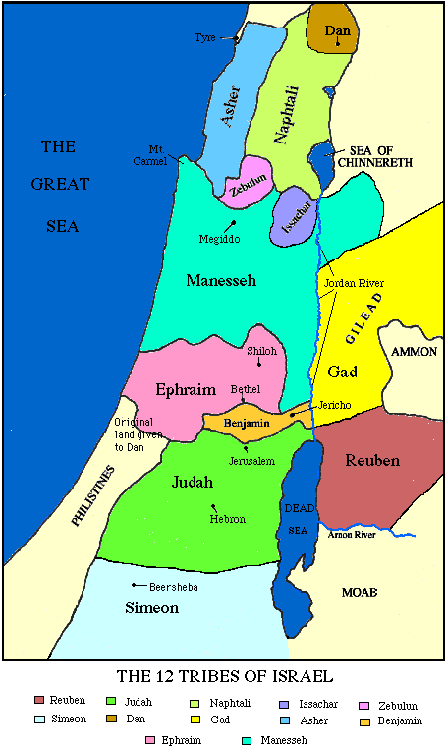
The Twelve Tribes of Israel formed the first constitutional monarchy in Palestine about 1000 B.C. The second king, David, first made Jerusalem the nation's capital. Although eventually Palestine was split into two separate kingdoms, Jewish independence there lasted for 212 years. This is almost as long as Americans have enjoyed independence in what has become known as the United States.
Even after the destruction of the Second Temple in Jerusalem and the beginning of the exile, Jewish life in Palestine continued and often flourished. Large communities were reestablished in Jerusalem and Tiberias by the ninth century. In the 11th century, Jewish communities grew in Rafah, Gaza, Ashkelon, Jaffa and Caesarea.
Many Jews were massacred by the Crusaders during the 12th century, but the community rebounded in the next two centuries as large numbers of rabbis and Jewish pilgrims immigrated to Jerusalem and the Galilee. Prominent rabbis established communities in Safed, Jerusalem and elsewhere during the next 300 years. By the early 19th century-years before the birth of the modern Zionist movement-more than 10,000 Jews lived throughout what is today Israel.
When Jews began to immigrate to Palestine in large numbers in 1882, fewer than 250,000 Arabs lived there, and the majority of them had arrived in recent decades. Palestine was never an exclusively Arab country, although Arabic gradually became the language of most the population after the Muslim invasions of the seventh century. No independent Arab or Palestinian state ever existed in Palestine. When the distinguished Arab-American historian, Princeton University Prof. Philip Hitti, testified against partition before the Anglo-American Committee in 1946, he said: "There is no such thing as 'Palestine' in history, absolutely not." In fact, Palestine is never explicitly mentioned in the Koran, rather it is called "the holy land" (al-Arad al-Muqaddash).
Prior to partition, Palestinian Arabs did not view themselves as having a separate identity. When the First Congress of Muslim-Christian Associations met in Jerusalem in February 1919 to choose Palestinian representatives for the Paris Peace Conference, the following resolution was adopted: We consider Palestine as part of Arab Syria, as it has never been separated from it at any time. We are connected with it by national, religious, linguistic, natural, economic and geographical bonds.
In 1937, a local Arab leader, Auni Bey Abdul-Hadi, told the Peel Commission, which ultimately suggested the partition of Palestine: "There is no such country [as Palestine]! 'Palestine' is a term the Zionists invented! There is no Palestine in the Bible. Our country was for centuries part of Syria."
The representative of the Arab Higher Committee to the United Nations submitted a statement to the General Assembly in May 1947 that said "Palestine was part of the Province of Syria" and that, "politically, the Arabs of Palestine were not independent in the sense of forming a separate political entity." A few years later, Ahmed Shuqeiri, later the chairman of the PLO, told the Security Council: "It is common knowledge that Palestine is nothing but southern Syria."
Palestinian Arab nationalism is largely a post-World War I phenomenon that did not become a significant political movement until after the 1967 Six-Day War and Israel's capture of the West Bank.
Israel's international "birth certificate" was validated by the promise of the Bible; uninterrupted Jewish settlement from the time of Joshua onward; the Balfour Declaration of 1917; the League of Nations Mandate, which incorporated the Balfour Declaration; the United Nations partition resolution of 1947; Israel's admission to the UN in 1949; the recognition of Israel by most other states; and, most of all, the society created by Israel's people in decades of thriving, dynamic national existence.
Geography Area: 20,330 sq. km.1 (7,850 sq. mi.); about the size of New Jersey. Cities: Capital--Jerusalem.2 Other cities--Tel Aviv, Haifa. Terrain: Plains, mountains, desert, and coast. Climate: Temperate, except in desert areas.
People Population (2009 est.): 7.23 million. Annual population growth rate (2009 est.): 1.7%. Ethnic groups: Jews 76.2%; Arabs 19.5%; other 4.3%. Religions: Judaism, Islam, Christianity, Druze. Languages: Hebrew (official), Arabic (official), English, Russian. Education: Years compulsory--11. Literacy--96.9% (female 95.6%; male 98.3%). Health: Infant mortality rate (2009 est.)--4.22/1,000 births. Life expectancy at birth--80.73 years; female 82.95 years, male 78.62 years. Work force (2.68 million; Central Bureau for Statistics, 2004): Agriculture--2.1%; manufacturing--16.2%; electricity and water supply--0.8%; construction--5.4%; trade and repair of motor vehicles--3.6%; accommodation services and restaurants--4.3%; transport, storage, and communication--6.5%; banking, insurance, and finance--3.3%; business activities--13.4%; public administration--4.7%; education--12.7%; health, welfare, and social services--10.7%; community, social, and personal services--4.6%; services for households by domestic personnel--1.6%.
Government Type: Parliamentary democracy. Independence: May 14, 1948. Constitution: None; however, the Declaration of Establishment (1948), the Basic Laws of the parliament (the Knesset), and the Israeli citizenship law fill many of the functions of a constitution. Branches: Executive--president (chief of state); prime minister (head of government). Legislative--unicameral Knesset. Judicial--Supreme Court. Political parties: Labor, Likud, Kadima, and various other secular and religious parties, including some wholly or predominantly supported by Israel's Arab citizens. A total of 12 parties are represented in the 18th Knesset, elected February 2009. Suffrage: Universal at 18.
Economy GDP (2008 est.): $203.4 billion. Annual growth rate (2008): 4.2%. Per capita GDP (2008): $28,600. Currency: Shekel (3.82shekels = 1 U.S. dollar; 2009 est.). Natural resources: Copper, phosphate, bromide, potash, clay, sand, sulfur, bitumen, manganese. Agriculture: Products--citrus and other fruits, vegetables, beef, dairy, and poultry products. Industry: Types--high-technology projects (including aviation, communications, computer-aided design and manufactures, medical electronics, fiber optics), wood and paper products, potash and phosphates, food, beverages, tobacco, caustic soda, cement, construction, plastics, chemical products, diamond cutting and polishing, metal products, textiles, and footwear. Trade: Exports (2008 est.)--$57.16 billion. Exports include polished diamonds, electronic communication, medical and scientific equipment, chemicals and chemical products, electronic components and computers, machinery and equipment, transport equipment, rubber, plastics, and textiles. Imports (excluding defense imports, 2008 est.)--$64.4 billion: raw materials, diamonds, energy ships and airplanes, machinery, equipment, land transportation equipment for investment, and consumer goods. Major partners--U.S., U.K., Germany; exports--U.S., Belgium, Hong Kong; imports--U.S., Belgium, Germany, Switzerland, U.K.
1Including Jerusalem 2Israel proclaimed Jerusalem as its capital in 1950. The United States, like nearly all other countries, maintains its embassy in Tel Aviv.
PEOPLE Of the approximately 7.23 million Israelis in 2009, about 76% were counted as Jewish, though some of those are not considered Jewish under Orthodox Jewish law. Since 1989, nearly a million immigrants from the former Soviet Union have arrived in Israel, making this the largest wave of immigration since independence. In addition, an estimated 105,000 members of the Ethiopian Jewish community have immigrated to Israel, 14,000 of them during the dramatic May 1991 Operation Solomon airlift. 32.9% of Israelis were born outside of Israel.
The three broad Jewish groupings are the Ashkenazim, or Jews who trace their ancestry to western, central, and eastern Europe; the Sephardim, who trace their origin to Spain, Portugal, southern Europe, and North Africa; and Eastern or Oriental Jews, who descend from ancient communities in Islamic lands. Of the non-Jewish population, about 68% are Muslims, about 9% are Christian, and about 7% are Druze.
Education is compulsory from age 6 to 16 and is free up to age 18. The school system is organized into kindergartens, 6-year primary schools, 3-year junior secondary schools, and 3-year senior secondary schools, after which a comprehensive examination is offered for university admissions. There are seven university-level institutions in Israel, a number of regional colleges, and an Open University program.
With a population drawn from more than 100 countries on 5 continents, Israeli society is rich in cultural diversity and artistic creativity. The arts are actively encouraged and supported by the government. The Israeli Philharmonic Orchestra performs throughout the country and frequently tours abroad. The Jerusalem Symphony and the New Israel Opera also tour frequently, as do other musical ensembles. Almost every municipality has a chamber orchestra or ensemble, many boasting the talents of gifted performers from the countries of the former Soviet Union.
Israel has several professional ballet and modern dance companies, and folk dancing, which draws upon the cultural heritage of many immigrant groups, continues to be very popular. There is great public interest in the theater; the repertoire covers the entire range of classical and contemporary drama in translation as well as plays by Israeli authors. Of the three major repertory companies, the most famous, Habimah, was founded in 1917.
Active artist colonies thrive in Safed, Jaffa, and Ein Hod, and Israeli painters and sculptors exhibit works worldwide. Israel boasts more than 120 museums, including the Israel Museum in Jerusalem, which houses the Dead Sea Scrolls along with an extensive collection of regional archaeological artifacts, art, and Jewish religious and folk exhibits. Israelis are avid newspaper readers, with more than 90% of Israeli adults reading a newspaper at least once a week. Major daily papers are in Hebrew; others are in Arabic, English, French, Polish, Yiddish, Russian, Hungarian, and German.
HISTORY The creation of the State of Israel in 1948 was preceded by more than 50 years of efforts to establish a sovereign state as a homeland for Jews. These efforts were initiated by Theodore Herzl, founder of the Zionist movement, and were given added impetus by the Balfour Declaration of 1917, which asserted the British Government's support for the creation of a Jewish homeland in Palestine.
In the years following World War I, Palestine became a British Mandate and Jewish immigration steadily increased, as did violence between Palestine's Jewish and Arab communities. Mounting British efforts to restrict this immigration were countered by international support for Jewish national aspirations following the near-extermination of European Jewry by the Nazis during World War II. This support led to the 1947 UN partition plan, which would have divided Palestine into separate Jewish and Arab states, with Jerusalem under UN administration.
On May 14, 1948, soon after the British quit Palestine, the State of Israel was proclaimed and was immediately invaded by armies from neighboring Arab states, which rejected the UN partition plan. This conflict, Israel's War of Independence, was concluded by armistice agreements between Israel, Egypt, Jordan, Lebanon, and Syria in 1949 and resulted in a 50% increase in Israeli territory.
In 1956, French, British, and Israeli forces engaged Egypt in response to its nationalization of the Suez Canal and blockade of the Straits of Tiran. Israeli forces withdrew in March 1957, after the United Nations established the UN Emergency Force (UNEF) in the Gaza Strip and Sinai. This war resulted in no territorial shifts and was followed by several years of terrorist incidents and retaliatory acts across Israel's borders.
In June 1967, Israeli forces struck targets in Egypt, Jordan, and Syria in response to Egyptian President Nasser's ordered withdrawal of UN peacekeepers from the Sinai Peninsula and the buildup of Arab armies along Israel's borders. After 6 days, all parties agreed to a cease-fire, under which Israel retained control of the Sinai Peninsula, the Golan Heights, the Gaza Strip, the formerly Jordanian-controlled West Bank of the Jordan River, and East Jerusalem. On November 22, 1967, the Security Council adopted Resolution 242, the "land for peace" formula, which called for the establishment of a just and lasting peace based on Israeli withdrawal from territories occupied in 1967 in return for the end of all states of belligerency, respect for the sovereignty of all states in the area, and the right to live in peace within secure, recognized boundaries.
The following years were marked by continuing violence across the Suez Canal, punctuated by the 1969-70 war of attrition. On October 6, 1973--Yom Kippur (the Jewish Day of Atonement), the armies of Syria and Egypt launched an attack against Israel. Although the Egyptians and Syrians initially made significant advances, Israel was able to push the invading armies back beyond the 1967 cease-fire lines by the time the United States and the Soviet Union helped bring an end to the fighting. In the UN Security Council, the United States supported Resolution 338, which reaffirmed Resolution 242 as the framework for peace and called for peace negotiations between the parties.
In the years that followed, sporadic clashes continued along the cease-fire lines but guided by the U.S., Egypt, and Israel continued negotiations. In November 1977, Egyptian President Anwar Sadat made a historic visit to Jerusalem, which opened the door for the 1978 Israeli-Egyptian peace summit convened at Camp David by President Carter. These negotiations led to a 1979 peace treaty between Israel and Egypt, pursuant to which Israel withdrew from the Sinai in 1982, signed by President Sadat of Egypt and Prime Minister Menahem Begin of Israel.
In the years following the 1948 war, Israel's border with Lebanon was quiet relative to its borders with other neighbors. After the expulsion of Palestinian fighters from Jordan in 1970 and their influx into southern Lebanon, however, hostilities along Israel's northern border increased and Israeli forces crossed into Lebanon. After passage of Security Council Resolution 425, calling for Israeli withdrawal and the creation of the UN Interim Force in Lebanon peacekeeping force (UNIFIL), Israel withdrew its troops.
In June 1982, following a series of cross-border terrorist attacks and the attempted assassination of the Israeli Ambassador to the U.K., Israel invaded Lebanon to fight the forces of Yasser Arafat's Palestine Liberation Organization (PLO). The PLO withdrew its forces from Lebanon in August 1982. Israel, having failed to finalize an agreement with Lebanon, withdrew most of its troops in June 1985 save for a residual force which remained in southern Lebanon to act as a buffer against attacks on northern Israel. These remaining forces were completely withdrawn in May 2000 behind a UN-brokered delineation of the Israel-Lebanon border (the Blue Line). Hezbollah forces in Southern Lebanon continued to attack Israeli positions south of the Blue Line in the Sheba Farms/Har Dov area of the Golan Heights.
The victory of the U.S.-led coalition in the Persian Gulf War of 1991 opened new possibilities for regional peace. In October 1991, the United States and the Soviet Union convened the Madrid Conference, in which Israeli, Lebanese, Jordanian, Syrian, and Palestinian leaders laid the foundations for ongoing negotiations designed to bring peace and economic development to the region. Within this framework, Israel and the PLO signed a Declaration of Principles on September 13, 1993, which established an ambitious set of objectives relating to a transfer of authority from Israel to an interim Palestinian authority. Israel and the PLO subsequently signed the Gaza-Jericho Agreement on May 4, 1994, and the Agreement on Preparatory Transfer of Powers and Responsibilities on August 29, 1994, which began the process of transferring authority from Israel to the Palestinians.
On October 26, 1994, Israel and Jordan signed a historic peace treaty, witnessed by President Clinton. This was followed by Israeli Prime Minister Rabin and PLO Chairman Arafat's signing of the historic Israeli-Palestinian Interim Agreement on September 28, 1995. This accord, which incorporated and superseded previous agreements, broadened Palestinian self-government and provided for cooperation between Israel and the Palestinians in several areas.
Israeli Prime Minister Yitzhak Rabin was assassinated on November 4, 1995, by a right-wing Jewish radical, bringing the increasingly bitter national debate over the peace process to a climax. Subsequent Israeli governments continued to negotiate with the PLO resulting in additional agreements, including the Wye River and the Sharm el-Sheikh memoranda. However, a summit hosted by President Clinton at Camp David in July 2000 to address permanent status issues--including the status of Jerusalem, Palestinian refugees, Israeli settlements in the West Bank and Gaza, final security arrangements, borders, and relations and cooperation with neighboring states--failed to produce an agreement.
Following the failed talks, widespread violence broke out in Israel, the West Bank, and Gaza in September 2000. In April 2001 the Sharm el-Sheikh Fact Finding Committee, commissioned by the October 2000 Middle East Peace Summit and chaired by former U.S. Senator George Mitchell, submitted its report, which recommended an immediate end to the violence followed by confidence-building measures and a resumption of security cooperation and peace negotiations. Building on the Mitchell report, in April 2003, the Quartet (the U.S., UN, European Union (EU), and the Russian Federation) announced the "roadmap," a performance-based plan to bring about two states, Israel and a democratic, viable Palestine, living side by side in peace and security.
Despite the promising developments of spring 2003, violence continued and in September 2003 the first Palestinian Prime Minister, Mahmoud Abbas (Abu Mazen), resigned after failing to win true authority to restore law and order, fight terror, and reform Palestinian institutions. In response to the deadlock, in the winter of 2003-2004 Prime Minister Sharon put forward his Gaza disengagement initiative, proposing the withdrawal of Israeli settlements from Gaza as well as parts of the northern West Bank. President Bush endorsed this initiative in an exchange of letters with Prime Minister Sharon on April 14, 2004, viewing Gaza disengagement as an opportunity to move towards implementation of the two-state vision and begin the development of Palestinian institutions. In a meeting in May 2004 the Quartet endorsed the initiative, which was approved by the Knesset in October 2004.
The run-up to disengagement saw a flurry of diplomatic activity, including the February 2005 announcement of Lieutenant General William Ward and subsequently Lieutenant General Keith Dayton as U.S. Security Coordinator; the March 2005 Sharon-Abbas summit in Sharm el-Sheikh; the return of Egyptian and Jordanian ambassadors to Israel; and the May 2005 appointment of former World Bank president James D. Wolfensohn as Special Envoy for Gaza Disengagement to work for a revitalization of the Palestinian economy after disengagement.
On August 15, 2005, Israel began implementing its disengagement from the Gaza Strip, and the Israeli Defense Forces completed their withdrawal, including the dismantling of 17 settlements, on September 12. After broad recognition for Prime Minister Sharon's accomplishment at that fall's UN General Assembly, international attention quickly turned to efforts to strengthen Palestinian governance and the economy in Gaza. The United States brokered a landmark Agreement on Movement and Access between the parties in November 2005 to facilitate further progress on Palestinian economic issues. However, the terrorist organization Hamas--building on popular support for its "resistance" to Israeli occupation and a commitment to clean up the notorious corruption of the Palestinian Authority (PA)--took a majority in the January 2006 Palestinian Legislative Council (PLC) elections, with Hamas leader Ismail Haniya as Prime Minister. The Israeli leadership pledged not to work with a Palestinian government in which Hamas had a role.
Shortly following Hamas' PLC victory, the Quartet--comprised of the United States, European Union, United Nations. and Russia--outlined three basic principles the Hamas-led PA must meet in order for the U.S. and the international community to reengage with the PA: renounce violence and terror, recognize Israel, and respect previous agreements, including the roadmap. The Hamas-led PA government rejected these principles, resulting in a Quartet statement of "grave concern" on March 30, 2006 and the suspension of U.S. assistance to the PA, complete prohibition on U.S. Government contacts with the PA, and prohibition of unlicensed transactions with the PA government. The Palestine Liberation Organization (PLO) under the leadership of PLO Chairman and PA President Mahmud Abbas (Abu Mazen), by contrast, remained consistently committed to the Quartet principles.
Despite several negotiated cease-fires between Hamas and Fatah, violent clashes in the Gaza Strip--and to a lesser extent in the West Bank--were commonplace between December 2006 and February 2007 and resulted in dozens of deaths and injuries. In an attempt to end the intra-Palestinian violence, the King of Saudi Arabia invited Palestinian rivals to Mecca, and on February 9, 2007, Abbas and Hamas leader Haniya agreed to the formation of a Palestinian national unity government and a cessation of violence. Hamas' rejectionist policies and violent behavior continued despite the formation of the national unity government.
In June 2007, Hamas effectively orchestrated a violent coup in Gaza. Hamas also launched scores of Qassam rockets into southern Israel in an attempt to involve Israel in the Hamas-Fatah conflict. On June 14, Palestinian Authority President Mahmoud Abbas exercised his lawful authority by declaring a state of emergency, dissolving the national unity government, and replacing it with a new government with Salam Fayyad as Prime Minister.
The Palestinian Authority (PA) government under President Abbas and Prime Minister Fayyad has no elements controlled by Hamas. The government is dedicated to pursuing a negotiated solution to the Arab-Israeli conflict, and the Quartet principles. As a result, the PA has been supported politically and financially by the international community, and engaged by Israel. The U.S. reinstated its assistance to the PA in 2007 and provides budget and development assistance as well as support for the PA’s efforts to reform and improve security and rule of law in the West Bank.
In November 2007, Israeli and Palestinian leaders participated in an international conference in Annapolis, at which they committed to launch bilateral negotiations towards the establishment of a Palestinian state in the West Bank and Gaza, and the realization of Israeli-Palestinian peace. During the year that followed, Israeli Prime Minister Olmert and Palestinian Authority President Abbas and other members of their governments engaged in regular bilateral negotiations on final status issues. Although the two sides reportedly narrowed their differences on some issues, the negotiations were suspended in December 2008 when conflict broke out between Israel and Hamas in Gaza.
On December 27, 2008, in response to a sharp increase in the number and frequency of rocket attacks into Israel shortly prior to and following the formal expiration of a six-month "calm" between Israel and Hamas, the Israel Defense Forces launched Operation Cast Lead, targeting Hamas security installations, personnel, and other facilities in the Gaza Strip. The Israeli military operation continued until January 18, 2009, when Israel and Hamas each declared a unilateral cease-fire.
On January 22, 2009, President Obama named Senator Mitchell his and Secretary Clinton’s special envoy for Middle East peace. Special Envoy Mitchell immediately travelled to the region and has subsequently returned on a nearly monthly basis in an effort to help create the conditions that would support a two-state solution as part and to re-launch credible and productive negotiations. The President has visited Turkey, Egypt, and Saudi Arabia and hosted Prime Minister Netanyahu and numerous Arab heads of state in Washington. On September 22, he hosted a trilateral meeting with Prime Minister Netanyahu and President Abbas, and he has written to over a dozen Arab heads of state asking for their assistance in ending the Arab-Israeli conflict. The Secretary has met many leaders from the region and has traveled to the Middle East multiple times since her appointment to promote a Middle East peace settlement.
GOVERNMENT Israel is a parliamentary democracy. Its governmental system is based on several basic laws enacted by its unicameral parliament, the Knesset. The president (chief of state) is elected by the Knesset for a 5-year term.
The prime minister (head of government) exercises executive power and has in the past been selected by the president as the party leader most able to form a government. Between May 1996 and March 2001, Israelis voted for the prime minister directly. (The legislation, which required the direct election of the prime minister, was rescinded by the Knesset in March 2001.) The members of the cabinet must be collectively approved by the Knesset.
The Knesset's 120 members are elected by secret ballot to 4-year terms, although the prime minister may decide to call for new elections before the end of the 4-year term. Voting is for party lists rather than for individual candidates, and the total number of seats assigned each party reflects that party's percentage of the vote. Successful Knesset candidates are drawn from the lists in order of party-assigned rank. Under the present electoral system, all members of the Knesset are elected at large.
The independent judicial system includes secular and religious courts. The courts' right of judicial review of the Knesset's legislation is limited. Judicial interpretation is restricted to problems of execution of laws and validity of subsidiary legislation. The highest court in Israel is the Supreme Court, whose judges are approved by the President.
Israel is divided into six districts, administration of which is coordinated by the Ministry of Interior. The Ministry of Defense is responsible for the administration of the occupied territories.
Principal Government Officials President--Shimon Peres Prime Minister--Benjamin Netanyahu (Likud) Foreign Minister--Avigdor Lieberman (Yisrael Beitanu) Ambassador to the United States--Michael Oren Ambassador to the United Nations--Gabriela Shalev
Israel maintains an embassy in the United States at 3514 International Drive NW, Washington DC, 20008 (tel. 202-364-5500). There also are consulates general in Atlanta, Boston, Chicago, Houston, Los Angeles, Miami, New York, Philadelphia, and San Francisco.
POLITICAL CONDITIONS From the founding of Israel in 1948 until the election of May 1977, Israel was ruled by successive coalition governments led by the Labor alignment or its constituent parties. From 1967-70, the coalition government included all of Israel's parties except the communist party. After the 1977 election, the Likud bloc, then composed of Herut, the Liberals, and the smaller La'am Party, came to power forming a coalition with the National Religious Party, Agudat Israel, and others. As head of Likud, Menachem Begin became Prime Minister. The Likud retained power in the succeeding election in June 1981, and Begin remained Prime Minister. In the summer of 1983, Begin resigned and was succeeded by his Foreign Minister, Yitzhak Shamir.
After Prime Minister Shamir lost a Knesset vote of confidence early in 1984, new elections in July provided no clear winner, with both Labor and Likud considerably short of a Knesset majority and unable to form even narrow coalitions. After several weeks of difficult negotiations, they agreed on a government of national unity, including the rotation of the office of Prime Minister and the combined office of Vice Prime Minister and Foreign Minister midway through the government's 50-month term.
During the first 25 months of unity government rule, Labor's Shimon Peres served as Prime Minister, while Likud's Shamir held the posts of Vice Prime Minister and Foreign Minister, until they switched positions in October 1986. In November 1988 elections, Likud edged Labor out by one seat but was unable to form a coalition, producing another national unity government in January 1989. Yitzhak Shamir became Prime Minister, and Shimon Peres became Vice Prime Minister and Finance Minister. This government fell in March 1990, however, in a vote of no confidence precipitated by disagreement over the government's response to U.S. Secretary of State Baker's initiative in the peace process. Labor Party leader Peres was unable to attract sufficient support among the religious parties to form a government. Yitzhak Shamir then formed a Likud-led coalition government, including members from religious and right-wing parties.
Shamir's government took office in June 1990, and held power for 2 years. In the June 1992 national elections, the Labor Party reversed its electoral fortunes, taking 44 seats. Labor Party leader Yitzhak Rabin formed a coalition with Meretz (a group of three leftist parties) and Shas (an ultra-Orthodox religious party). The coalition included the support of two Arab-majority parties. Rabin became Prime Minister in July 1992, presiding over the signing of the Oslo accords with the Palestine Liberation Organization. However, Rabin was assassinated by a right-wing Jewish radical on November 4, 1995. Peres, then Deputy Prime Minister and Foreign Minister, once again became Prime Minister and immediately proceeded to carry forward the peace policies of the Rabin government and to implement Israel's Oslo commitments, including military redeployment in the West Bank and the holding of historic Palestinian elections on January 20, 1996.
Enjoying broad public support and anxious to secure his own mandate, Peres called for early elections after just 3 months in office. (They would have otherwise been held by the end of October 1996.) In late February and early March, a series of suicide bombing attacks by Palestinian terrorists took some 60 Israeli lives, seriously eroding public support for Peres and raising concerns about the peace process. Increased fighting in southern Lebanon, which also brought Katyusha rocket attacks against northern Israel, also raised tensions and weakened the government politically a month before the May 29 elections.
In those elections--the first direct election of a Prime Minister in Israeli history--Likud leader Binyamin Netanyahu won by a narrow margin, having sharply criticized the government's peace policies for failing to protect Israeli security. Netanyahu subsequently formed a right-wing coalition government publicly committed to pursuing the peace process, but with an emphasis on security and reciprocity. In 1999, with a shrunken coalition and facing increasing difficulty passing legislation and defeating no-confidence motions, Netanyahu dissolved parliament and called for new elections. This time, the Labor candidate--Ehud Barak--was victorious. Barak formed a mixed coalition government of secular and religious parties, with Likud in the opposition. In May 2000, Barak fulfilled one of his major campaign promises by withdrawing Israeli forces from Southern Lebanon. However, by mid-autumn, with the breakdown of the Camp David talks and the worsening security situation caused by the new intifada, Barak's coalition was in jeopardy. In December, he resigned as Prime Minister, precipitating a new prime ministerial election.
In a special election on February 6, 2001, after a campaign stressing security and the maintenance of Israeli sovereignty over Jerusalem, Likud leader Ariel Sharon defeated Barak by over 20 percentage points. As he had promised in his campaign, Sharon formed a broad unity government that included the Labor and Likud parties, the far-right parties, some smaller secular parties, and several religious parties. The unity government collapsed in late 2002, and new elections were held in January 2003. Sharon again won, and formed a new government consisting of his own Likud party, the right-wing National Religious Party and National Union party, and centrist Shinui.
The summer of 2004 saw renewed instability in the government, as disagreement over the Gaza disengagement plan resulted in Sharon's firing two ministers of the National Union Party and accepting the resignation of a third from the National Religious Party in order to secure cabinet approval of the plan (it was endorsed on June 6, 2004). Continuing divisions within the Likud on next steps then prompted Ariel Sharon to leave the party in November 2005 to form the Kadima ("Forward") party and call new elections for March 2006. However, Sharon was unexpectedly incapacitated in January 2006 due to a severe stroke and leadership of Kadima shifted to Acting Prime Minister Ehud Olmert. Olmert led the Kadima party to its first electoral victory on March 28, and was able to form a coalition with Labor and several smaller parties. The new government was sworn in on May 4, 2006.
Following the attorney general opening a series of corruption investigations, Olmert resigned in September 2008. In October, President Peres asked deputy Prime Minister and Foreign Minister Tzippi Livni to form a new government. When Livni was unable to secure a governing majority, President Peres called for new elections to occur in February 2009. Even though Kadima, led by Tzippi Livni won more seats than any other single party, right-of-center parties, both religious and secular, had the largest overall gains in the new Knesset. Subsequently, President Peres asked Likud-leader Netanyahu to form a government. Netanyahu was sworn in as Prime Minister for the second time on March 31, 2009.
ECONOMY Israel has a diversified, technologically advanced economy with substantial but decreasing government ownership and a strong high-tech sector. The major industrial sectors include high-technology electronic and biomedical equipment, metal products, processed foods, chemicals, and transport equipment. Israel possesses a substantial service sector and is one of the world's centers for diamond cutting and polishing. It also is a world leader in software development and, prior to the violence that began in September 2000, was a major tourist destination.
Israel's strong commitment to economic development and its talented work force led to economic growth rates during the nation's first two decades that frequently exceeded 10% annually. The years after the 1973 Yom Kippur War were a lost decade economically, as growth stalled and inflation reached triple-digit levels. The successful economic stabilization plan implemented in 1985 and the subsequent introduction of market-oriented structural reforms reinvigorated the economy and paved the way for rapid growth in the 1990s.
A wave of Jewish immigration beginning in 1989, predominantly from the countries of the former U.S.S.R., brought nearly a million new citizens to Israel. These new immigrants, many of them highly educated, now constitute some 13% of Israel's 7.2 million inhabitants. Their successful absorption into Israeli society and its labor force forms a remarkable chapter in Israeli history. The skills brought by the new immigrants and their added demand as consumers gave the Israeli economy a strong upward push and in the 1990s, they played a key role in the ongoing development of Israel's high-tech sector.
During the 1990s, progress in the Middle East peace process, beginning with the Madrid Conference of 1991, helped to reduce Israel's economic isolation from its neighbors and opened up new markets to Israeli exporters farther afield. The peace process stimulated an unprecedented inflow of foreign investment in Israel, and provided a substantial boost to economic growth in the region over the last decade. The onset of the intifada beginning at the end of September of 2000, the downturn in the high-tech sector and Nasdaq crisis, and the slowdown of the global economy have all significantly affected the Israeli economy. However, despite the conflicts in Gaza and Lebanon, the Israeli economy grew during 2006.
Israeli companies, particularly in the high-tech area, have in the past enjoyed considerable success raising money on Wall Street and other world financial markets; Israel has approximately the same number of companies listed on NASDAQ as the next three countries (Canada, Japan, and Ireland) combined. Israel's tech market is very developed, and in spite of the pause in the industry's growth, the high-tech sector is likely to be the major driver of the Israeli economy. Almost 45 % of Israel's exports are high tech. Most leading players, including Intel, Motorola, IBM, and Cisco have a presence in Israel.
After growing by an exceptional 9.2% in 2000, growth was negative in 2001 and 2002, as a result of the security situation, global recession and high-tech downturn. Growth returned in 2003, and as a result of the improvement in the security situation and the economic recovery plan undertaken by the Government of Israel, the Israeli economy grew by an average of more than 5% a year from 2004 to 2007. This was followed by growth of 4% in 2008. With the onset of the global financial crisis, the slowdown in the Israeli economy only began in the third quarter of 2008, followed by negative growth of 1.6% in the fourth quarter of 2008 and -3.2% in the first quarter of 2009. Unemployment reached a high of 10.7% in 2003, a level not seen in 20 years, and declined consistently each year until 2008, when it reached 6.1%, the lowest level since 1995.
Trade of goods and services in Israel grew by 6%, 9.3%, and 5.2%, respectively in 2006, 2007, and 2008. Exports declined by a sharp 35.6% in the fourth quarter of 2008 and 28.6% in the first quarter of 2009. Diamond exports alone declined by more than 36% in the fourth quarter of 2008 compared with the same quarter the previous year. Agricultural exports, which increased by 44% in 2007, declined by almost 12% in the fourth quarter of 2008.
The GDP of the business sector grew by more than 6% from 2004 to 2006. In 2007 and 2008 GDP of the business sector increased, although at more moderate levels of 5.6% in 2007 and 4.5% in 2008. The finance and business services sector grew by 25% in both 2007 and 2008. The manufacturing sector grew by more than 14% in both 2007 and 2008 and commerce, restaurants and hotels grew by more than 11% in both 2007 and 2008.
The general consensus among economists is that Israel entered the global economic crisis in relatively good shape. Because the GOI maintained conservative policies during the crisis and avoided ambitious fiscal spending packages, the Israeli economy is expected to quickly emerge from a shallow recession and return to a path of growth, even if not at levels that were seen prior to the crisis.
The United States is Israel's largest single trading partner. In 2008, bilateral trade totaled $28 billion, an increase of almost 5% over 2007, even in light of the slowdown in global trade. The U.S. trade deficit with Israel was $11.9 billion in 2008, including diamonds. Excluding diamonds, the trade deficit was $4.5 billion in 2008. Israel is our 20th largest export market for goods. The principal goods exported from the U.S. include civilian aircraft parts, telecommunications equipment, semiconductors, civilian aircraft, electrical apparatus, and computer accessories. Israel's chief exports to the U.S. include diamonds, pharmaceutical preparations, telecommunications equipment, medicinal equipment, electrical apparatus, and cotton apparel. The two countries signed a free trade agreement (FTA) in 1985 that progressively eliminated tariffs on most goods traded between the two countries over the following 10 years. An agricultural trade accord signed in November 1996 addressed the remaining goods not covered in the FTA but has not entirely erased barriers to trade in the agricultural sector. Israel also has trade and cooperation agreements in place with the European Union, Canada, Mexico, and other countries.
Best prospect industry sectors in Israel for U.S. exporters are energy; defense; security and safety; health care; industrial chemicals; information and telecommunications; electronics; building and construction; travel and tourism; and education.
FOREIGN RELATIONS In addition to seeking an end to hostilities with Arab forces, against which it has fought five wars since 1948, Israel has given high priority to gaining wide acceptance as a sovereign state with an important international role.
Before 1967, Israel had established diplomatic relations with a majority of the world's nations, except for the Arab states and most other Muslim countries. UN Security Council resolutions provided the basis for cease-fire and disengagement agreements concerning the Sinai and the Golan Heights between Israel, Egypt, and Syria and for promoting the Camp David accords and the Egyptian-Israeli Peace Treaty. The Soviet Union and the communist states of Eastern Europe (except Romania) broke diplomatic relations with Israel during the 1967 war, but those relations were restored by 1991.
The landmark October 1991 Madrid conference recognized the importance of Security Council Resolutions 242 and 338 in resolving regional disputes, and brought together for the first time Israel, the Palestinians, and the neighboring Arab countries, launching a series of direct bilateral and multilateral negotiations. These talks were designed to finally resolve outstanding security, border, and other issues between the parties while providing a basis for mutual cooperation on issues of general concern, including the status of refugees, arms control and regional security, water and environmental concerns, and economic development.
Today, Israel has diplomatic relations with 163 states. Following the signing of the Israel-PLO Declaration of Principles on September 13, 1993, Israel established or renewed diplomatic relations with 36 countries. Israel has full diplomatic relations with Egypt and Jordan. In addition, on October 1, 1994, the Gulf States publicly announced their support for a review of the Arab boycott, in effect abolishing the secondary and tertiary boycotts against Israel.
Israel has diplomatic relations with nine non-Arab Muslim states and with 32 of the 43 Sub-Saharan states that are not members of the Arab League. Israel established relations with China and India in 1992 and with the Holy See in 1993.
DEFENSE Israel's ground, air, and naval forces, known as the Israel Defense Force (IDF), fall under the command of a single general staff. Conscription is universal for Jewish men and women over the age of 18, although exemptions may be made on religious grounds. Druze, members of a small Islamic offshoot living in Israel's mountains, also serve in the IDF. Israeli Arabs, with the exception of some Bedouins, do not serve. During 1950-66, Israel spent an average of 9% of GDP on defense. Real defense expenditures increased dramatically after both the 1967 and 1973 wars. The defense budget in 2009 totals USD 12 billion, representing 6.2% of GDP, and accounting for 16.3% of government expenditures. US military aid to Israel in 2009 totals USD 2.55 billion. This will increase to USD 3 billion in 2012, and will total USD 3.15 billion a year from 2013 to 2018.
In 1983, the United States and Israel established the Joint Political Military Group, which meets twice a year. Both the U.S. and Israel participate in joint military planning and combined exercises, and have collaborated on military research and weapons development.
U.S.-ISRAELI RELATIONS Commitment to Israel's security and well being has been a cornerstone of U.S. policy in the Middle East since Israel's founding in 1948, in which the United States played a key supporting role. Israel and the United States are bound closely by historic and cultural ties as well as by mutual interests. Continuing U.S. economic and security assistance to Israel acknowledges these ties and signals U.S. commitment. The broad issues of Arab-Israeli peace have been a major focus in the U.S.-Israeli relationship. U.S. efforts to reach a Middle East peace settlement are based on UN Security Council Resolutions 242 and 338 and have been based on the premise that as Israel takes calculated risks for peace the United States will help minimize those risks.
On a bilateral level, relations between the United States and Israel are continually strengthening in every field. In addition to the Joint Political-Military Group described above, there are: bilateral science and technology efforts (including the Binational Science Foundation and the Binational Agricultural Research and Development Foundation); the U.S.-Israeli Education Foundation, which sponsors educational and cultural programs; the Joint Economic Development Group, which maintains a high-level dialogue on economic issues; the Joint Counterterrorism Group, designed to enhance cooperation in fighting terrorism; and a high-level Strategic Dialogue.
Principal U.S. Officials: U.S. Embassy Ambassador--James Cunningham Deputy Chief of Mission--Luis Moreno Political Affairs--Marc Sievers Economic Affairs--David Burnett Management-- Elizabeth Moore, Acting Consular Affairs--Andrew Parker Public Affairs--Bonnie Gutman, Acting Commercial Affairs--Jonathan Heimer Science Attaché--Paul Rohrlich Defense Attaché-- Col. Richard Burgess Legal Attaché-- Jeff Walker
The U.S. Embassy in Israel is located at 71 Hayarkon Street, Tel Aviv (tel. 03-519-7575).
U.S. Consulate General Consul General--Daniel Rubinstein Deputy Principal Officer--Gregory Marchese
The U.S. Consulate General in Jerusalem has offices at 18 Agron Road (tel. 02-622-7230) and on Nablus Road (tel. 02-622-7230). The Consulate General in Jerusalem is an independent U.S. mission, established in 1928, whose members are not accredited to a foreign government.
U.S. Consular Agent The U.S. Consular Agent in Haifa is located at 26 Ben Gurion Boulevard (tel. 972-4-853-1470), and reports to the Embassy in Tel Aviv. The Consular Agent can provide routine and emergency services in the north. TRAVEL AND BUSINESS INFORMATION The U.S. Department of State's Consular Information Program advises Americans traveling and residing abroad through Country Specific Information, Travel Alerts, and Travel Warnings. Country Specific Information exists for all countries and includes information on entry and exit requirements, currency regulations, health conditions, safety and security, crime, political disturbances, and the addresses of the U.S. embassies and consulates abroad. Travel Alerts are issued to disseminate information quickly about terrorist threats and other relatively short-term conditions overseas that pose significant risks to the security of American travelers. Travel Warnings are issued when the State Department recommends that Americans avoid travel to a certain country because the situation is dangerous or unstable.
For the latest security information, Americans living and traveling abroad should regularly monitor the Department's Bureau of Consular Affairs Internet web site at http://www.travel.state.gov, where the current Worldwide Caution, Travel Alerts, and Travel Warnings can be found. Consular Affairs Publications, which contain information on obtaining passports and planning a safe trip abroad, are also available at http://www.travel.state.gov. For additional information on international travel, see http://www.usa.gov/Citizen/Topics/Travel/International.shtml.
The Department of State encourages all U.S. citizens traveling or residing abroad to register via the State Department's travel registration website or at the nearest U.S. embassy or consulate abroad. Registration will make your presence and whereabouts known in case it is necessary to contact you in an emergency and will enable you to receive up-to-date information on security conditions.
Emergency information concerning Americans traveling abroad may be obtained by calling 1-888-407-4747 toll free in the U.S. and Canada or the regular toll line 1-202-501-4444 for callers outside the U.S. and Canada.
The National Passport Information Center (NPIC) is the U.S. Department of State's single, centralized public contact center for U.S. passport information. Telephone: 1-877-4-USA-PPT (1-877-487-2778); TDD/TTY: 1-888-874-7793. Passport information is available 24 hours, 7 days a week. You may speak with a representative Monday-Friday, 8 a.m. to 10 p.m., Eastern Time, excluding federal holidays.
Travelers can check the latest health information with the U.S. Centers for Disease Control and Prevention in Atlanta, Georgia. A hotline at 800-CDC-INFO (800-232-4636) and a web site at http://wwwn.cdc.gov/travel/default.aspx give the most recent health advisories, immunization recommendations or requirements, and advice on food and drinking water safety for regions and countries. The CDC publication "Health Information for International Travel" can be found at http://wwwn.cdc.gov/travel/contentYellowBook.aspx.
Further Electronic Information Department of State Web Site. Available on the Internet at http://www.state.gov, the Department of State web site provides timely, global access to official U.S. foreign policy information, including Background Notes and daily press briefings along with the directory of key officers of Foreign Service posts and more. The Overseas Security Advisory Council (OSAC) provides security information and regional news that impact U.S. companies working abroad through its website http://www.osac.gov
Export.gov provides a portal to all export-related assistance and market information offered by the federal government and provides trade leads, free export counseling, help with the export process, and more.
STAT-USA/Internet, a service of the U.S. Department of Commerce, provides authoritative economic, business, and international trade information from the Federal government. The site includes current and historical trade-related releases, international market research, trade opportunities, and country analysis and provides access to the National Trade Data Bank.