Israel - My Love

Israel Flag

Quotes About "Palestine"


Remember: Israel is bad! Its existence keeps reminding Muslims what a bunch of losers they are. ~~~~~~~~~~~~~~~~~~~~~~~~~~~~~~
"There will be no peace until they will love their children more than they hate us."

-Golda Meir-
~~~~~~~~~~~~~~~~~~~~~~~~~~~~~~
'If the Arabs put down their weapons today, there would be no more ‎violence. If the Jews put ‎down their weapons ‎today, there would be no ‎more Israel'‎

~Benjamin Netanyahu~
~~~~~~~~~~~~~~~~~~~~~~~~~~~~~~~
"Peace of us means the destruction of Israel. We are preparing for an all out war, a war which will last for generations.

~Yasser Arafat~
~~~~~~~~~~~~~~~~~~~~~~~~~~~~~~
"The Palestinian people have no national identity. I, Yasser Arafat, man of destiny, will give them that identity through conflict with Israel."

~ Yasser Arafat ~
~~~~~~~~~~~~~~~~~~~~~~~
"The Palestinian people does not exist. The creation of a Palestinian state is only a means for continuing our struggle against the state of Israel. For our Arab unity. In reality today there is no difference between Jordanians, Palestinians, Syrians and Lebanese. Only for political and tactical reasons do we speak today about the existence of Palestinian people, since Arab national interest demand that we posit the existence of a distinct 'Palestinian people' to oppose Zionism".

~ Zahir Muhse'in ~
Showing posts with label Zionist. Show all posts

Wednesday, July 21, 2010

Cool Facts About Israel!


1. Voice over internet protocol (VoIP) technology was pioneered in Israel.

2. The Israeli pioneer Check-Point Ltd. is a world leader in the firewall and internet security software markets.

3. Israeli laser technology is powering the latest hair removal devices on the American market.

4. Intel's double-core processor was completely developed at its design facility in Israel, as well as the MMX Chip and Centrino technology.

5. In 2007, Israel was accepted as member at the OECD (Organization for Economic Co-operation and Development)

6. An Israeli doctor headed the Merck team that developed a vaccine against cervical cancer.

7. Prof. Robert Aumann, an economist, is the fourth Israeli in the last four years to win a Nobel Prize.

8. AirTrain JFK - the 8.1-mile light rail labrynthe that connects JFK Airport to New York City's mass transit - is protected by the Israeli-developed Nextiva surveillance system.

9. The Weizmann Institute of Science has been voted the best university in the world for life scientists to conduct research.

10. A 100-member Israeli delegation flew to Kenya in 2006 to rescue survivors of a building collapse.

11. An Israeli system to help dyslexic readers is being used throughout the US and Europe.

12. An Israeli 'super-sensor' has been installed in Sealy mattresses to control snoring problems.

13. Israel has the highest ratio of university degrees to the population in the world.

14. Israel hosts IBM's, Microsoft's, Intel's and Motorola's largest R&D; facilities outside the United States.

15. Hawaiian singer Don Ho underwent an Israeli-developed stem cell treatment to strengthen his heart.

16. Israeli company Ultrashape has developed a safe replacement for liposuction - a unique new body-contouring device that "blasts" unwanted fat from the body.

17. The Israeli women's national flag football team won the largest and most important open football tournament in Europe in 2005.

18. Israeli researchers have discovered the molecular trigger that causes psoriasis.

19. Israeli research has shown that dancers display consistent differences from the general population in two key genes.

20. Israeli research shows that we can find out more about what is buried beneath the earth's surface by launching a satellite into the sky.

21. An Israeli company has developed a device that helps nurses locate those hard-to-find veins.

22. An Israeli-made device helps restore the use of paralyzed hands. This device electrically stimulates the hand muscles, providing hope to millions of stroke sufferers and victims of spinal injuries

23. An Israeli company has unveiled a blood test that via the telephone diagnoses heart attacks.

24. The Israeli-developed Ex-Press shunt is providing relief for glaucoma sufferers.

25. An Israeli research team has found that the combination of electrical stimulation and chemotherapy makes cancerous metastases disappear.

26. Israel has designed and manufactured the first flight system to protect passenger and freighter aircraft against missile attack.

27. Jewish and Arab students at Hebrew University participate in the 'Billy Crystal Workshops - Peace Through the Performing Arts' project.

28. Israel produces more scientific papers per capita than any other nation by a large margin - 109 per 10,000 people - as well as one of the highest per-capital rates of patents filed.

29. In proportion to its population, Israel has the largest number of startup companies in the world. In absolute terms, Israel is second only to the U.S. in the total number of startup companies (3,500 companies mostly in hi-tech).

30. Israel is ranked #2 in the world for venture capital funds right behind the US.

31. Israel has the third largest number of companies trading on Wall Street after the U.S. and Canada.

32. More than 85% of solid waste in Israel is treated in an environmentally sound manner

33. On a per capita basis, Israel has the largest number of biotech start-ups.

34. Israel has the largest raptor migration in the world, with hundreds of thousands of African birds of prey crossing as they fan out into Asia.

35. 24% of Israel's workforce holds university degrees - ranking third in the industrialized world, after the U.S. and Holland - and 12% hold advanced degrees.

36. BabySense, an Israeli product aimed at preventing Sudden Infant Death Syndrome (SIDS), is saving babies' lives around the world.

37. Israel is the only liberal democracy in the Middle East.

38. Israel has the highest number of solar-power water heaters per capita.

39. Israeli actress Hanna Laslo took home the "Best Actress" award at the 2005 Cannes Film Festival for her performance in Amos Gitai's "Free Zone."

40. In 1984 and 1991, Israel airlifted a total of 22,000 Ethiopian Jews at risk in Ethiopia to safety in Israel.

41. When Mrs. Golda Meir was elected Prime Minister of Israel in 1969, she became the world's second elected female leader in modern times.

42. When the U.S. Embassy in Nairobi, Kenya was bombed in 1998, Israeli rescue teams were on the scene within a day - and saved three victims from the rubble.

43. Israel is one of only 8 countries in the world capable of launching their own satellites into space.

44. When earthquake struck western India and Turkey, Israel sent entire field hospitals, including medical staff and equipment, to help treat injured civilians.

45. Israel has the third highest rate of entrepreneurship - and the highest rate among women and among people over 55 - in the world.

46. Relative to its population, Israel is the largest immigrant-absorbing nation on earth. Immigrants come in search of democracy, religious freedom, and economic opportunity.

47. Israel was the first nation in the world to adopt the Kimberly process, an international standard that certifies diamonds as "conflict free."

48. According to industry officials, Israel designed the airline industry's most impenetrable flight security. U.S. officials now look to Israel for advice on how to handle airborne security threats.

49. Israel's Maccabi Tel-Aviv basketball team won the European championships in 1977, 1981 and 2001.

50. Israel has the world's second highest per capita of new books published per year.

51. Israel is the only country in the world that entered the 21st century with a net gain in its number of trees.

52. Approximately half of the Israelis have access to broadband telecommunication lines, compared to OECD average of 14%.

53. Israel has more museums per capita than any other country.

54. Israeli scientists developed the first fully computerized, no-radiation, diagnostic instrumentation for breast cancer.

55. An Israeli company developed a computerized system for ensuring proper administration of medications, thus removing human error from medical treatment. Every year in U.S. hospitals 7,000 patients die from treatment mistakes.

56. Israel's Given Imaging developed the first ingestible video camera, so small it fits inside a pill. Using the view of the small intestine from the inside, the camera helps doctors diagnose cancer and digestive disorders.

57. The Movement Disorder Surgery program at Israel's Hadassah Medical Center has successfully eliminated the physical manifestations of Parkinson's disease in a select group of patients with a deep brain stimulation technique.

58. Researchers in Israel developed a new device that directly helps the heart pump blood, an innovation with the potential to save lives among those with congestive heart failure. The new device is synchronized with the heart's mechanical operations through a sophisticated system of sensors.

59. In response to serious water shortages, Israeli engineers and agriculturalists developed a revolutionary drip irrigation system to minimize the amount of water used to grow crops.

60. Israel has the highest percentage in the world of home computers per capita.

61. Israel leads the world in the number of scientists and technicians in the workforce, with 145 per 10,000, as opposed to 85 in the U.S., over 70 in Japan, and less than 60 in Germany. Over 25% of the country's work force is employed in technical professions - first in this category as well

62. The cell phone was developed in Israel by Motorola, which has its largest development center in Israel.

63. Most of the Windows NT operating system was developed by Microsoft-Israel.

64. Both Microsoft and Cisco built their only R&D; facilities outside the US in Israel.

65. The technology for AOL Instant Messenger (ICQ) was developed in 1996 by four young Israelis.

66. A new acne treatment developed in Israel, the ClearLight device, produces a high-intensity, ultraviolet-light-free, narrow-band blue light that causes acne bacteria to self-destruct - all without damaging surroundings skin or tissue.

67. An Israeli company was the first to develop and install a large-scale solar-powered and fully functional electricity generating plant, in southern California's Mojave desert.
68. The first PC anti-virus software was developed in Israel in 1979.

69. The late Christopher Reeve called Israel the "world center" for research on paralysis treatment.

70. Israeli researchers are playing an important role in identifying a defective gene that causes a rare and usually fatal disease in Arab infants.

71. An Israeli company has been given a U.S. grant to develop an anti-smallpox first aid treatment kit.

72. An Israeli company M-Systems was the first to patent and introduce key chain storage ("Disk-On-Key").

73. Israeli microbiologists have developed the first passive vaccine against the mosquito-borne West Nile virus.

74. A team of Israeli and US researchers has designed a watermelon-picking robot endowed with artificial vision to do the job of harvesting.

75. Israeli researchers are using video games to investigate future treatments for memory disorders such as Alzheimer's disease.

76. An Israeli company has developed sensors that pick up signs of stress in plants.

77. Israeli medical researchers have shown that lycopene - the red pigment found in tomatoes - lowers blood pressure.

78. A small Israeli company called Lenslet has developed a revolutionary electro-optic processor which operates one thousand times faster than any known Digital Signal Processor.

79. Israeli stem-cell technology is being used in the U.S. to regenerate heart tissue.

80. An Israeli company has developed a device that could enable millions of American diabetics to painlessly inject themselves with insulin.

81. An Israeli company is providing the technology behind an American all-electric bus for urban use.

82. An Israeli medical delegation from the 'Save a Child's Heart' project recently spent two weeks in China performing open heart surgery on children.

83. Scientists in Israel have used strands of DNA to create tiny transistors that can literally build themselves.

84. A week-old Iraqi infant underwent an emergency operation in Israel to correct a congenital heart defect.

85. Some 500 million birds representing 300 species migrate across Israel's skies twice a year in the autumn and spring along the Great Valley Rift.

86. Israeli research shows that a tonsillectomy could be the key solving sleep apnea in children.

87. An Israeli company has developed a new device for monitoring coronary disease that will be integrated into future generation of cellphones.

88. An Israeli-developed algorithm enabled NASA to transmit images from Mars.

89. An Israeli has invented 'bone glue' that will reduce the need for bone transplants and heal bone defects caused by cancer.

90. A joint Israeli-Palestinian expedition recently scaled a peak in Antarctica in the name of coexistence.

91. Over 50 million Israeli flowers were sent to Europe for sale on Valentine's Day.

92. Israeli researchers have found a connection between sleep apnea and impotence.

93. Israel, American and Canadian researchers are working together to develop nanotech-based solutions to the water shortage in the Middle East.

94. The founder of the Cancer Prevention and Wellness Program at New York's prestigious Memorial Sloan-Kettering Cancer Center is Israeli.

95. Between 150 to 200 multinational clinical trials are regularly taking place in Israel every year.

96. An Israeli company is the world's leading sleep disorder sensors manufacturer.

97. Israeli researchers are successfully using magnets to treat post-traumatic stress disorder.

98. Israeli scientists have created a DNA nano-computer that not only detects cancer, but also releases drugs to treat the disease.

99. Tel Aviv has been named a UNESCO World Heritage Site.

100. The U.S. Marines in Iraq are using an Israel-developed hand-held computer for communication purposes, as well as add-on amour kit for better survivability of combat Armored Fighting Vehicles (AFV's).

101. Israel engineers are behind the development of the largest communications router in the world, launched by Cisco.

102. An Israeli company - Evogene - is developing cotton plants that are resistant to adverse salinity conditions and drought.

103. An Israeli company has developed the world's first jellyfish repellent.

104. Israel has helped farmers in Niger develop a horticultural production system called the African Market Garden (AMG).

105. Jerusalem hosted an international gay rights parade World Pride in 2005.

106. A newly developed Israeli cooking oil is capable of breaking up blood fats such as cholesterol.

107. Israeli scientists have alleviated Parkinson's-like symptoms in rats.

108. Israeli scientists are developing a nose drop that will provide a five-year flu vaccine.

109. Israeli researchers have solved the mystery of Lenin's death.

110. Israeli scientists have discovered how to turn mismatched cells into cancer fighters.

111. Over 20 Israeli companies provided security systems and services for the 2004 Olympic Games in Athens.

112. Israeli scientists have shown that hypnotism doubles the chances of success of in vitro fertilization.

113. An Israeli two-flush lavatory system can save western-world countries billions of gallons of water a year.

114. An Israeli-developed device can painlessly administer medications through microscopic pores in the skin.

115. Israeli researchers have shown that a daily dosage of Vitamin E is effective in helping to regain hearing loss.

116. Israeli researchers have created a 'biological pacemaker' which corrects faulty heart rhythms when injected into the failing hearts of pigs.

117. Two Israelis have won the 2004 Nobel Prize for Chemistry for their groundbreaking work in cancer research.

118. An Israeli physicist-turned-inventor has developed the world's first air-conditioned motorcycle.

119. Israeli researchers have proven that Prozac can improve the effectiveness of chemotherapy.

120. An Israeli-developed elderberry extract is one of America's best-selling flu prevention medicines.

121. Children injured in the school siege in Beslan, Russia in 2004 were able to convalesce at an Israeli coastal resort in Ashkelon - at the invitation of that city's mayor.

122. An Israeli company has developed a simple blood test that distinguishes between mild and more severe cases of MS.

123. Israeli scientists have discovered the cause of chronic bad breath and a painless solution.

124. Israeli technology is behind the successful testing of in-flight cell phone use.

125. Israeli research has found that citrus oils may hold the key for asthma treatment.

126. An Israeli company - Patus Ltd. - has donated thousands of its OdorScreen olfactory gel product to counter the crippling odors faced by on-scene Tsunami disaster workers.

127. An Israeli company has developed a nano-lubricant that one day could mean the end of changing your car oil.

128. A young Israeli scientist was among those chosen as an example of carrying on the work of Albert Einstein 100 years later.

129. Intel has sold more than $5 billion worth of the Israeli-developed Centrino chipsets since they were introduced in March 2003.

130. Israel, the 100th smallest country, with less than 1/1000th of the world's population, can make claim to the following:

131. Israel has the highest ratio of university degrees to the population in the world.

132. Israel produces more scientific papers per capita than any other nation by a large margin -109 per 10,000 people - as well as one of the highest per capita rates of patents filed.

133. In proportion to its population, Israel has the largest number of startup companies in the world. In absolute terms, Israel has the largest number of startup companies than any other country in the world, except the US (3,500 companies mostly in hi-tech).

134. Israel is ranked #2 in the world for venture capital funds right behind the US.

135. Outside the United States and Canada, Israel has the largest number of NASDAQ listed companies.

136. Israel has the highest average living standards in the Middle East. The per capita income in 2000 was over $17,500, exceeding that of the UK.

137 With an aerial arsenal of over 250 F-16s, Israel has the largest fleet of the aircraft outside of the US.

138. Israel's $100 billion economy is larger than all of its immediate neighbors combined.

139. On a per capita basis, Israel has the largest number of biotech start-ups.

140. Israel has the largest raptor migration in the world, with hundreds of thousands of African birds of prey crossing as they fan out into Asia.

141. Twenty-four percent of Israel's workforce holds university degrees - ranking third in the industrialized world, after the United States and Holland - and 12 percent hold advanced degrees.

1142. Israel is the only liberal democracy in the Middle East.

143. In 1984 and 1991, Israel airlifted a total of 22,000 Ethiopian Jews at risk in Ethiopia to safety in Israel.

144. When Gold Meir was elected Prime Minister of Israel in 1969, she became the world's second elected female leader in modern times.

145. When the U.S. Embassy in Nairobi, Kenya was bombed in 1998, Israeli rescue teams were on the scene within a day - and saved three victims from the rubble.

146. Israel has the third highest rate of entrepreneurship - and the highest rate among women and among people over 55 - in the world.

147. Relative to its population, Israel is the largest immigrant-absorbing nation on earth. Immigrants come in search of democracy, religious freedom, and economic opportunity.

148. Israel was the first nation in the world to adopt the Kimberly process, an international standard that certifies diamonds as "conflict free."

149. According to industry officials, Israel designed the airline industry's most impenetrable flight security. U.S. officials now look to Israel for advice on how to handle airborne security threats.

150. Israel's Maccabi basketball team won the European championships in 2001.

151. Israeli tennis player Anna Smashnova is the 15th ranked female player in the world.

152. Mighty Morphin' Power Rangers was produced by Haim Saban, an Israeli whose family fled persecution in Egypt.

153. In 1991, during the Gulf War, the Israel Philharmonic Orchestra played a concert wearing gas masks as scud missiles fired by Saddam Hussein fell on Tel Aviv.

154. Israel has the world's second highest per capita of new books.

155. Israel is the only country in the world that entered the 21st century with a net gain in its number of trees.

156. Israel has more museums per capita than any other country.

157. Israel has two official languages: Hebrew and Arabic.

158. Israeli scientists developed the first fully computerized, no-radiation, diagnostic instrumentation for breast cancer.

159. An Israeli company developed a computerized system for ensuring proper administration of medications, thus removing human error from medical treatment. Every year in U.S. hospitals 7,000 patients die from treatment mistakes.

160. Israel's Givun imaging developed the first ingestible video camera, so small it fits inside a pill. Used to view the small intestine from the inside, the camera helps doctors diagnose cancer and digestive disorders.

161. Researchers in Israel developed a new device that directly helps the heart pump blood, an innovation with the potential to save lives among those with congestive heart failure. The new device is synchronized with the heart's mechanical operations through a sophisticated system of sensors.

162. With more than 3,000 high-tech companies and start-ups, Israel has the highest concentration of hi-tech companies in the world (apart from the Silicon Valley).

163. In response to serious water shortages, Israeli engineers and agriculturalists developed a revolutionary drip irrigation system to minimize the amount of water used to grow crops.

164. Israel has the highest percentage in the world of home computers per capita.

165. Israel leads the world in the number of scientists and technicians in the workforce, with 145 per 10,000, as opposed to 85 in the U.S., over 70 in Japan, and less than 60 in Germany. With over 25% of its work force employed in technical professions. Israel places first in this category as well.

166. The cell phone was developed in Israel by Motorola, which has its largest development center in Israel.

167. Most of the Windows NT operating system was developed by Microsoft-Israel.

168. The Pentium MMX Chip technology was designed in Israel at Intel.

169. Voice mail technology was developed in Israel.

170) Israel is the only country in the world that entered the 21st century with a net gain in its number of trees.

171) Israel has more museums per capital than any other country.

172) Israel has two official languages: Hebrew and Arabic.

Medicine...
173) Israeli scientists developed the first fully computerized, no-radiation, diagnostic instrumentation for breast cancer.

174) An Israeli company developed a computerized system for ensuring proper administration of medications, thus removing human error from medical treatment. Every year in U.S. hospitals 7,000 patients die from treatment mistakes.

175) Israel's Given imaging developed the first ingestible video camera, so small it fits inside a pill. Used to view the small intestine from the inside, the camera helps doctors diagnose cancer and digestive disorders.

176) Researchers in Israel developed a new device that directly helps the heart pump blood, an innovation with the potential to save lives among those with congestive heart failure. The new device is synchronized with the heart's mechanical operations through a sophisticated system of sensors.

Technology...
177) With more than 3,000 high-tech companies and start-ups, Israel has the highest concentration of hi-tech companies in the world (apart from the Silicon Valley).

178) In response to serious water shortages, Israeli engineers and agriculturalists developed a revolutionary drip irrigation system to minimize the amount of water used to grow crops.

179) Israel has the highest percentage in the world of home computers per capital.

180) Israel leads the world in the number of scientists and technicians in the workforce, with 145 per 10,000, as opposed to 85 in the U.S., over 70 in Japan, and less than 60 in Germany. With over 25% of its work force employed in technical professions. Israel places first in this category as well.

181) The cell phone was developed in Israel by Motorola, which has its largest development center in Israel.

182) Most of the Windows NT operating system was developed by Microsoft-Israel.

183) The Pentium MMX Chip technology was designed in Israel at Intel.

184) Voice mail technology was developed in Israel.

185) Both Microsoft and Cisco built their only R&D facilities outside the US in Israel.

186) The technology for AOL Instant Messenger was developed in 1996 by four young Israelis.

187) A new acne treatment developed in Israel, the ClearLight device, produces a high-intensity, ultraviolet-light-free, narrow-band blue light that causes acne bacteria to self-destruct - all without damaging surroundings skin or tissue.

188) An Israeli company was the first to develop and install a large-scale solar-powered and fully functional electricity generating plant, in southern California's Mojave desert.


IDF - Marva Program


General Description:
Marva is an IDF program that allows young Jews to learn and experience the basics of IDF and Israeli life. The program lasts between seven to eight weeks and each week, students are stationed at a different base.

Program Outline:‏
This program is open to participants from all over the world.
The program is conducted in simple Hebrew, allowing for significant improvement of Hebrew skills. Activities range from camp craft, navigation, and topography to hikes, lectures, seminars and walking tours, participation in training exercises, and being in the field. Emphasis is placed on Israel’s security situation during lectures on specific social and political issues. The program is based in the Southern Negev on a Gadna base, but participants will spend considerable time in various other parts of the country, including Jerusalem, the Golan Heights, the Galilee, and more.‏

General Information
Category: General Long Term Programs

Organizer: Tnuat Aliyah

Dates Information: This program runs more than once a year. Contact the organizer for further details.

Length: 8 weeks

Requirements:
Minimum Age: 18
Maximum Age: 28

Target Population: Jewish Tourists

Special Requirements: *Excellent physical condition. *High motivation. *Minimum of aleph level Hebrew. There is no ulpan as part of the program. If your Hebrew is not sufficient, we suggest you do an ulpan prior to the program.

Acceptance Criteria:‏
Applicants should be Jewish tourists between the ages of 18-28. A working knowledge of Hebrew is required (must complete ulpan level aleph). Marva is a physically and mentally demanding program. Applicants are expected to be in excellent physical health and must be highly motivated. It is necessary to undergo a personal interview prior to acceptance.‏

Marva - Frequently Asked Questions(FAQ):
Q: What is Marva and how did it come about?
A: Marva began in 1982 as an advanced gadna (the educational youth branch of the IDF) style program. It originally started on a base called Marva (Sage) in the Gallil.

Q: What is the goal of the program?
A: One of the great forces in the Israeli experience is the army. It is one great leveler and probably the best tool for absorption of new immigrants. Yet in most western countries the word Army bring out negative connotations. The goal of Marva is to expose foreign students to the complexities of the problems and challenges facing the Israeli Army, and the role of the IDF within the framework of Israeli society. It must be emphasized that one who does Marva is not doing army service and is no way part of the IDF. The course is open to any Jew who is interested in learning about the IDF. You do not have to think about Aliyah or army service. During the course participants will have to deal with army disipline, the challenge of the mind will be harder than the challenge of the body.

Q: Do I need to speak Hebrew?
A: Since the program is given in Hebrew the more Hebrew you know the more you will gain out of the program. There is a Hebrew test as part of the application procedure. You need to be able to carry a conversation, even if it's only on a "street level."

Q: Do I have to be especially fit?
A: You must be physically healthy and have documentation. Beyond that you do not need physical strength but you do need determination and stamina.

Q: What is the application procedure?
A: If you are applying from abroad, see your local Aliyah representative. If you do not know how to contact your representative abroad, or you are in Israel, contact Tnuat Aliyah.

Q: Where is the program located?
A: Today's main base is the Gadna base at Sde Boker however during the program participants travel all over the country.

Q: What are the living conditions like?
A: Army accommodations. Be aware that it is located in the Negev and the heat in the summer is very dry and the winter nights can be quite cold.

Q: How many people, on an average, do the program?
A: There are approximately 40 people in each session from all over the world.

Q: What will I learn there?
A: You will learn, topography, campcraft, history, celestial navigation, as well as current events and their effect on the army and riflery. You will visit army bases and see army projects with other sectors of Israeli society. For around 6 weeks of the program you will be "on the road," including one week at the Wingate Institute for physical fitness training. Most of all you will learn how to act as a group and how to help others in your unit to achieve a common goal - as such you will learn the true secret of the Israeli army moral and team cooperation. For more information, contact your local Shaliach or call or write to:

Marva Program Tnuat Aliyah
Shmuel Hanagid 7 POB 92
Jerusalem 91000
Phone:(972)2-620-4407


Quotes by previous program participants: "Marva is a chance to see a side of Israel that only Israeli soldiers get to see. On one occasion we stood on a runway as six f-16’s taxied by. Wow. We met many soldiers and spoke to them. We were considered soldiers and for a short time at least experienced a little bit of what it is like to be a soldier in a country in which the army is survival itself. Marva is not only about what we get out of it. It is also about what we can give to others. Our presence can help boost the morale of soldiers and provide pride for Israelis. In short Marva is a great way that Diaspora Jews can at least show how much we love and appreciate Israel, and how much we appreciate the sacrifice that real Israeli soldiers make so that we can have a country of our own." Anthony Herman, Melbourne

Israel Experience (Marva Program)Zach Goelman
I’ve made the trip to Israel several times in my life, and I used to notice the same thing when I first climbed off the jet. I always stared at the soldiers, everywhere, in packs of olive green and khaki. Young Israelis, my age, carrying their guns, black and shiny, slung casually over their shoulders. Between the uniforms and the guns, I never thought about the actual people wearing the heavy leather boots, or how it felt to wear them. I simply stood and stared, imagining fighter pilots and romantic one-eyed generals. I was never so bold as to ask one of them to pose in a picture, but I was fascinated.

I spent a year in Israel in 2000-2001, in between high school and university. It was an incredible year, and was made drastically more intense by the explosive Intifadah that flared up. Traveling alone and constantly feeling the violence that was gripping the country, being a young Jew in Israel forced me to look at the concept of Zionism, and what it meant to me. It was on a program called Marva that I got a completely new look at the State of Israel and its history. I spent ten weeks in a pair of black leather boots that carried me through mud, dust and water.
I had a new bed mate, a long black rifle that hogged the sleeping bag. I started to forget about relaxing when I began averaging about four hours of sleep a night and I realized that often it is better to agree with a commanding officer rather than do another set of push-ups.

Marva is a program organized by the Educational & Youth Corp. of the IDF, designed for Diaspora Jews to salute, march, and otherwise pretend to be soldiers in the IDF. On a simple level, it was basic training, stressing physical fitness, discipline, military history, and firing ranges. We learned skills such as field navigation, radio operation, combat first aid, squad tactics and camouflage. We ran alarm drills, simulated a base under attack, combat in urban areas and a uniquely Israeli form of unarmed combat, Krav Maga.

On a higher level, a large part of the program was to show us new ways of looking at the State of Israel. We reenacted the 1967 Battle of Ammunition Hill. We went to the Memorial Day Ceremony at Yad VaShem, where speakers included Prime Minister Ariel Sharon and President Moshe Katsav. We went on long hikes, off the beaten path to see those still-rugged areas of Israel denied to tourists but ideal for training. We had a full day trek up Mount Ardon in the
Ramon Crater, carrying full gear and extra food. By the end of the hike, full of outward-bound camaraderie we felt like we actually had earned the mountain. It was ours, we conquered it with our sweat and our determination.

But the most meaningful part of the ten weeks was not the muscle I built, not even the "chavura" I formed with the others in my unit but rather it was the reaction of Israelis around me. It was the old woman who brought me to the front of the line to buy a train ticket one Friday afternoon. It was the Ben Yehuda shop owner who refused to charge me for the falafel I ordered. It was the rabbi who gave me a blessing, calling me, .Magen Yisrael. Those are the moments that I think of when I’m asked about my time in the Israeli Army. I even chuckle when I think about the tourists who asked to take a picture with me at the Knesset, and I, faking a Sabra dialect, obliged.

Why make Aliyah?

Yoel Meltzer explains why for a Jew there is no better place than the State of Israel

Roughly 15 years ago I made a personal decision to leave the comfortable lifestyle and familiar surroundings of America in order to settle down and build my life in Israel.

As important as this decision was, it had nothing to do with any negative feelings that I had towards the US. In fact, just the opposite is true and most of my memories of life in America are very positive. From childhood vacations in the Lake George region of upstate New York, to a couple of cross-country ventures in my mid-20s, to a few years of life in the middle of New York City, I can honestly say that the United States is really one incredible, beautiful country. Furthermore, the variety of quality choices and lifestyles that are available in an enormous country of nearly 300 million residents truly makes settling down in America such an attractive option.

Nonetheless, despite all the wonderful things that can be said about America, I would not trade for a second the life that I have built in Israel. Moreover, I am 100% convinced that there is no place in the world that is potentially more suitable for a Jew to live than in the Land of Israel. To someone living outside of Israel this may sound like quite a bombastic declaration, but nonetheless this does not detract from the veracity of the statement.

The problem is the chicken and the egg factor. Only by living here and experiencing the reality of life in Israel can one honestly come to such an internal realization. Thus, to a Jew who still lives outside of Israel, it is only natural that such a statement will be somewhat incomprehensible or perhaps even irritating.

Nonetheless, I would like to present a short list of positive reasons for a Jew to consider building a life in Israel:

1. Percentage-wise the best chance to find a Jewish spouse is in Israel.

2. Statistically the lowest rate of intermarriage is in Israel.

3. Within a few short hours one can hike in the desert, swim in the Mediterranean, ski on the Hermon or float in the Dead Sea.

4. Jewish holidays are a natural part of the life cycle here.

5. There is no Christmas shopping season in Israel.

6. The cost of Jewish education in Israel is a fraction of the cost in the US.

7. In Israel there is a feeling of "home" for the Jewish people.

8. Israel is the only Jewish country in the world. There are no others.

9. In Israel a Jew does not have to integrate into a non-Jewish society.

10. Although like any country there are many problems and issues, at least they are our problems and issues.

11. Mitzvah observance and their significance take on a whole different meaning in the Land of Israel.

12. There is only one Jerusalem in the whole world and it is here, in the Land of Israel.

13. After a few thousand years, Hebrew, the language of the Prophets, is once again heard throughout the Land of Israel.

14. Israel boasts the fastest growing Jewish population in the world.

15. After a long respite of nearly 2,000 years, Israel is once again the physical and spiritual center of the Jewish people.

16. History is literally unfolding here in front of our eyes. All that has transpired here during such a relatively short time period is nothing short of mind-boggling. As such, there is an incredible and unique opportunity available to any Jew throughout the world to come to Israel and to actually have an impact on the shaping of history.

In summary, the greatest potential for a Jew to be in tune with his real self, to live his life according to his true inner voice, is here in the Land of Israel. In this respect there is absolutely no comparison to anywhere else in the world. As great as America might be, and I say this as a former American who has nothing but fond memories of the US, the best home for a Jew is in the Land of Israel. It's really that simple.


The State of Israel

A full profile of the State of Israel including information concerning government and administration, geography and economy

Israel's Borders
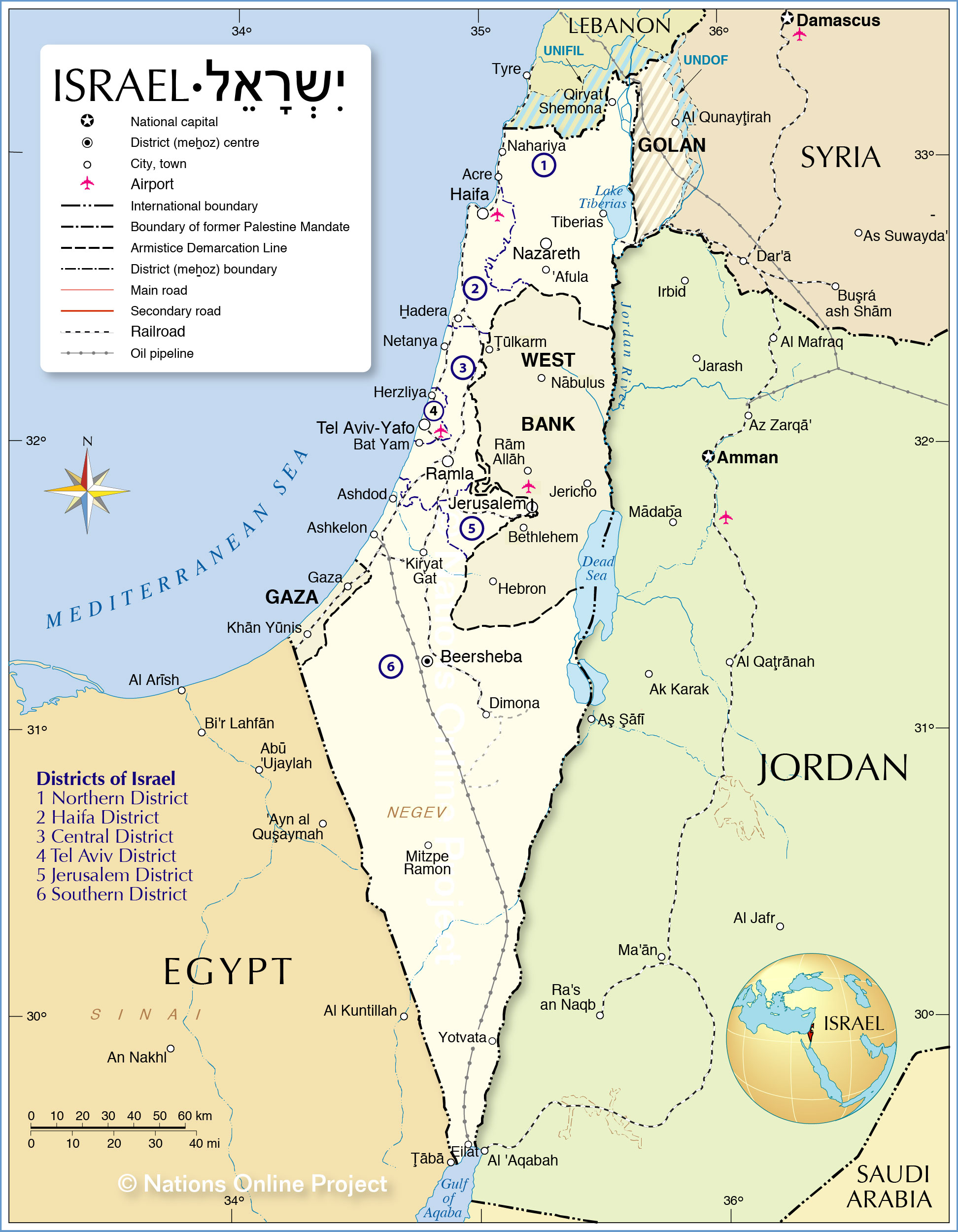
In the West – the Mediterranean Sea and the Gaza Strip; in the North – Lebanon and Syria; in the East – Jordon and Palestinian Authority autonomous territories; in the South – Egypt and the Red Sea. Israel holds territories that it captured in 1967 from Syria (the Golan Heights), Jordan (the West Bank) and Egypt (Gaza). In certain sections of the West Bank, an autonomous Palestinian Authority was established.

Government and Administration
The state of Israel is republic, defined as a parliamentary democracy with proportional representation. The legislative authority is the Knesset and the executive authority is the government. Since the country's inception, no political party has achieved an absolute majority, and thus, all of Israel's governments have been coalition governments. Israel has a president who is chosen by the Knesset once every seven years. His role is symbolic, having only the power to appoint the specific member of Knesset who determines the make-up of the government and to grant pardons.

Israel is administratively divided into 6 districts and 14 provinces. Judea, Samaria and Gaza have a separate administration. Regional authorities – municipalities and local or regional councils – have legal jurisdiction in their area, as well as responsibility for legal services.

The country has a mandatory education law, which states that all Israeli children are entitled to eleven free years of education, from kindergarten to grade ten. For higher learning, Israel has universities, colleges and institutions of religious instruction (yeshivot, midrashot).

The state of Israel has general health care, which provides a medical services package for every citizen. Enforcement of this is split between the Ministry of Health and the health maintenance organizations. Citizens pay a health tax to national insurance.

Official name: State of Israel
GPI: 22,145 square km
Population: 7,047,0001
Population growth rate: 1.39 percent
Demographics - Ethnicity Jewish 80.1 percent (32.1 percent born in Europe/North America, 20.8 percent born in Israel, 14.6 percent born in
Africa, 12.6 percent born in Asia). Non-Jewish (primarily Arab) 19.9 percent
Demographics - Religion Jewish 79 percent, Muslim 17.3 percent, Christian 2.1 percent, Druze 1.6 percent
Official languages: Hebrew, Arabic
Capital: Jerusalem
Government: Democratic republic
GDP: 523.852 billion NIS (as of 2004)
Estimated GDP growth rate: 3.9 percent (as of 2004)
Population under poverty line: 23.6 percent (as of 2004)
Inflation rate: 1.4 percent (as of 2004)
Unemployment rate: 10.7 percent (as of 2004)
Major industries: Software, telecommunications, weapons, phosphates, diamonds, agriculture
Imports: 34.41 billion dollars (as of 2004)
Exports: 36.84 billion dollars (as of 2004)

State of Israel: History
The State of Israel was established in 1948, amidst clashes with British Mandatory forces, Arab residents, and the Arab states which declared war on the nascent state on the very day of its founding.

The struggle for Israeli independence
In the wake of the Holocaust, the Jewish community in the Land of Israel, as well as the worldwide Zionist Movement, became increasingly cognizant of the fact that an independent and sovereign Jewish state was necessary to provide haven for the decimated Jewish nation.

The struggle was conducted on two fronts: an armed and political battle against the British Mandatory forces and a worldwide diplomatic and explanatory campaign, especially in the United States. Concurrently, much effort was invested in the Ha’apalah, the so-called “illegal” Jewish immigration to the Land of Israel, which was, in effect, an attack against British Mandatory policies.

Although Britain emerged victorious from World War II, the country was heavily hit in economic and social terms. Then, during the post-war years, the British Empire began to unravel. Once the British Raj ended in India, the Land of Israel lost much of its strategic importance, as the British no longer required a foothold adjacent to the Suez Canal.

In 1947, Britain requested that the UN retract the Mandate granted to Britain by the League of Nations. The UN appointed a special committee (UNESCOP), which recommended that the land west of the Jordan River be partitioned into two states: one Jewish and one Arab. On November 29, 1947, the General Assembly voted in favor of partition, which became known as Resolution 181. The Jewish community rejoiced, but the Arabs rejected the decision and began fighting the very next day.

According to Resolution 181, the British Mandate was set to expire on May 15, 1948. Since the 15th came out on Shabbat that year, the National Council convened on Friday, May 14, and declared the establishment of the State of Israel. The Declaration of Independence surveyed the historical connection between Am Yisrael (the nation of Israel) and its land and laid out the new state’s founding principles, but specific borders were not mentioned.

In addition, the Declaration of Independence introduced the name of the Jewish State: “We hereby declare that as from the termination of the Mandate… the present National Council shall act as the provisional administration and… shall constitute the Provisional Government of the Jewish State, to be called Israel.” The name was derived from the Land of Israel, the historic name of the Jewish national homeland.

Both the US and the USSR immediately recognized Israel, and additional countries followed suit. However, the Arab League was determined to destroy the new state, and on May 15, the Egyptian, Jordanian (then called Trans-Jordanian), Syrian, Iraqi and Lebanese armies, together with irregular forces from other Arab nations, invaded Israel.

The War of Independence thus evolved from a conflict between two resident populations to a full-fledged war between organized armies. Following a year and a half of fighting, an Armistice Agreement was reached between Israel and most of the Arab countries. Iraq, which continued to maintain a state of war with Israel, remained the lone exception.

From this point on, Israeli history was punctuated by wars with its Arab neighbors. Each war left a unique and lasting impact on Israel’s foreign affairs, economy, and social fabric.

From the War of Independence until the Sinai War (1948-1956)
Even as the war raged, the new state’s institutions were organized. For example, the Assembly of Representatives became the Knesset, and the National Council became the government, under the leadership of David Ben-Gurion. The government assumed the Mandatory Government’s authorities, but since the British left without arranging for an orderly transfer of power, the process was complex and difficult.

War of Independence: Hagana troops practicing
Meanwhile, large immigration waves reached Israeli shores. Between 1948 and 1951, approximately 700,000 Jews arrived; entire communities came from Libya, Yemen, Bulgaria, and Iraq. In 1950, the Law of Return, which granted full Israeli citizenship to every Jewish immigrant, was enacted. More immigrants arrived during 1955-1957, including around 160,000 North African and Eastern European Jews.

As a result of the economic costs of the war and absorbing the immigrants, an austerity program (1949-1952), which involved much rationing, was instituted. In 1952, the government signed a controversial reparations agreement with Germany. Despite the resulting political and public storm, the agreement increased the market’s momentum.

Arab infiltrations began almost immediately following the Armistice. Palestinian refugees would clandestinely cross Israel’s borders, in order to commit crimes and, later, also sabotage. Israel responded with reprisal attacks. Although the process escalated gradually, some historians cite the Black Arrow attack of February 28, 1955, as a key turning point. On that night, the IDF attacked an Egyptian army installation in the Gaza Strip; previously, most of the operations had been directed at Palestinian targets. The Egyptians began organizing bands of Palestinian infiltrators called “fedayeen”, which, in essence, comprised the first Palestinian terror organization.

In September 1955, Egypt signed an arms deal with Czechoslovakia. (In fact, Czechoslovakia, as a Soviet satellite, would be passing on weapons supplied by the USSR.) The huge amount of weaponry involved was unprecedented in the Middle East. Syria signed a similar deal, albeit on a smaller scale. Israelis sensed that “Round Two”, between Israel and its Arab neighbors, was fast approaching.

Israel began strengthening its military ties with France, since Ben-Gurion had insisted that Israel not go to war without the support of at least one major power. France was amenable to Israeli overtures, because the French blamed Egyptian leader Gamal Abed an-Nasser for much of their Algerian troubles. After Nasser nationalized the Suez Canal on July 26, 1956, Britain joined the conflict. On October 22, senior representatives of France, Britain and Israel met in Sèvres, outside of Paris, and agreed to go to war against Egypt. The Sinai War began on
October 29.

From the Sinai War until the Six Day War (1957-1967)
The Sinai War ended on November 6, 1956, and, to Israel’s chagrin, the world’s superpowers soon forced Israel to relinquish all its territorial achievements. The IDF pulled back from the Sinai and the Gaza Strip in March 1957, and a UN Emergency Force was mobilized along the border.

A period of relative quiet ensued, and Israel strengthened its economy and developed the national infrastructure during the interlude. Also, the Eichmann Trial, which occurred during this time, increased Israeli sensitivity to the Holocaust. Meanwhile, by 1966, another 300,000 immigrants had arrived. However, in the wake of a severe recession in 1965, immigration rates dropped. Several scandals rocked the political establishment; in particular, the infamous “Lavon Affair” sent shockwaves up to the highest echelons. David Ben-Gurion resigned and left the Mapai party; Levi Eshkol became the next prime minister. Finally, Israel sent out diplomatic feelers to a number of newly independent Asian and African nations, as well as to several South American countries.

In 1964, neighboring Arabs began infiltrating the country again, after ceasing the phenomenon in the wake of the Sinai War. In addition, the Palestinians established the al-Fatah organization, and terrorists entered Israeli territory. The Palestine Liberation Organization (PLO), with al-Fatah at its core, was founded at the end of 1964. Nevertheless, the number of attacks was lower that during 1954-1956, and there were fewer reprisal raids.

A more serious problem was meanwhile developing on the northern border. Following the completion of the National Water Carrier, both Syria and Lebanon repeatedly attempted to divert the sources of the Jordan River; Israel responded with fire. The situation quickly deteriorated, and the IDF and Syrian army were involved in heavy fighting, referred to as “the War for Water”.

At the same time, Egypt expressed concern over the nuclear reactor that Israel was allegedly building near Dimona. After an air battle over the Golan Heights on April 7, 1967, during which six Syrian aircraft were downed, Egypt announced that it was allying itself with Syria. Thus, on May 15, Egyptian forces entered the Sinai, in violation of the agreement signed in 1957, in the wake of the Sinai War. In addition, Egypt closed the Straits of Tiran to Israeli ships and ordered UN forces to withdraw from their positions along the border.

IDF Chief Rabbi, Goren, at the Kotel
Israel realized that a war was imminent, and the mood throughout the country was somber and grave. The IDF called up the reserves, and Prime Minister Eshkol, aware that he had not managed to inspire confidence, transferred the defense portfolio to Moshe Dayan. A historical first was achieved when the Herut party joined the newly formed national unity government.

On June 6, the Six Day War broke out, as the IDF went to war against Egypt, Syria, and Jordan.

From the Six Day War until the Yom Kippur War (1967-1973)
In the wake of Israel’s stunning victory in the Six Day War, unbridled euphoria swept through the country. The IDF had acquired the Golan Heights, Judea, Samaria, the Gaza Strip, and the entire Sinai Peninsula up to the Suez Canal (which had been closed to shipping). But most significantly, Jerusalem had been reunified, and for the first time since 1948, Jews were able to pray at the Western Wall. Israel immediately annexed the eastern portion of Jerusalem but declared that other territories were being held in the hope of a peace treaty. “We are waiting for a telephone call from the Arabs,” Dayan asserted.

Yet, despite Dayan’s declaration, Jewish communities were built in the territories. The government officially authorized settlement of the Golan Heights, the Jordan Valley, southern Sinai, and, eventually, also the area around Rafah. However, official policy was more ambiguous in Judea and Samaria, where the government preferred that Jews not move into areas heavily populated by Arabs. Nevertheless, many such settlements were established, with considerable support from numerous government ministers as well as Knesset members. In addition, a construction wave was initiated in eastern Jerusalem, which the Arabs and much of the world insisted on calling “occupied territory”.

In November 1967, the UN Security Council accepted Resolution 242, which included the concept of “land for peace”, but the vote had no practical significance. US Secretary of State William Rogers introduced another peace initiative, which also never took effect but led to the unraveling of the Israeli national unity government. Previously, in February 1969, Prime Minister Eshkol passed away, and Golda Meir took his place.

The PLO built bases in the eastern Jordan Valley and dispatched terrorists into Israeli territory. Several pursuits were launched in the valley (which became known as “pursuit land”) during 1968-1970, until Jordan expelled the terrorists following the “Black September” riots of 1970. Most Palestinian organizations relocated to southern Lebanon and Syria.

Arab terrorism also concentrated on Israeli civilian aviation and targets throughout the world, and high profile attacks were committed in Israel itself, sometimes with the help and support of foreign terror organizations. Several glaring examples included the hijacking of an El Al airplane to Algeria on July 23, 1968, which was the first of its kind; the massacre at Lod Airport on May 30, 1972, which was committed by Japanese terrorists masquerading as passengers; and the abduction and subsequent murder of 11 Israeli Olympians in Munich on September 5, 1972.

In March 1969, Egyptian President Nasser instructed his army on the Suez Canal front to open fire on all exposed targets. Thus began the War of Attrition, which mainly comprised heavy exchanges of fire across the canal, as well as several raids behind enemy lines (on both sides)and Israeli air attacks deep into Egyptian territory. The US was forced to intervene and impose the above mentioned Rogers plan. In August 1970, the war ended, and Nasser died a few weeks later.

In spite of the fighting along the borders, many Israelis felt safe and secure. The country had complete confidence in the IDF’s ability to protect the nation. In fact, for the first time since the establishment of the state, the public believed that Israel’s existence was guaranteed. The severe recession of the prewar period made way for an era of economic growth, and many citizens trusted that the situation would only continue.


From the Yom Kippur War until the Political Upset (1973-1977)
Disillusionment was exceptionally painful. Egypt and Syria clandestinely planned a full-fledged surprise attack on Israel, hoping to retrieve the territories they had lost during the Six Day War. The working assumption was that even if the Egyptian and Syrian armies were unable to regain the land themselves, Israel would be forced to give up the territories, due to the international pressure which would surely result from the war. On Yom Kippur 5733, October 6, 1973, the Yom Kippur War broke out.

The IDF was not prepared. Even though the army soon recovered, – the territory lost on the Golan Heights was regained within three days, and ten days after the fighting began, IDF forces penetrated Egyptian territory, although Egyptian forces were not yet pushed out of the Sinai – nevertheless, the sense of defeat, which had characterized the first few days of fighting, did not abate even once the war had ended.

In the aftermath of the war, an investigative committee, headed by Chief Justice Shimon Agranat, was appointed. The so-called Agranat Commission made several recommendations concerning high-ranking military leaders, including Chief of Staff David Elazar, but refrained from discussing the political echelon.

A number of Arab countries sent troops to fight alongside Egypt and Syria. (Jordan notably stayed away.) In addition, the oil-rich Arab nations, collectively known as OAPEC, announced that they were decreasing production and placing an oil embargo on the US and Holland, due to their support of Israel. Shockwaves raced around the world; the so-called “first energy crisis” had begun. The Organization of Petroleum Exporting Countries (OPEC), which included all the OAPEC members, took advantage of the Arab embargo. Crude oil prices quadrupled within just a few months.

The energy crisis threatened most of the world’s non-OPEC members, many of whom blamed Israel. As a result of the war, which was perceived in some circles as an Arab victory, and the deteriorating global economy, Israel lost much of its international standing. Furthermore, the rising oil prices directly affected Israel’s economy, which was largely dependent on oil imports.

Nonetheless, Israel managed to weather the war’s economic fallout, mainly due to unprecedented American aid. Since 1974, American foreign aid to Israel, comprised of both military and economic aid, has equaled several billion dollars a year. Still, the economic upswing of the prewar period was considerably overturned.

The settlement enterprise continued, occasionally accompanied by clashes with the government in places such as Kedumim. Terror persisted as well, including the infamous hijacking of an Air France plane to Entebbe, Uganda. The subsequent IDF rescue mission on July 4, 1976, made headlines throughout the world. On June 7, 1981, Israel conducted another daring raid and destroyed Iraq’s nuclear reactor a short while before it was scheduled to go live.

The Alignment Party won a proportional majority in Israeli elections held shortly after the war. However, the public no longer trusted the party’s veteran leadership, and Prime Minister Meir and Defense Minister Dayan were forced to resign. Yitzchak Rabin became the next prime
minister.

From the Political Upset until the Lebanon War (1977-1982)
The elections of 1977 have been described as a dramatic upset; for the first time in Israeli history, a group of center/right parties, collectively known as the Likud, formed a government. Menachem Begin, who had led the opposition since the state’s founding, became the prime minister. Although the upset can be attributed to the aftershocks of the Yom Kippur War, other factors also contributed to the political turnaround. Wide swaths of the public felt disenfranchised, and great rifts were becoming apparent throughout Israeli society.

Israeli PM Begin with Egyptian President, Saadat in Camp David
A radical turnabout in Israeli-Arab relations occurred towards the end of 1977. Following clandestine talks between Israeli and Egyptian officials, Egyptian President Anwar Sadat publicly announced that he intended to visit Jerusalem, address the Knesset, and discuss peace.
Sadat arrived in Israel on November 19, and Egypt and Israel launched peace talks, under American auspices. Two years later, in 1979, the two countries signed the Camp David Accords. Virulent public storms arose in the wake of the subsequent Israeli withdrawal from the Sinai and the evacuation of Yamit in 1982. A series of governmental countermeasures included the enactment of the Jerusalem Law of 1980 and the declaration of Israeli sovereignty over the Golan Heights in 1981.

One major social development at that time was the growing strength of the hared sector. Prior to 1977, this closed community had been elatively insignificant; although the Haredim always enjoyed Knesset representation, Haredi involvement in the nation’s political life was minimal. However, in 1977, Begin invited Agudat Yisrael, a Haredi party, to join his coalition, even though the Dash party, comprised of former Alignment members, was larger. As a result, the Haredi public’s ranks swelled, and its members became more politically and economically active.

The Lebanese civil war, which had begun in 1975, grew steadily worse, and the northern terrorists became bolder. Israel’s anti-terrorist activities included establishing the South Lebanese Army (SLA) under Saad Hadad’s command and opening the so-called “Good Fence”. Nevertheless, the terror continued, and on March 14, 1978, the IDF entered Lebanese territory as part of Operation Litani. Israel retreated approximately three months later, after a UN peacekeeping force was stationed as a buffer between the Israeli border and PLO positions throughout southern Lebanon. (In effect, the buffer became an SLA-controlled security zone.)

The arrangement soon proved ineffective, and on June 6, 1982, following an assassination attempt on the Israeli ambassador to Britain, the Lebanon War began.

From the Lebanon War until the Oslo Accords (1982-1995)
As opposed to the previous Arab-Israeli wars, the Lebanon War did not end with either a ceasefire or an armistice agreement. In fact, Israel’s objectives were not fully achieved. Although the IDF controlled about half of Lebanon’s territory, Israel had not managed to either destroy the PLO or impose a “new order” on Lebanon. Prior to the war, Israel had envisioned a sovereign Christian-controlled Lebanon which would sign a peace treaty with Israel and conduct full diplomatic relations. However, Lebanese Phalangist leader Bashir Gamayel’s assassination on September 14 shattered all Israeli illusions.

In the wake of the assassination, Christian forces massacred Palestinian residents of the Sabra and Shatila refugee camps, thus igniting a storm of protests in Israel and throughout the world. The Israeli government and the IDF leadership were accused of ignoring the massacre, and the Kahan Commission, appointed to investigate the killings, recommended that Defense Minister Ariel Sharon be dismissed.

IDF forces in Lebanon came under continuous fire and were the targets of terror attacks committed by the assorted paramilitary organizations then operating in Lebanon, including those that had initially welcomed the IDF with flowers. In 1985, the IDF began slowly retreating southward, and a “security zone”, under joint IDF-SLA control, was established in southern Lebanon. Relative quiet prevailed on Israel’s northern border, but flare-ups persisted within the security zone.

Socially and economically, this was a tempestuous period in Israeli history. The Likud government, which adhered to a liberal worldview, oversaw certain economic steps which quickly led to a galloping inflation, which had reached 400% by 1983. During that same year, bank shares collapsed, and the Israeli economy was in chaos. Strikes were rampant, and emigration increased. In August 1983, the Lebanese quagmire and the country’s desperate economic straits caused Begin to resign, citing “personal reasons”. Yitzchak Shamir became the next prime minister.

The 1984 general elections resulted in a “hung” Knesset, and a national unity government was formed on a rotation basis. Shimon Peres was the prime minister for the first two years, and then Shamir, maintaining the same coalition, replaced him in October 1986. In order to stabilize the economy, the national unity government took a number of drastic steps, including the implementation of a comprehensive price freeze, and managed to curb the inflation. Nevertheless, the economy did not immediately rebound. During the 1988 elections, the Likud achieved a very narrow margin of victory. As a result, another unity government was formed, but this time, there was to be no rotation. In March 1990, Peres, seeking to regain power, tried to cause the Shamir government to fall. However, the so-called “stinking maneuver” failed, and the Labor party found itself back in the opposition.

Although some Palestinian Arabs had become members of terror organizations and a small number had committed terror attacks, most refrained from protesting Israeli rule. In December 1987, however, everything changed. A wave of uprisings, called the Intifada, broke out in Judea, Samaria and the Gaza Strip. Israel proved unable to quell the riots. Shamir even agreed to participate in the Madrid Conference, an international peace conference which included Palestinian representatives, albeit as part of the Jordanian delegation. However, the Palestinian uprising continued unabated.

In early 1991, Israel became an unwilling participant in the First Gulf War. Iraq responded to Coalition attacks by launching Scud missiles into Israel. Although there were few casualities and property damage was relatively minimal, the constant fear of unconventional weapons led to widespread panic. Nonetheless, life quickly returned to normal once the war had ended.

Rabin replaced Peres as Labor party chairman and garnered a majority in the 1992 elections, largely as a result of the optimism generated by the collapse of the Soviet Union and the ensuing large immigration wave which began in late 1989. The economy flourished, and the government’s primary concern was the Intifada.

Clandestine talks between Israeli and Palestinian officials in Oslo, Norway, climaxed in the Oslo Accords. As part of the controversial agreement, Israel accepted the PLO as the official representative of the Palestinians and granted it autonomy over a large portion of Judea, Samaria, and the Gaza Strip. In return, the Palestinians promised to recognize Israel’s existence, to refrain from further terrorist activities, and to end the Intifada. The Accords were signed in Washington on the White House lawn on September 13, 1993, accompanied by a much-hyped handshake between Rabin and PLO leader Yasser Arafat.

From the Oslo Accords (1993) until Today
The Oslo Accords significantly impacted Israel. As per the agreement, the Palestinian Authority (PA) was founded. Shortly thereafter, in October 1994, Israel signed an historic peace treaty with Jordan, and tentative peace talks were initiated with Syria. Israel’s international standing improved dramatically, and immigration continued to soar. In the period between 1990 and 1995, over 500,000 immigrants arrived from Eastern Europe and other locations. In addition, the economy boomed.

Yet, Israel paid dearly for the Accords. The Palestinian attacks continued unabated, and Israel accused Arafat and the PA of not preventing the terror. In addition, the PA established military or paramilitary armies in excess of their Oslo mandate. The Palestinians, meanwhile, claimed that new Israeli settlements violated Oslo “in spirit”.

On November 4, 1995, the so-called “peace process” exploded when Rabin was shot by an Israeli Jew. Peres, who took his place as prime minister, advanced the elections to the beginning of 1996 (direct prime ministerial elections had been introduced in the meantime) and was defeated by the Likud’s Binyamin Netanyahu, whose political views were diametrically opposed to Rabin’s and Peres’. The peace process advanced sporadically at best, and many more Israelis began to vociferously oppose the Oslo Accords. The new government did not last, and Netanyahu resigned in 1999. In May of that year, Ehud Barak was elected as the next prime minister.

Barak was unable to get the peace process back on track. However, he did keep his election promise of an Israeli withdrawal from Lebanon. In May 2000, the last IDF soldiers retreated to the Israeli border; the SLA collapsed; and an uneasy quiet reigned along the northern border. Although the Syrian talks resumed, no breakthrough was achieved. US President Bill Clinton attempted to jumpstart the peace process and, modeling himself after his predecessor Jimmy Carter in 1978, invited Barak and Arafat to Camp David in July 2000. However, the talks failed, and shortly thereafter, in September, the Intifada resumed with a vengeance. Barak resigned at the end of the year, and new elections were held in early 2001. In the meantime, the direct election law had been revoked. The Likud, headed by Ariel Sharon, returned to power.

The renewed Intifada hit Israel hard. Seemingly overnight, the economy plummeted from accelerated growth into a recession (which was further exacerbated by the global dot-com crash); immigration decreased; and Israeli society became more fractured. Sharon’s Likud garnered a large majority in the 2003 elections, and he remained prime minister. Meanwhile, the so-called “Al-Aksa Intifada” raged on, and Israeli efforts to decrease the terror (such as “targeted killing”, a euphemism for assassinating terrorists) had little to no effect.

The Oslo Accord: Rabin, Arafat and Clinton
In March 2003, Mahmoud Abbas, also known as Abu Mazen, became PA prime minister under Arafat, and many were optimistic that change was in the air. By that time, the Israeli government had declared that Arafat was “irrelevant”. The Palestinians declared a “hudna” (a temporary ceasefire of sorts) and claimed that they were refraining from terror attacks. At the same time, Israel pulled back some of its forces from PA-controlled territory. However, the hudna led nowhere; within a very short while, the Palestinians were once again committing terror attacks, and the Israelis were forced to respond.

Israeli Society: Jewish-Arab Relations
After the War of Independence and the signing of the Armistice Agreement in 1949, officials noted that approximately 500,000 Arabs had fled from the area which was now included within Israeli borders.

The reasons for the Arab flight are sharply disputed. Israel supports the accepted Zionist position that most, if not all, of the Arabs left on their own volition, in order to distance themselves from the fighting and so as to avoid remaining under Jewish rule. In fact, the Arab leadership has been quoted as urging the refugees to flee (and promising them that they would be able to quickly return). Nevertheless, others claim that the Arabs were either forcefully removed or left after being threatened. Some even go so far as to allege incidents of violence against the refugees (including the now-widely debunked Dir Yassin incident).

In any event, the refugee problem was created in the wake of the war. Very few refugees, specifically the wealthy and those with close relatives in the neighboring countries, managed to integrate in their host nations. The rest of them were herded into refugee camps in Judea, Samaria, the Gaza Strip, southern Lebanon and Jordan.

The United Nations Relief and Works Agency for Palestine Refugees in the Near East (UNRWA), which was established to take care of the refugees’ needs, still operates today. Some Arab villagers, such as the residents of Ikrit and Biram, were controversially evacuated by Israeli security forces; the Ikrit and Biram villagers continue in their decades-long attempt to return to their former homes. Approximately 150,000 Arabs, who were left without their social, political and economic leaders, remained within Israeli borders and instantaneously became a minority.

Demography
Israel’s non-Jewish citizens are not all cut from the same cloth. Most notably, they divide along religious lines; at the end of 2001, 15.4 percent of the total population was Moslem, 1.7 percent was Christian, and 1.6 percent was Druze. Moreover, although most of the Moslems are Sunnis, there are also fewer than 5000 Circassians. Similarly, the Christian population is split between the Greek Orthodox (33 percent of all Christians), Greek Catholics (25 percent), Roman Catholics (20 percent), Maronites (around 5 percent, including many former SLA fighters who fled to Israel in 2000), and others such as Protestants, Armenians, Ethiopian Copts and more. Also, the non-Jewish citizens include city-dwellers, villagers and Bedouins.

Most Israeli Arabs reside in the Galil, the Nahal Iron area, the northern plain (the so-called “little triangle”), the Jerusalem corridor, and the Negev. In addition, some Arabs live in mixed cities, such as Haifa, Jaffa, Ramle, Acre, and others. Most Bedouin tribes can be found in the northern Negev and the Lower Galilee. The Druze are concentrated in the Carmel, the Galilee, and several Golan Heights villages.

Unequal citizens
In the Declaration of Independence, Israel called out to Arab residents of the state to keep the peace and to take part in building the state. Arab residents were offered full and equal citizenship and relative representation in all state institutions, both temporary and permanent. Furthermore, the State of Israel, established as a Jewish state, recognized the right of the Arab minority to religious autonomy. In 1952, the Citizenship Law guaranteed the rights of Arabs who had resided in Israel at the time of the state’s establishment. Israeli Arabs are officially considered full citizens, and they may vote and be elected to the Knesset and local governments.

Nevertheless, historical enmity and political-security considerations ensured that Israeli Arabs would remain under constant suspicion and be treated, upon occasion, with inequality. Thus, for example, when the Arabs parties garnered eight seats in the 1951 elections for the second Knesset, David Ben-Gurion insisted that he would not form a government based on Arab votes. In fact, the policies of most subsequent Israeli governments largely reflected Ben-Gurion’s declaration.

Until 1966, Israeli Arabs lived under military rule, which oversaw their every move and action and impinged on their basic rights. Moreover, starting from the 1950’s, the government began systematically expropriating Arab lands under the Absentee Property Law. Dozens of Jewish settlements later arose on these lands.

Israeli Arabs’ sense of grievance only grew in the wake of the so-called Kfar Kassem massacre on the first day of the Sinai War in 1956. 49 villagers, who remained outdoors after curfew, were shot, and Israeli Arabs were enraged by the light sentences imposed on those responsible for the killings. Furthermore, Israeli Arabs felt that their culture was marginalized and that they were discriminated against in terms of funding, infrastructure development and employment.

The Six Day War
The late 1960’s and early 1970’s marked a significant improvement in Israeli-Arab life. First of all, military rule was abolished. Also, in the wake of the Six Day War, Judea, Samaria and the Gaza Strip became accessible, and Israeli Arabs were able to renew their familial and economic ties with the Palestinians. In addition, as a result of the Mandatory Education Law, Arab illiteracy rates dropped dramatically from almost 50 percent in the 1960’s to 35 percent during the 1970’s and then to about 10 percent in the 1990’s. Moreover, the healthcare system in the Arab sector was considerably upgraded, and other parameters indicated that Arab quality of life had indeed noticeably improved

However, a new crisis arose with the advent of the so-called Land Day events in 1976. Following a series of governmental decisions regarding Arab land expropriation, Israeli Arabs rioted violently, and several protestors were killed during the disturbances. Since then, the annual Land Day commemorations have become a yearly violent flash point between Israeli Arabs and police and defense officials. Also, these events are considered to be a fairly accurate gauge of Arab-state relations.

Palestinian identification
By the early 1980’s, Israeli Arabs had become ever increasingly segregated from the rest of the nation. The Lebanon War in general, and the Sabra and Shatila episode in particular, stimulated Israeli-Arab empathy for the Palestinian cause. During the so-called first Intifada, which broke out in 1987, Israeli Arabs expressed solidarity with their brethren in Judea and Samaria and began to identify themselves as Palestinians.

The Oslo Accords of 1993 had two major impacts on Israeli Arabs. On one hand, the founding of the Palestinian Authority (PA) further increased Israeli Arabs’ sense of Palestinian national identification. On the other hand, Israeli Arabs realized that they were being essentially ignored by the Palestinian leadership and that Israeli-Arab interests were not addressed during the Oslo process negotiations. As a result, a considerable number of organizations were established to handle Israeli-Arab needs and to bring attention to their minority rights as Israeli citizens.

The October riots
Jewish-Arab relations deteriorated rapidly during the bloody riots of October 2000. Then-opposition chairman Ariel Sharon’s controversial visit to the Temple Mount (which either triggered or was used as an excuse for a raging Palestinian uprising) enraged the Arab sector.

Shortly thereafter, thousands of Israeli Arabs participated in violent disturbances. Efforts were made to attack Jewish communities; major highways were closed to Jewish traffic; numerous structures were destroyed; and a Jew was killed when a rock was thrown at his vehicle.

Israeli police attempts to quell the riots led to the deaths of 13 Arab citizens; many more were wounded. Meanwhile, some angry Jews demonstrated against their Arab neighbors. Meanwhile, Palestinians in Judea, Samaria and the Gaza Strip continued to clash with Israeli forces (in the so-called “Al-Aksa Intifada”), and Israeli Arabs evidenced unprecedented levels of cooperation and identification with their brethren on the other side of the Green Line. As a result, suspicions and hostility between Israeli Jews and Arabs dramatically increased.

Israeli Arabs expressed their feelings by largely boycotting the 2001 prime ministerial elections, thus emphasizing their sense of alienation from the Jewish establishment. Then-Prime Minister Ehud Barak set up the Or Commission to investigate the circumstances of the riots and as well as the governmental response, including police behavior, which led to the death of 13 Israeli citizens.

In 2003, the Or Commission publicized its findings, which included a review of Jewish-Arab relations:

“Minority-majority relationships are problematic in every place, and especially in a state that defines itself according to the majority’s nationality… In any event, establishing reasonable harmony in majority-minority relations is a difficult task imposed on every societal
sector. This task requires a particular effort from state institutions which express the majority’s hegemony… Refraining from such an effort, or only partially attempting it, creates a sense of neglect and a reality of neglect among the minority, which are likely to become more
severe with the passage of time. These phenomena also characterize the Arab minority in the State of Israel, which, in many respects, is the victim of discrimination.”

Arab leaders were skeptical about the report and asserted that the commission was too lenient with those responsible for causing the demonstrators’ deaths. Meanwhile, Israeli Arabs claim that they still suffer from discrimination in terms of public office advancement, employment opportunities, and limited budgets. They cite 2003 statistics which indicate that every other Arab child lives below the poverty line and note that Arab sector unemployment rates are much higher than the national average.

Israeli Arabs also complain about their treatment with respect to construction and urban expansion. According to Arab claims, the government is discriminatory when issuing building permits and does not allow Arabs to either build homes or expand existing structures in order to accommodate natural growth. As a result, Arabs say, they are forced to construct illegally; the authorities, in turn, are then required to tear down these structures. In 2003, over 30,000 houses were built without a permit.

Concurrently, there has been a worrisome increase in the number of Arab citizens of Israel who have participated or indicate that they are willing to participate in terror attacks against Jewish targets. The first Israeli-Arab suicide bomber acted in September 2001, and during 2002 alone, thirty-two terror attempts by Israeli Arabs were uncovered. In addition, Islamism is making significant inroads within Israeli-Arab society. This development can be attributed to the results of the Six Day War (which allowed Israeli Arabs to have access to holy Islamic sites in Jerusalem), the newly permitted pilgrimage to Mecca in the late 1970’s, the Arab sector’s social and economic plight and sense of discrimination, and awakening fundamentalism throughout the Muslim world, including a growing religiously-oriented leadership. According to Israeli officials, Israeli Arabs have been strengthening their ties with fundamentalists throughout the Moslem world, thus becoming more politically and socially extremist.


The Hope - Hatikva - The Jewish Anthem

The Hope - "Hatikva"

Kol ode balevav As long as the Jewish spirit is yearning deep in the heart,
P'nimah - Nefesh Yehudi homiyah

Ulfa'atey mizrach kadimah With eyes turned toward the East, looking toward Zion,
Ayin l'tzion tzofiyah.

Ode lo avdah tikvatenu Then our hope - the two-thousand-year-old hope -
Hatikvah bat shnot alpayim: will not be lost:

L'hiyot am chofshi b'artzenu - To be a free people in our land,
Eretz Tzion v'Yerushalayim. The land of Zion and Jerusalem.

The Silent Partners Of Hitler

All that is necessary For evil to triumph is for good men to do nothing.
~Edmond Burke~


The mass of ordinary Germans did know about the evolving terror of Hitler's Holocaust, according to a new research study.

They knew concentration camps were full of Jewish people who were stigmatised as sub-human and race-defilers.

They knew that these, like other groups and minorities, were being killed out of hand.

They knew that Adolf Hitler had repeatedly forecast the extermination of every Jew on German soil.

They knew these details because they had read about them.

They knew because the camps and the measures which led up to them had been prominently and proudly reported step by step in thousands of officially-inspired German media articles and posters according to the study.

BUT THEY ARE SAYING: WE DIDN'T KNOW!!!!

And now, we got "Radical Islam", the same racism, the same ideology, the same principles... Don't say you didn't know....


The Modern anti-Semitism

Anti-Semitism did not disappear with the establishment of a Jewish state, when Jews became people like others. Modern anti-Semitism does not look like the traditional version. Its line of thinking is, “The Israelis have got more than they deserve. They should stop arguing with the Arabs and be glad we gave them any state at all.” Israeli security issues are only relatively important to her allies: terrorists do not blow up Christian children in Israeli school buses. The allies are willing to help, but if treaty-based security does not work out, they lose nothing. Nothing happens to them if Israel is destroyed. Centuries ago, Israel asked for the protection of a superpower, Assyria, which soon annexed it. The same happened with Rome. Israel should not ignore history’s lessons and be aware of how America manipulates her. Israel must be strong since militant anti-Semitism is alive. Centuries after the medieval mass murders of Jews, civilized people were sure the atrocities would not recur. Then in the mid-seventeenth century, a throng led by Bohdan Hmelnitsky (the hero of modern Ukraine)

decimated the Jewish population of Ukraine, claiming to have killed a million Jews. Decades after Russian pogroms, written off as an aberration perpetrated by barbarous Mongolized mobs, no one imagined the highly educated Germans would bring about the Holocaust. It happened, however, only sixty years ago, not long enough to hope for a change of mentality. The anti-Semites are never quiet for long. A new clash is neither impossible nor unlikely but all but inevitable. Jews must make it a fight, not an atrocity. Adherence to Judaism makes the Jews defiantly different from others, and will perpetually cause hatred. Anti-Semitism does not evaporate from societies and then re-appear. It is always brewing, ready to burn. Jewish organizations are wrong in trying to suppress anti-Semitism to invisibility. They fool Jews, not Gentiles. Jews forget that they must be strong to survive, and resettle in Diaspora and assimilate – until the next wave of atrocities. Even to the extent of cooperating with Neo-Nazi organizations, the Jews must keep anti-Semitism on the surface: a controllable, but clear danger.


Adolf Eichmann

The kidnapping of Nazi criminal Adolf Eichmann by the Israeli Mossad was one of it's most known coups of the 1960's. Eichmann was one of Nazi Germany's most notorious war criminals, who was personally responsible for the killing of millions of Jews in occupied Europe. This book brings the story of Isser Harel, Israel's legendary intelligence spymaster who was Head of the Mossad at the time of the operation.

Harel's story of this complex action is told in a simple and moving way. The editor Shlomo Shpiro, an Israeli intelligence expert, places in his detailed introduction the operation in its overall historical context. The new books contains, for the first time, the real names of all Mossad personnel involved, as well as the astounding facts about the involvement of West Germany in this operation. A must reading not only to those interested in the hunt for Nazi criminals but also to everyone interested in real, as opposed to fictional, intelligence work.

SOON OR LATER ALL OF U NAZIS, WILL GET THE SAME... LONG LIVE ISRAEL!


Anti Zionism = Anti Semitism

Anti-Zionism has become the most dangerous and effective form of anti- Semitism in our time, through its systematic de-legitimization, defamation, and demonetization of Israel. Although not a priory anti-Semitic, the calls to dismantle the Jewish state, whether they come from Muslims, the Left, or the radical Right, increasingly rely on an anti-Semitic stereotypization of classic themes, such as the manipulative "Jewish lobby," the Jewish/Zionist "world conspiracy," and Jewish/Israeli "warmongers."

One major driving force of this anti-Zionism/anti-Semitism is the transformation of the Palestinian cause into a "holy war"; another source is anti-Americanism linked with fundamentalist Islamism. In the current context, classic conspiracy theories, such as the Protocols of the Elders of Zion, are enjoying a spectacular revival.

The common denominator of the new anti-Zionism has been the systematic effort to criminalize Israeli and Jewish behavior, so as to place it beyond the pale of civilized and acceptable conduct.

Indeed, Israel is today the only state on the face of this planet that such a large number of disparate people wish to see disappear - itself a chilling reminder of the Nazi propaganda of the 1930s. The most virulent expressions of this "exterminationist" or genocidal anti-Zionism have come from the Arab-Muslim world, which is the historical heir of the earlier 20th-century forms of totalitarian anti-Semitism in Hitler's Germany and the Soviet Union.

Even "moderate" Muslim statesmen such as Mahathir Mohammad have publicly repeated the classic anti-Semitic belief that "Jews rule the world" while eliciting virtually no objections in the Islamic world.

The more radical Islamists from Al-Qaida to the Palestinian Hamas go much further since they fuse indiscriminate terror, suicide bombings, and a Protocols of Zion style of anti-Semitism with the ideology of jihad. In this case, the so called "war against Zionism" unmistakably embraces the total demonization of the "Jewish other": as the "enemy of mankind," as deadly poisonous snakes, as barbarian "Nazis" and "Holocaust manipulators" who control international finance, not to mention America, or the Western mass media, while they busily instigate wars and revolutions to achieve world domination. Such conspiracy theories sailing under "anti-Zionist" colors constitute a highly toxic, even murderous worldview that today is linked to religious fanaticism and a worldwide revolutionary agenda.

The same demonizing stereotypes can, however, be found in moderate pro-Western Egypt (home to the Protocols based anti-Semitic soap opera Rider without a Horse), secular Baathist Syria, conservative Wahhabite Saudi Arabia, and the Shiite fundamentalist Iran of the ayatollahs. This is an ideological anti-Zionism that seeks both the annihilation of Israel and a world "liberated from the Jews" - in other words, it is a totalist form of anti-Semitism.

Palestinian suffering and Arab "anti-Zionism" have helped to infect Europe with an old-new version of anti-Semitism in which Jews are rapacious, bloodsucking colonialists. The theme is that Jews were rootless, imperialist invaders who came to Palestine to conquer the land by brute force, to expel or "cleanse" it of its natives. They are the modern "Crusaders" with no legitimate rights to the soil - an alien transplant, absolutely foreign to the region.

They succeeded only because of a gigantic occult conspiracy in which the Zionists manipulated Great Britain and subsequently America. This is a typically anti-Semitic narrative of which Hitler might have approved - widely believed around the world, even credited by millions of educated people in the West.

The popularity of the Protocols today is the one telling symptom of the growing merger between anti-Semitism and anti-Zionism. Zionism is increasingly depicted in some mainstream media as being "criminal" in its essence as well as its behavior.


Related Posts Plugin for WordPress, Blogger...

My Videos Bar

Breaking News