'If the Arabs put down their weapons today, there would be no more violence. If the Jews put down their weapons today, there would be no more Israel'
~Benjamin Netanyahu~
Israel - My Love
Quotes About "Palestine"
Remember:
Israel is bad!
Its existence keeps reminding Muslims what a bunch of losers they are.
~~~~~~~~~~~~~~~~~~~~~~~~~~~~~~
"There will be no peace until they will love their children more than they hate us."
-Golda Meir-
~~~~~~~~~~~~~~~~~~~~~~~~~~~~~~
'If the Arabs put down their weapons today, there would be no more violence. If the Jews put down their weapons today, there would be no more Israel'
~Benjamin Netanyahu~
~~~~~~~~~~~~~~~~~~~~~~~~~~~~~~~
"Peace of us means the destruction of Israel.
We are preparing for an all out war, a war which will last for generations.
~Yasser Arafat~
~~~~~~~~~~~~~~~~~~~~~~~~~~~~~~
"The Palestinian people have no national identity.
I, Yasser Arafat, man of destiny, will give them that identity through conflict with Israel."
~ Yasser Arafat ~
~~~~~~~~~~~~~~~~~~~~~~~
"The Palestinian people does not exist. The creation of a Palestinian state is only a means for continuing our struggle against the state of Israel. For our Arab unity. In reality today there is no difference between Jordanians, Palestinians, Syrians and Lebanese. Only for political and tactical reasons do we speak today about the existence of Palestinian people, since Arab national interest demand that we posit the existence of a distinct 'Palestinian people' to oppose Zionism".
According to the Torah (Lev. 23:15), we are obligated to count the days from the second night of Passover to the day before Shavu'ot, seven full weeks. This period is known as the Counting of the Omer. An omer is a unit of measure. On the second day of Passover, in the days of the Temple, an omer of barley was cut down and brought to the Temple as an offering. Every night, from the second night of Passover to the night before Shavu'ot, we recite a blessing and state the count of the omer in both weeks and days. So on the 16th day, you would say, "Today is sixteen days, which is two weeks and two days of the Omer."
The counting is intended to remind us of the link between Passover, which commemorates the Exodus, and Shavu'ot, which commemorates the giving of the Torah. It reminds us that the redemption from slavery was not complete until we received the Torah.
This period is a time of partial mourning, during which weddings, parties, and dinners with dancing are not conducted, in memory of a plague during the lifetime of Rabbi Akiba. Haircuts during this time are also forbidden. The 33rd day of the Omer (the eighteenth of Iyar) is a minor holiday commemorating a break in the plague. The holiday is known as Lag b'Omer. The mourning practices of the omer period are lifted on that date. The word "Lag" is not really a word; it is the number 33 in Hebrew, as if you were to call the Fourth of July "IV July" (IV being 4 in Roman numerals). See Hebrew Alphabet for more information about using letters as numbers.
The ten days starting with Rosh Hashanah and ending with Yom Kippur are commonly known as the Days of Awe (Yamim Noraim) or the Days of Repentance. This is a time for serious introspection, a time to consider the sins of the previous year and repent before Yom Kippur.
One of the ongoing themes of the Days of Awe is the concept that G-d has "books" that he writes our names in, writing down who will live and who will die, who will have a good life and who will have a bad life, for the next year. These books are written in on Rosh Hashanah, but our actions during the Days of Awe can alter G-d's decree. The actions that change the decree are "teshuvah, tefilah and tzedakah," repentance, prayer, good deeds (usually, charity). These "books" are sealed on Yom Kippur. This concept of writing in books is the source of the common greeting during this time is "May you be inscribed and sealed for a good year."
Among the customs of this time, it is common to seek reconciliation with people you may have wronged during the course of the year. The Talmud maintains that Yom Kippur atones only for sins between man and G-d. To atone for sins against another person, you must first seek reconciliation with that person, righting the wrongs you committed against them if possible.
Another custom observed during this time is kapparot. This is rarely practiced today, and is observed in its true form only by Chasidic and occasionally Orthodox Jews. Basically, you purchase a live fowl, and on the morning before Yom Kippur you waive it over your head reciting a prayer asking that the fowl be considered atonement for sins. The fowl is then slaughtered and given to the poor (or its value is given). Some Jews today simply use a bag of money instead of a fowl. Most Reform and Conservative Jews have never even heard of this practice.
Work is permitted as usual during the intermediate Days of Awe, from Tishri 3 to Tishri 9, except of course for the Sabbath during that week.
Two lesser special occasions occur during the course of the Days of Awe.
Tishri 3, the day after the second day of Rosh Hashanah, is the Fast of Gedalia. This really has nothing to do with the Days of Awe, except that it occurs in the middle of them. For more information, see Minor Fasts.
The Sabbath that occurs in this period is known as Shabbat Shuvah (the Sabbath of Return). This is considered a rather important Sabbath.
The Nature of Shabbat The Sabbath (or Shabbat, as it is called in Hebrew) is one of the best known and least understood of all Jewish observances. People who do not observe Shabbat think of it as a day filled with stifling restrictions, or as a day of prayer like the Christian Sabbath. But to those who observe Shabbat, it is a precious gift from G-d, a day of great joy eagerly awaited throughout the week, a time when we can set aside all of our weekday concerns and devote ourselves to higher pursuits. In Jewish literature, poetry and music, Shabbat is described as a bride or queen, as in the popular Shabbat hymn Lecha Dodi Likrat Kallah (come, my beloved, to meet the [Sabbath] bride). It is said "more than Israel has kept Shabbat, Shabbat has kept Israel."
Shabbat is the most important ritual observance in Judaism. It is the only ritual observance instituted in the Ten Commandments. It is also the most important special day, even more important than Yom Kippur. This is clear from the fact that more aliyahs (opportunities for congregants to be called up to the Torah) are given on Shabbat than on any other day.
Shabbat is primarily a day of rest and spiritual enrichment. The word "Shabbat" comes from the root Shin-Bet-Tav, meaning to cease, to end, or to rest.
Shabbat is not specifically a day of prayer. Although we do pray on Shabbat, and spend a substantial amount of time in synagogue praying, prayer is not what distinguishes Shabbat from the rest of the week. Observant Jews pray every day, three times a day. See Jewish Liturgy. To say that Shabbat is a day of prayer is no more accurate than to say that Shabbat is a day of feasting: we eat every day, but on Shabbat, we eat more elaborately and in a more leisurely fashion. The same can be said of prayer on Shabbat.
In modern America, we take the five-day work-week so much for granted that we forget what a radical concept a day of rest was in ancient times. The weekly day of rest has no parallel in any other ancient civilization. In ancient times, leisure was for the wealthy and the ruling classes only, never for the serving or laboring classes. In addition, the very idea of rest each week was unimaginable. The Greeks thought Jews were lazy because we insisted on having a "holiday" every seventh day.
Shabbat involves two interrelated commandments: to remember (zachor) the Sabbath, and to observe (shamor) the Sabbath. Zachor: To Remember
We are commanded to remember Shabbat; but remembering means much more than merely not forgetting to observe Shabbat. It also means to remember the significance of Shabbat, both as a commemoration of creation and as a commemoration of our freedom from slavery in Egypt.
In Exodus 20:11, after Fourth Commandment is first instituted, G-d explains, "because for six days, the L-rd made the heavens and the earth, the sea and all that is in them, and on the seventh day, he rested; therefore, the L-rd blessed the Sabbath day and sanctified it." By resting on the seventh day and sanctifying it, we remember and acknowledge that G-d is the creator of heaven and earth and all living things. We also emulate the divine example, by refraining from work on the seventh day, as G-d did. If G-d's work can be set aside for a day of rest, how can we believe that our own work is too important to set aside temporarily?
In Deuteronomy 5:15, while Moses reiterates the Ten Commandments, he notes the second thing that we must remember on Shabbat: "remember that you were a slave in the land of Egypt, and the L-rd, your G-d brought you forth from there with a might hand and with an outstretched arm; therefore the L-rd your G-d commanded you to observe the Sabbath day."
What does the Exodus have to do with resting on the seventh day? It's all about freedom. As I said before, in ancient times, leisure was confined to certain classes; slaves did not get days off. Thus, by resting on the Sabbath, we are reminded that we are free. But in a more general sense, Shabbat frees us from our weekday concerns, from our deadlines and schedules and commitments. During the week, we are slaves to our jobs, to our creditors, to our need to provide for ourselves; on Shabbat, we are freed from these concerns, much as our ancestors were freed from slavery in Egypt.
We remember these two meanings of Shabbat when we recite kiddush (the prayer over wine sanctifying the Sabbath or a holiday). Friday night kiddush refers to Shabbat as both zikkaron l'ma'aseh bereishit (a memorial of the work in the beginning) and zeicher litzi'at mitzrayim (a remembrance of the exodus from Egypt). Shamor: To Observe
Of course, no discussion of Shabbat would be complete without a discussion of the work that is forbidden on Shabbat. This is another aspect of Shabbat that is grossly misunderstood by people who do not observe it.
Most Americans see the word "work" and think of it in the English sense of the word: physical labor and effort, or employment. Under this definition, turning on a light would be permitted, because it does not require effort, but a rabbi would not be permitted to lead Shabbat services, because leading services is his employment. Jewish law prohibits the former and permits the latter. Many Americans therefore conclude that Jewish law doesn't make any sense.
The problem lies not in Jewish law, but in the definition that Americans are using. The Torah does not prohibit "work" in the 20th century English sense of the word. The Torah prohibits "melachah" (Mem-Lamed-Alef-Kaf-Heh), which is usually translated as "work," but does not mean precisely the same thing as the English word. Before you can begin to understand the Shabbat restrictions, you must understand the word "melachah."
Melachah generally refers to the kind of work that is creative, or that exercises control or dominion over your environment. The word may be related to "melech" (king; Mem-Lamed-Kaf). The quintessential example of melachah is the work of creating the universe, which G-d ceased from on the seventh day. Note that G-d's work did not require a great physical effort: he spoke, and it was done.
The word melachah is rarely used in scripture outside of the context of Shabbat and holiday restrictions. The only other repeated use of the word is in the discussion of the building of the sanctuary and its vessels in the wilderness. Exodus Ch. 31, 35-38. Notably, the Shabbat restrictions are reiterated during this discussion (Ex. 31:13), thus we can infer that the work of creating the sanctuary had to be stopped for Shabbat. From this, the rabbis concluded that the work prohibited on the Sabbath is the same as the work of creating the sanctuary. They found 39 categories of forbidden acts, all of which are types of work that were needed to build the sanctuary:
1. Sowing 2. Plowing 3. Reaping 4. Binding sheaves 5. Threshing 6. Winnowing 7. Selecting 8. Grinding 9. Sifting 10. Kneading 11. Baking 12. Shearing wool 13. Washing wool 14. Beating wool 15. Dyeing wool 16. Spinning 17. Weaving 18. Making two loops 19. Weaving two threads 20. Separating two threads 21. Tying 22. Untying 23. Sewing two stitches 24. Tearing 25. Trapping 26. Slaughtering 27. Flaying 28. Salting meat 29. Curing hide 30. Scraping hide 31. Cutting hide up 32. Writing two letters 33. Erasing two letters 34. Building 35. Tearing a building down 36. Extinguishing a fire 37. Kindling a fire 38. Hitting with a hammer 39. Taking an object from the private domain to the public, or transporting an object in the public domain.
(Mishnah Shabbat, 7:2)
All of these tasks are prohibited, as well as any task that operates by the same principle or has the same purpose. In addition, the rabbis have prohibited coming into contact with any implement that could be used for one of the above purposes (for example, you may not touch a hammer or a pencil), travel, buying and selling, and other weekday tasks that would interfere with the spirit of Shabbat. The use of electricity is prohibited because it serves the same function as fire or some of the other prohibitions, or because it is technically considered to be "fire."
The issue of the use of an automobile on Shabbat, so often argued by non-observant Jews, is not really an issue at all for observant Jews. The automobile is powered by an internal combustion engine, which operates by burning gasoline and oil, a clear violation of the Torah prohibition against kindling a fire. In addition, the movement of the car would constitute transporting an object in the public domain, another violation of a Torah prohibition, and in all likelihood the car would be used to travel a distance greater than that permitted by rabbinical prohibitions. For all these reasons, and many more, the use of an automobile on Shabbat is clearly not permitted.
As with almost all of the commandments, all of these Shabbat restrictions can be violated if necessary to save a life. A Typical Shabbat
At about 2PM or 3PM on Friday afternoon, observant Jews leave the office to begin Shabbat preparations. The mood is much like preparing for the arrival of a special, beloved guest: the house is cleaned, the family bathes and dresses up, the best dishes and tableware are set, a festive meal is prepared. In addition, everything that cannot be done during Shabbat must be set up in advance: lights and appliances must be set (or timers placed on them, if the household does so), the light bulb must be refrigerator is removed, so it does not turn on when you open it, and preparations for the remaining Shabbat meals must be made.
The Sabbath, like all Jewish days, begins at sunset, because in the story of creation in Genesis Ch. 1, you will notice that it says, "And there was evening, and there was morning, one day." From this, we infer that a day begins with evening, that is, sunset. Shabbat candles are lit and a blessing is recited no later than eighteen minutes before sunset. This ritual, performed by the woman of the house, officially marks the beginning of the Sabbath. Two candles are lit, representing the two commandments: zachor and shamor.
The family then attends a brief evening service (45 minutes - that's brief by Jewish standards - see Jewish Liturgy).
After services, the family comes home for a festive, leisurely dinner. Before dinner, it is customary for parents to bless their children. Then the man of the house recites Kiddush, a prayer over wine sanctifying the Sabbath. The usual prayer for eating bread is recited over two loaves of challah, a sweet, eggy bread shaped in a braid. The family then eats dinner. Although there are no specific requirements or customs regarding what to eat, meals are generally stewed or slow cooked items, because of the prohibition against cooking during the Sabbath. (Things that are mostly cooked before Shabbat and then reheated or kept warm are OK).
After dinner, the birkat ha-mazon (grace after meals) is recited. Although this is done every day, on the Sabbath, it is done in a leisurely manner with many upbeat tunes.
By the time all of this is completed, it may be 9PM or later. The family has an hour or two to talk or study Torah, and then go to sleep.
The next morning Shabbat services begin around 9AM and continue until about noon. After services, the family says kiddush again and has another leisurely, festive meal. A typical afternoon meal is cholent, a very slowly cooked stew. By the time birkat ha-mazon is done, it is about 2PM. The family studies Torah for a while, talks, takes an afternoon walk, plays some checkers, or engages in other leisure activities. A short afternoon nap is not uncommon. It is traditional to have a third meal before the Sabbath is over. This is usually a light meal in the late afternoon.
Shabbat ends at nightfall, when three stars are visible, approximately 40 minutes after sunset. At the conclusion of Shabbat, the family performs a concluding ritual called Havdalah (separation, division). Blessings are recited over wine, spices and candles. Then a blessing is recited regarding the division between the sacred and the secular, between the Sabbath and the working days, etc.
As you can see, Shabbat is a very full day when it is properly observed, and very relaxing. You really don't miss being unable to turn on the TV, drive a car or go shopping.
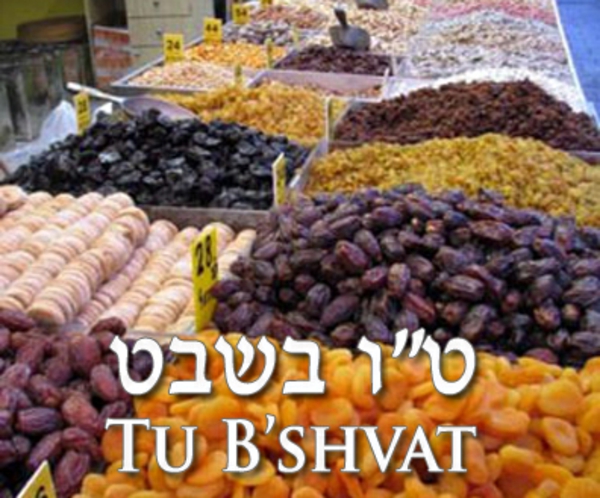
Tu B’Shevat, the 15th day of the Jewish month of Shevat, is a holiday also known as the New Year for Trees. The word "Tu" is not really a word; it is the number 15 in Hebrew, as if you were to call the Fourth of July "Iv July" (IV being 4 in Roman numerals). See Hebrew Alphabet for more information about using letters as numbers and why the number 15 is written this way.
As I mentioned in Rosh Hashanah, Judaism has several different "new years." This is not as strange a concept as it sounds at first blush; in America, we have the calendar year (January-December), the school year (September-June), and many businesses have fiscal years. It's basically the same idea with the various Jewish new years.
Tu B’Shevat is the new year for the purpose of calculating the age of trees for tithing. See Lev. 19:23-25, which states that fruit from trees may not be eaten during the first three years; the fourth year's fruit is for G-d, and after that, you can eat the fruit. Each tree is considered to have aged one year as of Tu B’'Shevat, so if you planted a tree on Shevat 14, it begins it second year the next day, but if you plant a tree two days later, on Shevat 16, it does not reach its second year until the next Tu B’Shevat.
Tu B’Shevat is not mentioned in the Bible. I have found only one reference to it in the Mishnah, and the only thing said there is that it is the new year for trees, and there is a dispute as to the proper date for the holiday (Beit Shammai said the proper day was the first of Shevat; Beit Hillel said the proper day was the 15th of Shevat. As usual, we follow Beit Hillel.
There are few customs or observances related to this holiday. One custom is to eat a new fruit on this day. Some people plant trees on this day. A lot of Jewish children go around collecting money for trees for Israel at this time of year. That's about all there is to it.
Tisha B'Av, the Fast of the Ninth of Av, is a day of mourning to commemorate the many tragedies that have befallen the Jewish people, many of which coincidentally have occurred on the ninth of Av.
Tisha B'Av means "the ninth (day) of Av." It usually occurs during August.
Tisha B'Av primarily commemorates the destruction of the first and second Temples, both of which were destroyed on the ninth of Av (the first by the Babylonians in 586 B.C.E.; the second by the Romans in 70 C.E.).
Although this holiday is primarily meant to commemorate the destruction of the Temple, it is appropriate to consider on this day the many other tragedies of the Jewish people, many of which occurred on this day, most notably the expulsion of the Jews from Spain in 1492.
Tisha B'Av is the culmination of a three week period of increasing mourning, beginning with the fast of the 17th of Tammuz, which commemorates the first breach in the walls of Jerusalem, before the First Temple was destroyed. During this three week period, weddings and other parties are not permitted, and people refrain from cutting their hair. From the first to the ninth of Av, it is customary to refrain from eating meat or drinking wine (except on the Sabbath) and from wearing new clothing.
The restrictions on Tisha B'Av are similar to those on Yom Kippur: to refrain from eating and drinking (even water); washing, bathing, shaving or wearing cosmetics; wearing leather shoes; and engaging in sexual relations. Work in the ordinary sense of the word is also restricted. People who are ill need not fast on this day. Many of the traditional mourning practices are observed: people refrain from smiles, laughter and idle conversation, and sit on low stools.
In synagogue, the book of Lamentations is read and mourning prayers are recited. The ark (cabinet where the Torah is kept) is draped in black.
Shavuot, the Festival of Weeks, is the second of the three major festivals with both historical and agricultural significance (the other two are Passover and Sukkot). Agriculturally, it commemorates the time when the first fruits were harvested and brought to the Temple, and is known as Hag ha-Bikkurim (the Festival of the First Fruits). Historically, it celebrates the giving of the Torah at Mount Sinai, and is also known as Hag Matan Torateinu (the Festival of the Giving of Our Torah).
The period from Passover to Shavuot is a time of great anticipation. We count each of the days from the second day of Passover to the day before Shavuot, 49 days or 7 full weeks, hence the name of the festival. See The Counting of the Omer. Shavuot is also sometimes known as Pentecost, because it falls on the 50th day. The counting reminds us of the important connection between Passover and Shavuot: Passover freed us physically from bondage, but the giving of the Torah on Shavuot redeemed us spiritually from our bondage to idolatry and immorality.
It is noteworthy that the holiday is called the time of the giving of the Torah, rather than the time of the receiving of the Torah. The sages point out that we are constantly in the process of receiving the Torah, that we receive it every day, but it was first given at this time. Thus it is the giving, not the receiving, that makes this holiday significant.
Shavuot is not tied to a particular calendar date, but to a counting from Passover. Because the length of the months used to be variable, determined by observation (see Jewish Calendar), and there are two new moons between Passover and Shavuot, Shavuot could occur on the 5th or 6th of Sivan. However, now that we have a mathematically determined calendar, and the months between Passover and Shavuot do not change length on the mathematical calendar, Shavuot is always on the 6th of Sivan (the 6th and 7th outside of Israel. See Extra Day of Holidays.)
Work is not permitted during Shavuot.
It is customary to stay up the entire first night of Shavuot and study Torah, then pray as early as possible in the morning.
It is customary to eat a dairy meal at least once during Shavuot. There are varying opinions as to why this is done. Some say it is a reminder of the promise regarding the land of Israel, a land flowing with "milk and honey." According to another view, it is because our ancestors had just received the Torah (and the dietary laws therein), and did not have both meat and dairy dishes available. See Separation of Meat and Dairy.
The book of Ruth is read at this time. Again, there are varying reasons given for this custom, and none seems to be definitive.
Independence Day, Israel national holiday, marks Israel’s Declaration of Independence with the end of the British Mandate. It is the only full holiday in the calendar decreed by law without a tradition of hundreds or thousands of years.
Independence Day is on the fifth day of the Jewish month of Iyar (from the end of April till mid-May), the day in which David Ben-Gurion, the state’s first prime minister, declared the country’s independence in 1948. It was declared a full holiday in a law enacted in the Knesset in 1949. Over the years various traditions evolved to celebrate the holiday, and it is now marked by family picnics in scenic spots all over the country.
Independence Day celebrations begin on the evening of the fifth of Iyar with the end of Yom Hazikaron, the Remembrance Day for the Fallen of Israel’s Wars, with special ceremonies marking the transition from mourning to celebration. The main ceremony is held in Har (Mount) Herzl in Jerusalem. During Independence Day, the World Bible Quiz is held in Jerusalem and the prestigious Israel Prizes are distributed to the year’s winners in a special ceremony.
Most businesses are closed on Independence Day, but cafes restaurants and other places of entertainment are open because it is not a religious holiday.
HOLIDAY CUSTOMS Flags – Many Israelis fly flags from their houses, porches or cars, often with colorful decorations.
Entertainment Stages – Because of Independence Day’s profoundly secular nature, a tradition of evolved of free entertainment by performers, dancers and comics on stages set up in the center of cities and other communities on the eve of Independence Day. The shows are often accompanied by fireworks. The main streets of towns and cities are usually packed with people.
Barbeque - Independence Day has become Israel’s unofficial barbeque holiday with families picnicking huge amounts of meat in every green spot they can find in the country.
Visits the IDF camps – Many of the army’s camps are open to the public on Independence Day, offering Israelis a chances to see arms, navy ships, tanks and aircraft.
Israeli Movies - Local channels devote all of their programming to the holiday and often screen old Israeli movies which have become cult items.
Prayer – Even though this is a national and not a religious holidayt, religious Zionists tend to say a special prayer composed by the chief rabbinate. This prayer sometimes includes blowing a shofar (a ram’s horn).
IMPORTANT INFORMATION Most sites in the countryside are usually packed on Independence Day, also because this is the only holiday in which both religious and secular Israeli Jews can travel. Since so many Israelis use this day to visits these sites, tourists might wish to stay inside the cities, the main streets of which are also full of people.
Yom Hazikaron, the Remembrance Day for the Fallen of Israel’s Wars and for Terror Victims is marked every year on the fourth of Iyar (towards the end of April or beginning of May,) one week after the Holocaust Remembrance Day and two weeks after Pesach (Passover.) The day is dedicated to commemorating the country’s soldiers and members of security forces, the memory of the fallen from the pre-state undergrounds, and to victims of terrorism.
Yom Hazikaron was formally decreed by law in 1963, but the practice of commemorating the fallen on this day started in 1951 to mark the connection between Independence Day and the people who died to achieve and maintain this independence.
The day starts on the evening of the fourth of Iyar and ends the following evening with the opening of the Independence Day celebrations. By law, all places of entertainment are close on Yom Hazikaron, ceremonies commemorating the fallen are held throughout the country, and flags are flown at half mast. On the eve of Yom Hazikaron a siren is sounded at 8 p.m. and again at 11 a.m. on the following morning. It is customary to stand in silence when the sirens are sounded.
Commemoration ceremonies are held in urban centers, public buildings and cemeteries and TV and radio are devoted to the subject.
Yom Hazikaron Customs There is hardly anybody in Israel who has not lost a family member, friend or acquaintance in Israel’s wars, which makes this day significant for every Israeli. Many go to commemoration ceremonies, and family members of the fallen go on this day to military cemeteries.
IMPORTANT INFORMATION Yom Hazikaron is not a holiday and work places that do not deal with entertainment are open as usual, but it is worth while checking in advance to see if specific places are open. In any case, the special atmosphere of mourning is discernable in the street.
The full name of the day commemorating the victims of the Holocaust is “Yom Hashoah Ve-Hagevurah”— literally the "Day of (remembrance of) the Holocaust and the Heroism." It is marked on the 27th day in the month of Nisan — a week after the seventh day of Passover, and a week before Yom Hazikaron (Memorial Day for Israel's fallen soldiers). It marks the anniversary of the Warsaw Ghetto uprising.
The date was selected by the Knesset (Israeli Parliament) on April 12, 1951. The full name became formal in a law that was enacted by the Knesset on August 19, 1953. Although the date was established by the Israeli government, it has become a day commemorated by Jewish communities and individuals worldwide.
In the early 1950s, education about the Holocaust (Shoah, meaning catastrophe, in Hebrew) emphasized the suffering inflicted on millions of European Jews by the Nazis. Surveys conducted in the late 1950s indicated that young Israelis did not sympathize with the victims of the Holocaust, since they believed that European Jews were "led like sheep for slaughter." The Israeli educational curriculum began to shift the emphasis to documenting how Jews resisted their Nazi tormentors through "passive resistance" — retaining their human dignity in the most unbearable conditions — and by "active resistance," fighting the Nazis in the ghettos and joining underground partisans who fought the Third Reich in its occupied countries.
Since the early 1960s, the sound of a siren on Yom Hashoah stops traffic and pedestrians throughout the State of Israel for two minutes of silent devotion. The siren blows at sundown and once again at 11:00 A.M. on this date. All radio and television programs during this day are connected in one way or another with the Jewish destiny in World War II, including personal interviews with survivors. Even the musical programs are adapted to the atmosphere of Yom Hashoah. There is no public entertainment on Yom Hashoah, as theaters, cinemas, pubs, and other public venues are closed throughout Israel.
Many Orthodox and ultra-Orthodox rabbis have never endorsed this memorial day, nor have they formally rejected it. There is no change in the daily religious services in some Orthodox synagogues on Yom Hashoah. The Orthodox Rabbinate of Israel attempted to promote the Tenth of Tevet — a traditional fast day commemorating the beginning of the siege of Jerusalem in ancient times — as the "General Kaddish Day" in which Jews should recite the memorial prayer and light candles in memory of those who perished in the Holocaust. Several ultra-Orthodox rabbis have recommended adding piyyutim (religious poems) that were written by contemporary rabbis to the liturgy of the Ninth of Av, and many communities follow this custom. Ismar Schorsch, the chancellor of the Conservative movement's Jewish Theological Seminary, has also suggested moving Holocaust commemorations to Tisha b'Av, because that is the day in which Judaism ritualizes its most horrible destructions.
Jews in North America observe Yom Hashoah within the synagogue as well as in the broader Jewish community. Commemorations range from synagogue services to communal vigils and educational programs. A few congregations find it more practical to hold commemorative ceremonies on the closest Sunday to Yom Hashoah. Many Yom Hashoah programs feature a talk by a Holocaust survivor, recitation of appropriate songs and readings, or viewing of a Holocaust-themed film. Some communities choose to emphasize the depth of loss that Jews experienced in the Holocaust by reading the names of Holocaust victims one after another — dramatizing the unfathomable notion of six million deaths. Many Jewish schools also hold Holocaust-related educational programs on or near Yom Hashoah.
Rituals associated with Yom Hashoah are still being created and vary widely among synagogues. Attempts have also been made to observe this memorial day at home. One suggestion is that every Jewish home should light a yahrzeit (memorial) candle on this day.
There have been numerous attempts to compose special liturgy (text and music) for Yom Hashoah. In 1988 the Reform movement published Six Days of Destruction. This book, co-authored by Elie Wiesel and Rabbi Albert Friedlander, was meant to be viewed as a "sixth scroll," a modern addition to the five scrolls that are read on specific holidays. Six narratives from Holocaust survivors are juxtaposed to the six days of creation found in Genesis.
In 1984, Rabbi David Golinkin of the Masorti (Conservative) movement in Israel wrote an article in which he suggested a program of observance for Yom HaShoah, which included fasting. One of the most recent achievements is Megillat Hashoah (The Holocaust Scroll) created by the Conservative movement as a joint project of rabbis and lay-leaders in Canada, the U.S., and Israel. This Holocaust scroll contains personal recollections of Holocaust survivors and is written in biblical style. It was composed under the direction of Professor Avigdor Shinan of Hebrew University and published by the International Rabbinical Assembly, the international body of Conservative rabbis, and the Masorti (Conservative) movement's Schecter Institute of Jewish Studies in Jerusalem.
Rabbi Avraham (Avi) Weiss, a modern Orthodox rabbi in New York, wrote a special Haggadah for the Yom HaShoah seder, to create a seder (much like on Passover and Tu b'Shevat) in which the story of the Holocaust is retold.
While Yom Hashoah rituals are still in flux there is no question that this day holds great meaning for Jews worldwide. The overwhelming theme that runs through all observances is the importance of remembering — recalling the victims of this catastrophe, and insuring that such a tragedy never happen again. The Shoah (Holocaust) posed an enormous challenge to Judaism and raised many questions: Can one be a believing Jew after the Holocaust? Where was God? How can one have faith in humanity? Facing this recent event in history, does it really matter if one practices Judaism? Jewish theologians and laity have struggled with these questions for decades. The very fact that Jews still identify Jewishly, practice their religion — and have embraced the observance of Yom Hashoah answers some of the questions raised by the Holocaust.
Passover is probably the best known of the Jewish holidays, mostly because it ties in with Christian history (the Last Supper was apparently a Passover Seder), and because a lot of its observances have been reinterpreted by Christians as Messianic and signs of Jesus.
Passover begins on the 15th day of the Jewish month of Nissan. It is the first of the three major festivals with both historical and agricultural significance (the other two are Shavu’ot and Sukkot). Agriculturally, it represents the beginning of the harvest season in Israel, but little attention is paid to this aspect of the holiday. The primary observances of Passover are related to the Exodus from Egypt after 400 years of slavery. This story is told in Exodus, Ch. 1-15. Many of the Passover observances are instituted in Chs. 12-15.
The name “Passover” refers to the fact that G-d “passed over” the houses of the Jews when he was slaying the firstborn of Egypt. In Hebrew, it is known as Pesach (that “ch” is pronounced as in the Scottish “loch”), which is based on the Hebrew root meaning “pass over”. The holiday is also referred to as Chag he-Aviv (the Spring Festival), Chag ha-Matzoth (the Festival of Matzahs), and Zeman Herutenu (the Time of Our Freedom) (again, all with those Scottish “ch”s).
Probably the most significant observance related to Passover involves the removal of chametz (leaven; sounds like “hum it’s” with that Scottish ch) from our homes. This commemorates the fact that the Jews leaving Egypt were in a hurry, and did not have time to let their bread rise. It is also a symbolic way of removing the “puffiness” (arrogance, pride) from our souls.
Chametz includes anything made from the five major grains (wheat, rye, barley, oats and spelt) that has not been completely cooked within 18 minutes after coming into contact with water. Traditional Jews of Ashkenazic background also avoid rice, corn, peanuts, and legumes (beans) as if they were chametz. All of these items have been used to make bread, thus use of them was prohibited to avoid any confusion. Such additional items are referred to as “kitniyos.” We may not eat chametz during Passover; we may not even own it or derive benefit from it. We may not even feed it to our pets or cattle. All chametz, including utensils used to cook chametz, must either be disposed of or sold to a non-Jew.
The process of cleaning the home of all chametz in preparation for Passover is an enormous task. To do it right, you must spend several days scrubbing everything down, going over the edges of your stove and fridge with a toothpick and a Q-Tip, covering all surfaces that come in contact with foil or shelf-liner, etc., etc., etc. After the cleaning is completed, the morning before the seder, a formal search of the house for chametz is undertaken, and any remaining chametz is burned.
The grain product we eat during Passover is called matzah. Matzah is unleavened bread, made simply from flour and water and cooked very quickly. This is the bread that the Jews made for their flight from Egypt. We have come up with many inventive ways to use matzah; it is available in a variety of textures for cooking: matzah flour (finely ground), matzah meal (coarsely ground), matzah farfel (little chunks, used as a noodle substitute), and full-sized matzahs (about 10 inches square, a bread substitute).
The day before Passover is the fast of the firstborn, a minor fast for all firstborn males, commemorating the fact that the firstborn Jewish males in Egypt were not killed during the final plague.
On the first night of Passover (first two nights for traditional Jews outside Israel), we have a special family meal filled with ritual to remind us of the significance of the holiday. This meal is called a seder, from a Hebrew root word meaning “order.” It is the same root from which we derive the word “siddur” (prayer book). There is a specific set of information that must be covered in a specific order. This is the seder. An overview of a traditional seder is included later in this page.
Passover lasts for seven days (eight days outside of Israel). The first and last days of the holiday (first two and last two outside of Israel) are days on which no work is permitted. See Extra Day of Holidays for more information. Work is permitted on the intermediate days. These intermediate days on which work is permitted are referred to as Chol Ha-Mo’ed, as are the intermediate days of Sukkot. The Passover Seder
The text of the Passover seder is written in a book called the Haggadah. The content of the seder can be summed up by the following Hebrew rhyme:
1. Kaddesh: Sanctification The word is derived from the Hebrew root Qof-Dalet-Shin, meaning holy. This is a blessing over wine in honor of the holiday. The wine is drunk, and a second cup is poured.
2. Urechatz: Washing A washing of the hands without a blessing, in preparation for eating the Karpas.
3. Karpas: Vegetable A vegetable (usually parsley) is dipped in salt water and eaten. The vegetable symbolizes the lowly origins of the Jewish people; the salt water symbolizes the tears shed as a result of our slavery. Parsley is a good vegetable to use for this purpose, because when you shake off the salt water, it looks like tears.
4. Yachatz: Breaking One of the three matzahs on the table is broken. Part is returned to the pile, the other part is set aside for the afikomen (see below).
5. Maggid: The Story A retelling of the story of the Exodus from Egypt and the first Passover. This begins with the youngest person asking The Four Questions, a set of questions about the proceedings designed to encourage participation in the seder. The Four Questions are also known as Mah Nishtanah (Why is it different?), which are the first words of the Four Questions.
The maggid is designed to satisfy the needs of four different types of people: the wise son, who wants to know the technical details; the wicked son, who excludes himself (and learns the penalty for doing so); the simple son, who needs to know the basics; and the son who is unable to ask, the one who doesn’t even know enough to know what he needs to know.
At the end of the maggid, a blessing is recited over the second cup of wine and it is drunk.
6. Rachtzah: Washing A second washing of the hands, this time with a blessing, in preparation for eating the matzah.
7. Motzi: Blessing over Grain Products The ha-motzi blessing, a generic blessing for bread or grain products used as a meal, is recited over the matzah.
8. Matzah: Blessing over Matzah A blessing specific to matzah is recited, and a bit of matzah is eaten.
9. Maror: Bitter Herbs A blessing is recited over a bitter vegetable (usually raw horseradish; sometimes romaine lettuce), and it is eaten. This symbolizes the bitterness of slavery. The maror is eaten with charoses, a mixture of apples, nuts, cinnamon and wine, which symbolizes the mortar used by the Jews in building during their slavery.
10. Korech: The Sandwich Rabbi Hillel was of the opinion that the maror should be eaten together with matzah and the paschal offering in a sandwich. In his honor, we eat some maror on a piece of matzah, with some charoses (we don’t do animal sacrifice anymore, so there is no paschal offering).
11. Shulchan Orech: Dinner A festive meal is eaten. There is no particular requirement regarding what to eat at this meal (except, of course, that chametz cannot be eaten). Among Ashkenazic Jews, gefilte fish and matzah ball soup are traditionally eaten at the beginning of the meal.
12. Tzafun: The Afikom The piece of matzah set aside earlier is eaten as “desert,” the last food of the meal. Different families have different traditions relating to the afikomen. Some have the children hide it, while the parents have to either find it or ransom it back. Others have the parents hide it. The idea is to keep the children awake and attentive throughout the pre-meal proceedings, waiting for this part.
13. Barech: Grace after Meals The third cup of wine is poured, and grace after meals is recited. This is similar to the grace that would be said on any Sabbath. At the end, a blessing is said over the third cup and it is drunk. The fourth cup is poured, including a cup set aside for the prophet Elijah, who is supposed to herald the Messiah, and is supposed to come on Passover to do this. The door is opened for a while at this point (supposedly for Elijah, but historically because Jews were accused of nonsense like putting the blood of Christian babies in matzah, and we wanted to show our Christian neighbors that we weren’t doing anything unseemly).
14. Hallel: Praises Several psalms are recited. A blessing is recited over the last cup of wine and it is drunk.
15. Nirtzah: Closing A simple statement that the seder has been completed, with a wish that next year, we may celebrate Passover in Jerusalem (i.e., that the Messiah will come within the next year). This is followed by various hymns and stories.
Purim is one of the most joyous and fun holidays on the Jewish calendar. It commemorates a time when the Jewish people living in Persia were saved from extermination.
The story of Purim is told in the Biblical book of Esther. The heroes of the story are Esther, a beautiful young Jewish woman living in Persia, and her cousin Mordecai, who raised her as if she were his daughter. Esther was taken to the house of Ahasuerus, King of Persia, to become part of his harem, and he loved her more than his other women and made her queen. But the king did not know that Esther was a Jew, because Mordecai told her not to reveal her nationality.
The villain of the story is Haman, an arrogant, egotistical advisor to the king. Haman hated Mordecai because Mordecai refused to bow down to Haman, so Haman plotted to destroy the Jewish people. In a speech that is all too familiar to Jews, Haman told the king, “There is a certain people scattered abroad and dispersed among the peoples in all the provinces of thy kingdom; and their laws are diverse from those of every people; neither keep they the king's laws; therefore it does not profit the king to suffer them.” Esther 3:8. The king gave the fate of the Jewish people to Haman, to do as he pleased to them. Haman planned to exterminate all of the Jews.
Mordecai persuaded Esther to speak to the king on behalf of the Jewish people. This was a dangerous thing for Esther to do, because anyone who came into the king's presence without being summoned could be put to death, and she had not been summoned. Esther fasted for three days to prepare herself, then went into the king. He welcomed her. Later, she told him of Haman's plot against her people. The Jewish people were saved, and Haman was hanged on the gallows that had been prepared for Mordecai.
The book of Esther is unusual in that it is the only book of the bible that does not contain the name of G-d. In fact, it includes virtually no reference to G-d. Mordecai makes a vague reference to the fact that the Jews will be saved by someone else, if not by Esther, but that it the closest the book comes to mentioning G-d. Thus, one important message that can be gained from the story is that G-d often works in ways that are not apparent, in ways that appear to be chance, coincidence or ordinary good luck.
Purim is celebrated on the 14th day of Adar, which is usually in March. The 14th of Adar is the day that Haman chose for the extermination of the Jews. In leap years, when there are two months of Adar, Purim is celebrated in the second month of Adar, so it is always one month before Passover. In cities that were walled in the time of Joshua, Purim is celebrated on the 15th of the month, because the book of Esther says that in Shushan (a walled city), deliverance from the massacre was not complete until the next day.
The word “Purim” means “lots” and refers to the lottery that Haman used to choose the date for the massacre.
The Purim holiday is preceded by a minor fast, the Fast of Esther, which commemorates Esther's three days of fasting in preparation for her meeting with the king.
The primary commandment related to Purim is to hear the reading of the book of Esther. The book of Esther is commonly known as the Megillah, which means scroll. Although there are five books of Jewish scripture that are properly referred to as megillahs (Esther, Ruth, Ecclesiastes, Song of Songs, and Lamentations), this is the one people usually mean when the speak of The Megillah. It is customary to boo, hiss, stamp feet and rattle gragers (noisemakers; see illustration) whenever the name of Haman is mentioned in the service. The purpose of this custom is to “blot out the name of Haman.”
We are also commanded to eat, drink and be merry. According to the Talmud, a person is required to drink until he cannot tell the difference between “cursed be Haman” and “blessed be Mordecai,” though opinions differ as to exactly how drunk that is.
In addition, we are commanded to send out gifts of food or drink, and to make gifts to charity. The sending of gifts of food and drink is referred to as shalach manos (lit. sending out portions). Among Ashkenazic Jews, a common treat at this time of year is hamentaschen (lit. Haman's pockets). These triangular fruit-filled cookies are supposed to represent Haman's three-cornered hat.
It is customary to hold carnival-like celebrations on Purim, to perform plays and parodies, and to hold beauty contests. I have heard that the usual prohibitions against cross-dressing are lifted during this holiday, but I am not certain about that. Americans sometimes refer to Purim as the Jewish Mardi Gras.
Work is permitted as usual on Purim, unless of course it falls on a Saturday.
Chanukah, the Jewish festival of rededication, also known as the festival of lights, is an eight day festival beginning on the 25th day of the Jewish month of Kislev.
Chanukah is probably one of the best known Jewish holidays, not because of any great religious significance, but because of its proximity to Christmas. Many non-Jews (and even many assimilated Jews!) think of this holiday as the Jewish Christmas, adopting many of the Christmas customs, such as elaborate gift-giving and decoration. It is bitterly ironic that this holiday, which has its roots in a revolution against assimilation and suppression of Jewish religion, has become the most assimilated, secular holiday on our calendar.
The story of Chanukah begins in the reign of Alexander the Great. Alexander conquered Syria, Egypt and Judea, but allowed the people under his control to continue observing their own religions and retain a certain degree of autonomy. Under this relatively benevolent rule, many Jews assimilated, adopting much of Hellenistic culture, including the language, customs, dress, etc., in much the same way that Jews in America today blend into the secular American society.
More than a century later, a successor of Alexander, Antiochus IV was in control of the region. He began to oppress the Jews severely, placing a Hellenistic priest in the Temple, massacring Jews, prohibiting the practice of the Jewish religion, and desecrating the Temple by requiring the sacrifice of pigs (a non-kosher animal) on the altar. Two groups opposed Antiochus: a basically nationalistic group led by Mattathias the Hasmonean and his son Judah Maccabee, and a religious traditionalist group known as the Chasidim, the forerunners of the Pharisees (no direct connection to the modern movement known as Chasidism). They joined forces in a revolt against both the assimilation of the Hellenistic Jews and oppression by the Selucid Greek government. The revolution succeeded and the Temple was rededicated.
According to tradition as recorded in the Talmud, at the time of the rededication, there was very little oil left that had not been defiled by the Greeks. Oil was needed for the menorah (candelabrum) in the Temple, which was supposed to burn throughout the night every night. There was only enough oil to burn for one day, yet miraculously, it burned for eight days. An eight day festival was declared to commemorate this miracle. Note that the holiday commemorates the miracle of the oil, not the military victory: Jews do not glorify war.
Chanukah is not a very important religious holiday. The holiday's religious significance is far less than that of Rosh Hashanah, Yom Kippur, Sukkot, Passover, and Shavu'ot. It is roughly equivalent to Purim in significance, and you won't find many non-Jews who have even heard of Purim! Chanukah is not mentioned in Jewish scripture; the story is related in the book of the Maccabbees, which Jews do not accept as scripture.
The only religious observance related to the holiday is the lighting of candles. The candles are arranged in a candelabrum called a Hanukia. Many people refer to the Hanukia incorrectly as a menorah. The name menorah is used only to describe the seven-branched candelabrum that was housed in the Jewish Temple. The Hanukiah holds nine candles: one for each night, plus a shamash (servant) at a different height. On the first night, one candle is placed at the far right. The shamash candle is lit and three berakhot (blessings) are recited: l'hadlik neir (a general prayer over candles), she-asah nisim (a prayer thanking G-d for performing miracles for our ancestors at this time), and she-hekhianu (a general prayer thanking G-d for allowing us to reach this time of year). The first candle is then lit using the shamash candle, and the shamash candle is placed in its holder. The candles are allowed to burn out on their own after a minimum of 1/2 hour. Each night, another candle is added from right to left (like the Hebrew language). Candles are lit from left to right (because you pay honor to the newer thing first).
Because of the law prohibiting the lighting of a fire on Shabbat, Chanukah candles are lit before the Shabbat candles on Friday night, and they are lit after Havdalah on Saturday night. The following blessings are said:
On the first night, the Shehecheyanu is also recited.
Why the shamash candle? The Chanukah candles are for pleasure only; we are not allowed to use them for any productive purpose. We keep an extra one around (the shamash), so that if we need to do something useful with a candle, we don't accidentally use the Chanukah candles. The shamash candle is at a different height so that it is easily identified as the shamash.
It is traditional to eat fried foods on this holiday, because of the significance of oil to the holiday. Among Ashkenazic Jews, this usually includes latkes (pronounced “lot-kuhs” or “lot-keys” depending on where your grandmother comes from), or “potato pancakes.”
Gift-giving is not a traditional part of the holiday, but has been added in places where Jews have a lot of contact with Christians as a way of dealing with children’s jealousy of their Christian friends. The only traditional gift of the holiday is “gelt,” small amounts of money. Chanukah gelt is a Jewish custom rooted in the Talmud: “The Talmud states that even a very poor person must light Chanukah lights, even if he can’t afford it. A person with no money is required to go ‘knocking on doors’ until he collects enough to buy at least one candle for each night of Chanukah. The Torah concept of charity -- tzedakah -- requires us to help the recipient in the most dignified manner possible. Therefore, the custom arose to give gifts of money during Chanukah so that someone who needs extra money for Chanukah candles can receive it in the form of ‘Chanukah Gelt.’”
Another tradition of the holiday is playing dreidel, a gambling game played with a square top. Most people play for matchsticks, pennies, M&Ms or chocolate coins. A dreidel is marked with the following four Hebrew letters: Nun, Gimmel, Heh and Shin. On Israeli dreidels, there is no Shin but rather a Peh, which stands for Po, meaning here.
This supposedly stands for the Hebrew phrase “nes gadol hayah sham,” a great miracle happened there. Actually, it stands for the Yiddish words nit (nothing), gantz (all), halb (half) and shtell (put), which is the rules of the game! There are some variations in the way people play the game, but the way I learned it, everyone puts in one coin. A person spins the dreidel. On Nun, nothing happens; on Gimmel (or, as we called it as kids, “gimme!”), you get the whole pot; on Heh, you get half of the pot; and on Shin, you put one in. When the pot is empty, everybody puts one in. Keep playing until one person has everything. Then redivide it, because nobody likes a poor winner.
A traditional song of this holiday is “Maoz Tzur,” better known to Christians as “Rock of Ages” (the tune is the same as one of the more popular ones; the Christian translation takes substantial liberties).
Tishri 22, the day after the seventh day of Sukkot, is the holiday Shemini Atzeret. In Israel, Shemini Atzeret is also the holiday of Simkhat Torah. Outside of Israel, where extra days of holidays are held, only the second day of Shemini Atzeret is Simkhat Torah. These two holidays are commonly thought of as part of Sukkot, but that is technically incorrect; Shemini Atzeret is a holiday in its own right and does not involve the special observances of Sukkot.
Shemini Atzeret literally means "the assembly of the eighth (day)." Rabbinic literature explains the holiday this way: G-d is like a host, who invites us as visitors for a limited time, but when the time comes for us to leave, He has enjoyed himself so much that He asks us to stay another day.
The annual cycle of weekly Torah readings is completed at this time. We read the last Torah portion, then proceed immediately to the first chapter of Genesis, reminding us that the Torah is a circle, and never ends. This completion of the readings is a time of great celebration. There are processions around the synagogue carrying Torahs and plenty of high-spirited singing and dancing. As many people as possible are given the honor of carrying a Torah scroll in these processions. This aspect of the holiday is known as Simkhat Torah, which means "Rejoicing in the Torah." As I said before, Simkhat Torah and Shemini Atzeret are separated in areas that observe an extra day of holidays, so outside of Israel, Shemini Atzeret is Tishri 22 and Simkhat Torah is Tishri 23.
In some synagogues, confirmation ceremonies or ceremonies marking the beginning of a child's Jewish education are held at this time.
Shemini Atzeret and Simkhat Torah are holidays on which work is not permitted.
The Festival of Sukkot begins on Tishri 15, the fifth day after Yom Kippur. It is quite a drastic transition, from one of the most solemn holidays in our year to one of the most joyous.
This festival is sometimes referred to as Zeman Simkhateinu, the Season of our Rejoicing. Sukkot lasts for seven days. The two days following the festival are separate holidays, Shemini Atzeret and Simkhat Torah, but are commonly thought of as part of Sukkot.
The word "Sukkot" means "booths," and refers to the temporary dwellings that we are commanded to live in during this holiday. The name of the holiday is frequently translated "The Feast of Tabernacles," which, like many translations of technical Jewish terms, isn't terribly useful unless you already know what the term is referring to. The Hebrew pronunciation of Sukkot is "Sue COAT," but is often pronounced as in Yiddish, to rhyme with "BOOK us."
Like Passover and Shavu'ot, Sukkot has a dual significance: historical and agricultural. The holiday commemorates the forty-year period during which the children of Israel were wandering in the desert, living in temporary shelters. Sukkot is also a harvest festival, and is sometimes referred to as Chag Ha-Asif, the Festival of Ingathering.
The festival of Sukkot is instituted in Leviticus 23:33 et seq. No work is permitted on the first and second days of the holiday. Work is permitted on the remaining days. These intermediate days on which work is permitted are referred to as Chol Ha-Mo'ed, as are the intermediate days of Passover.
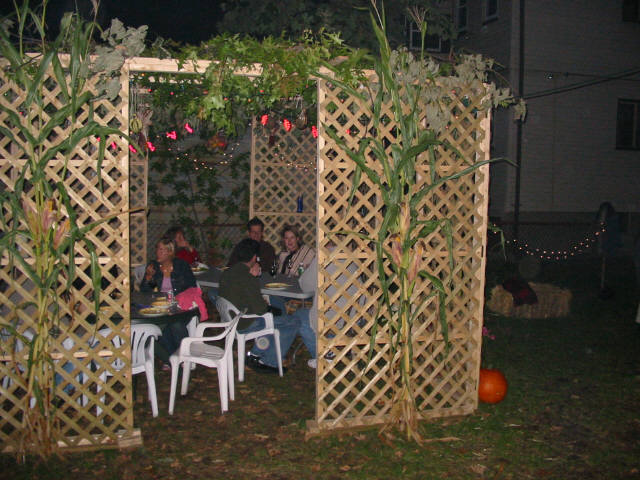
In honor of the holiday's historical significance, we are commanded to dwell in temporary shelters, as our ancestors did in the wilderness. The commandment to "dwell" in a sukkah can be fulfilled by simply eating all of one's meals there; however, if the weather, climate, and one's health permit, one should live in the sukkah as much as possible, including sleeping in it.
A sukkah must have at least three walls covered with a material that will not blow away in the wind. Canvas covering tied or nailed down is acceptable and quite common in the United States. A sukkah may be any size, so long as it is large enough for you to fulfill the commandment of dwelling in it. The roof of the sukkah must be made of material referred to as sekhakh (literally, covering). To fulfill the commandment, sekhakh must be something that grew from the ground and was cut off, such as tree branches, corn stalks, bamboo reeds, sticks, or two-by-fours. Sekhakh must be left loose, not tied together or tied down. Sekhakh must be placed sparsely enough that rain can get in, and preferably sparsely enough that the stars can be seen, but not so sparsely that more than ten inches is open at any point or that there is more light than shade. The sekhakh must be put on last.
It is common practice, and highly commendable, to decorate the sukkah. In the northeastern United States, Jews commonly hang dried squash and corn in the sukkah to decorate it, because these vegetables are readily available at that time for the American holidays of Halloween and Thanksgiving. Building and decorating a sukkah is a fun, family project, much like decorating the Christmas tree is for Christians. It is a sad commentary on modern American Judaism that most of the highly assimilated Jews who complain about being deprived of the fun of having and decorating a Christmas tree have never even heard of Sukkot.
The following blessing is recited when eating a meal in the sukkah:
Many Americans, upon seeing a decorated sukkah for the first time, remark on how much the sukkah (and the holiday generally) reminds them of Thanksgiving. This is not entirely coincidental. Our American pilgrims, who originated the Thanksgiving holiday, were deeply religious people. When they were trying to find a way to express their thanks for their survival and for the harvest, they looked to the Bible for an appropriate way of celebrating and based their holiday in part on Sukkot. (Nifty facts they don't teach you in public school!)
Another observance related to Sukkot involves what are known as The Four Species (arba minim in Hebrew) or the lulav and etrog. We are commanded to take these four plants and use them to "rejoice before the L-rd." The four species in question are an etrog (a citrus fruit native to Israel), a palm branch (in Hebrew, lulav), a myrtle branch (hadas) and a willow branch (arava).
Every morning of Sukkot, except on Shabbat, it is the custom to hold the lulav in the right hand and the etrog in the left. Bringing them together (with the pitam, the stem of the etrog pointing downward), the following blessing is recited:
The four species are also held during the Hallel prayer in religious services, and are held during processions around the bimah (the pedestal where the Torah is read) each day during the holiday. These processions commemorate similar processions around the alter of the ancient Temple in Jerusalem. The processions are known as Hoshanahs, because while the procession is made, we recite a prayer with the refrain, "Hosha na!" (please save us!). On the seventh day of Sukkot, seven circuits are made. For this reason, the seventh day of Sukkot is known as Hoshanah Rabbah (the great Hoshanah).
Yom Kippur is probably the most important holiday of the Jewish year. Many Jews who do not observe any other Jewish custom will refrain from work, fast and/or attend synagogue services on this day. Yom Kippur occurs on the 10th day of Tishri. The holiday is instituted at Leviticus 23:26 et seq.
The name “Yom Kippur” means “Day of Atonement,” and that pretty much explains what the holiday is. It is a day set aside to “afflict the soul,” to atone for the sins of the past year. In Days of Awe, I mentioned the “books” in which G-d inscribes all of our names. On Yom Kippur, the judgment entered in these books is sealed. This day is, essentially, your last appeal, your last chance to change the judgment, to demonstrate your repentance and make amends.
As I noted in Days of Awe, Yom Kippur atones only for sins between man and G-d, not for sins against another person. To atone for sins against another person, you must first seek reconciliation with that person, righting the wrongs you committed against them if possible. That must all be done before Yom Kippur.
Yom Kippur is a complete Sabbath; no work can be performed on that day. It is well-known that you are supposed to refrain from eating and drinking (even water) on Yom Kippur. It is a complete, 25-hour fast beginning before sunset on the evening before Yom Kippur and ending after nightfall on the day of Yom Kippur. The Talmud also specifies additional restrictions that are less well-known: washing and bathing, anointing one's body (with cosmetics, deodorants, etc.), wearing leather shoes (Orthodox Jews routinely wear canvas sneakers under their dress clothes on Yom Kippur), and engaging in sexual relations are all prohibited on Yom Kippur.
As always, any of these restrictions can be lifted where a threat to life or health is involved. In fact, children under the age of nine and women in childbirth (from the time labor begins until three days after birth) are not permitted to fast, even if they want to. Older children and women from the third to the seventh day after childbirth are permitted to fast, but are permitted to break the fast if they feel the need to do so. People with other illnesses should consult a physician and a rabbi for advice.
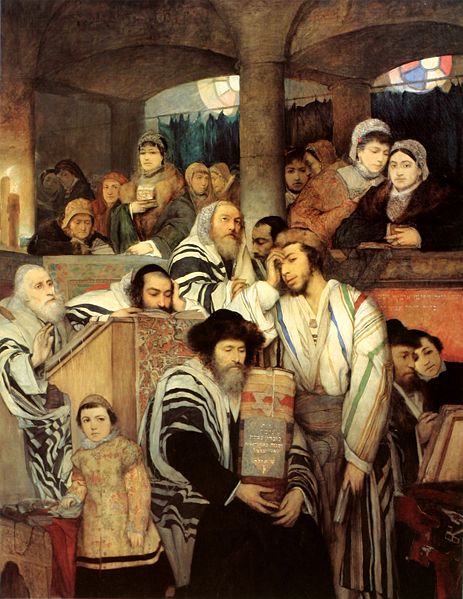
Most of the holiday is spent in the synagogue, in prayer. In Orthodox synagogues, services begin early in the morning (8 or 9 AM) and continue until about 3 PM. People then usually go home for an afternoon nap and return around 5 or 6 PM for the afternoon and evening services, which continue until nightfall. The services end at nightfall, with the blowing of the tekiah gedolah, a long blast on the shofar. See Rosh Hashanah for more about the shofar and its characteristic blasts.
It is customary to wear white on the holiday, which symbolizes purity and calls to mind the promise that our sins shall be made as white as snow (Is. 1:18). Some people wear a kittel, the white robe in which the dead are buried.
Yom Kippur Liturgy Yom Kippur has its own candlelighting blessing. If the holiay coincides with Shabbat, the words in parentheses are added:
"Blessed are You, LORD our God, King of the universe, Who sanctified us with his commandments, and commanded us to kindle the (sabbath and) Yom Kippur candles".
After the candles are lit, the Shehecheyanu prayer is recited.
Blessed art thou, Lord our God, Master of the universe, who has kept us alive and sustained us and has brought us to this special time.
The evening service that begins Yom Kippur is commonly known as Kol Nidre, named for the prayer that begins the service. “Kol nidre” means “all vows,” and in this prayer, we ask G-d to annul all personal vows we may make in the next year. It refers only to vows between the person making them and G-d, such as “If I pass this test, I'll pray every day for the next 6 months!”
This prayer has often been held up by anti-Semites as proof that Jews are untrustworthy (we do not keep our vows), and for this reason the Reform movement removed it from the liturgy for a while. In fact, the reverse is true: we make this prayer because we take vows so seriously that we consider ourselves bound even if we make the vows under duress or in times of stress when we are not thinking straight. This prayer gave comfort to those who were converted to Christianity by torture in various inquisitions, yet felt unable to break their vow to follow Christianity. In recognition of this history, the Reform movement restored this prayer to its liturgy.
There are many additions to the regular liturgy. Perhaps the most important addition is the confession of the sins of the community, which is inserted into the Shemoneh Esrei (Amidah) prayer. Note that all sins are confessed in the plural (we have done this, we have done that), emphasizing communal responsibility for sins.
There are two basic parts of this confession: Ashamnu, a shorter, more general list (we have been treasonable, we have been aggressive, we have been slanderous...), and Al Chet, a longer and more specific list (for the sin we sinned before you forcibly or willingly, and for the sin we sinned before you by acting callously...) Frequent petitions for forgiveness are interspersed in these prayers. There's also a catch-all confession: “Forgive us the breach of positive commands and negative commands, whether or not they involve an act, whether or not they are known to us.”
It is interesting to note that these confessions do not specifically address the kinds of ritual sins that some people think are the be-all-and-end-all of Judaism. There is no “for the sin we have sinned before you by eating pork, and for the sin we have sinned against you by driving on Shabbat” (though obviously these are implicitly included in the catch-all). The vast majority of the sins enumerated involve mistreatment of other people, most of them by speech (offensive speech, scoffing, slander, talebearing, and swearing falsely, to name a few). These all come into the category of sin known as “lashon ha-ra” (lit: the evil tongue), which is considered a very serious sin in Judaism.
The concluding service of Yom Kippur, known as Ne'ilah, is one unique to the day. It usually runs about 1 hour long. The ark (a cabinet where the scrolls of the Torah are kept) is kept open throughout this service, thus you must stand throughout the service. There is a tone of desperation in the prayers of this service. The service is sometimes referred to as the closing of the gates; think of it as the “last chance” to get in a good word before the holiday ends. The service ends with a very long blast of the shofar. See Rosh Hashanah for more about the shofar and its characteristic blasts.
After Yom Kippur, one should begin preparing for the next holiday, Sukkot, which begins five days later.
The Five Prohibitions Once the holiday candles are lit, Yom Kippur and its five prohibitions take effect. From sunset to sunset, there is:
1. No eating or drinking 2. No bathing 3. No using creams or oils 4. No wearing leather shoes 5. No sexual relations
KAPPAROT (Heb. כַּפָּרוֹת, plural of the Heb. כַּפָּרָה, kapparah; "expiation"), custom in which the sins of a person are symbolically transferred to a fowl. The custom is practiced in certain Orthodox circles on the day before the*Day of Atonement (in some congregations also on the day before *Rosh Ha-Shanah or on *Hoshana Rabba ). Psalms 107:10, 14, 17–21, and Job 33:23–24 are recited; then a cock (for a male) or a hen (for a female) is swung around the head three times while the following is pronounced: "This is my substitute, my vicarious offering, my atonement; this cock (or hen) shall meet death, but I shall find a long and pleasant life of peace." The fowl is thought to take on any misfortune which might otherwise befall a person in punishment of his sins. After the ceremony, it is customary to donate the fowl to the poor, except for the intestines which are thrown to the birds. Some rabbis recommended that money, equivalent to the fowl's value, be given instead.
This custom is nowhere mentioned in the Talmud. It appears first in the writings of the geonim of the 9th century, who explain that a cock is used in the rite because the word gever means both "man" and "cock"; the latter can, therefore, substitute for the former.
In Babylonia, other animals were used, especially the ram since Abraham offered a ram in lieu of his son Isaac (see: *Akedah and Gen. 22:13), or plants, e.g., beans, peas, (cf. Rashi, Shab. 81b). After the destruction of the Temple, no animals used in sacrificial rites could serve similar purposes outside the Temple (Magen Abraham to Sh. Ar., OḤ 605) and therefore cocks or hens were employed in the kapparot rite because they were not used in the Temple sacrificial cult. R. Solomon b. Abraham *Adret strongly opposed kapparot because it was similar to the biblical atonement rites (see *Azazel; cf. Lev. 16:5–22); he also considered the kapparah ritual to be a heathen superstition ("Darkhei Emori," responsa ed. Lemberg (1811) pt. 1, no. 395). This opinion was shared by *Naḥmanides and Joseph *Caro who called the kapparot "a stupid custom" (OḤ 605). The kabbalists (Isaac *Luria, Isaiah *Horowitz), however, invested the custom with mystical interpretations. These appealed strongly to the masses, and it became very popular when the rabbis acquiesced to it. Isserles made it a compulsory rite and enjoined for it many ceremonials similar to those of the sacrificial cult; e.g., the laying of the hands upon the animal, its immediate slaughter after the ceremony, prayers of confession, etc.
If a cock, or hen, cannot be obtained, other animals, fish or geese, may be used instead. A white cock or hen was especially desirable (based on Isa. 1:18, and Yoma 6:8). Some authorities, e.g., Joel Sirkes, forbade the use of a white cock on the grounds that it was a pagan rite (cf. Bayit Ḥadash, to Tur., OḤ 605, and Av. Zar. 1:5 and 14a). Kapparot is not practiced with a fowl at all in some traditional and many modern congregations. Money is substituted for a cock and the formula is changed accordingly ("this coin shall go to charity but we…," etc.). In Yiddish and popular Hebrew parlance the word kapparot may also refer to a financial or material loss, a regretted waste, or a vain effort.
Rosh Hashanah occurs on the first and second days of Tishri. In Hebrew, Rosh Hashanah means, literally, "head of the year" or "first of the year." Rosh Hashanah is commonly known as the Jewish New Year. This name is somewhat deceptive, because there is little similarity between Rosh Hashanah, one of the holiest days of the year, and the American midnight drinking bash and daytime football game.
There is, however, one important similarity between the Jewish New Year and the American one: Many Americans use the New Year as a time to plan a better life, making "resolutions." Likewise, the Jewish New Year is a time to begin introspection, looking back at the mistakes of the past year and planning the changes to make in the new year. More on this concept at Days of Awe.
The name "Rosh Hashanah" is not used in the Bible to discuss this holiday. The Bible refers to the holiday as Yom Ha-Zikkaron (the day of remembrance) or Yom Teruah (the day of the sounding of the shofar). The holiday is instituted in Leviticus 23:24-25.
The shofar is a ram's horn which is blown somewhat like a trumpet. One of the most important observances of this holiday is hearing the sounding of the shofar in the synagogue. A total of 100 notes are sounded each day. There are four different types of shofar notes: tekiah, a 3 second sustained note; shevarim, three 1-second notes rising in tone, teruah, a series of short, staccato notes extending over a period of about 3 seconds; and tekiah gedolah (literally, "big tekiah"), the final blast in a set, which lasts (I think) 10 seconds minimum. The Bible gives no specific reason for this practice. One that has been suggested is that the shofar's sound is a call to repentance. The shofar is not blown if the holiday falls on a Sabbath.
No work is permitted on Rosh Hashanah.
Another popular observance during this holiday is eating apples dipped in honey, a symbol of our wish for a sweet new year. We also dip bread in honey (instead of the usual practice of sprinkling salt on it) at this time of year for the same reason. In addition to dipping an apple honey, we eat round challah bread to symbolize the circle of the life and the cycle of a new year. The challah is also in the shape of a crown because we refer to God as royalty several times throughout the holidays.
Another popular practice of the holiday is Tashlikh ("casting off"). We walk to flowing water, such as a creek or river, on the afternoon of the first day and empty our pockets into the river, symbolically casting off our sins. This practice is not discussed in the Bible, but is a long-standing custom.
Religious services for the holiday focus on the concept of God's sovereignty.
The common greeting at this time is L'shanah tovah ("for a good year"). This is a shortening of "L'shanah tovah tikatev v'taihatem" (or to women, "L'shanah tovah tikatevi v'taihatemi"), which means "May you be inscribed and sealed for a good year." More on that concept at Days of Awe.
You may notice that the Bible speaks of Rosh Hashanah as occurring on the first day of the seventh month. The first month of the Jewish calendar is Nissan, occurring in March and April. Why, then, does the Jewish "new year" occur in Tishri, the seventh month?
Judaism has several different "new years," a concept which may seem strange at first, but think of it this way: the American "new year" starts in January, but the new "school year" starts in September, and many businesses have "fiscal years" that start at various times of the year. In Judaism, Nissan 1 is the new year for the purpose of counting the reign of kings and months on the calendar, Elul 1 (in August) is the new year for the tithing of animals, Shevat 15 (in February) is the new year for trees (determining when first fruits can be eaten, etc.), and Tishri 1 (Rosh Hashanah) is the new year for years (when we increase the year number. Sabbatical and Jubilee years begin at this time).
Marcia Pravder Mirkin states that, "On Rosh Hashanah we read the tragic and transforming family story of Sarah, Hagar, Abrham, Ishmael, and Isaac. We read it on a holiday that emphasizes teshuvah, turning around, becoming a better person, living a life closer to what God wants from us. How can we experience teshuvah?...teshuvah needs to include empathy, empathetic listening, paying attention, hearing beyond words to the soul and meaning of what is uttered...On Rosh Hashanah we ask God to be empathetic toward us, even tough empathy was so often lacking in ourselves."
See Extra Day of Jewish Holidays for an explanation of why this holiday is celebrated for two days instead of the one specified in the Bible.