Israel - My Love

Israel Flag

Quotes About "Palestine"


Remember: Israel is bad! Its existence keeps reminding Muslims what a bunch of losers they are. ~~~~~~~~~~~~~~~~~~~~~~~~~~~~~~
"There will be no peace until they will love their children more than they hate us."

-Golda Meir-
~~~~~~~~~~~~~~~~~~~~~~~~~~~~~~
'If the Arabs put down their weapons today, there would be no more ‎violence. If the Jews put ‎down their weapons ‎today, there would be no ‎more Israel'‎

~Benjamin Netanyahu~
~~~~~~~~~~~~~~~~~~~~~~~~~~~~~~~
"Peace of us means the destruction of Israel. We are preparing for an all out war, a war which will last for generations.

~Yasser Arafat~
~~~~~~~~~~~~~~~~~~~~~~~~~~~~~~
"The Palestinian people have no national identity. I, Yasser Arafat, man of destiny, will give them that identity through conflict with Israel."

~ Yasser Arafat ~
~~~~~~~~~~~~~~~~~~~~~~~
"The Palestinian people does not exist. The creation of a Palestinian state is only a means for continuing our struggle against the state of Israel. For our Arab unity. In reality today there is no difference between Jordanians, Palestinians, Syrians and Lebanese. Only for political and tactical reasons do we speak today about the existence of Palestinian people, since Arab national interest demand that we posit the existence of a distinct 'Palestinian people' to oppose Zionism".

~ Zahir Muhse'in ~
Showing posts with label Chazal. Show all posts

Tuesday, July 20, 2010

Talmud - In the Image of God

Written by Gil Student

"And G-d said, 'Let us make man in our image, after our likeness... And G-d created man in His image, in the image of G-d He created him..."
"[F]or in His image did G-d make man."

Genesis (1:26-27; 9:6) - NJPS Translation

Four times, in three different verses, the Torah says that man was created in G-d's image. Exactly what this means, that man was created in G-d's image, is a matter with many different approaches. What we intend to do in this essay is to discuss 8 different philosophical explanations of this divine image that man has and then show that according to almost all opinions every person has a divine image. One possible exception will also be discussed. Due to the nature of this endeavour, we will be quoting both prominent and somewhat obscure philosophers. However, those familiar with Jewish philosophy will immediately recognize the more prominent names and their opinions (e.g. Maimonides).

Before we discuss these different understandings, it is important to note that some commentators do not read these verses as saying that man was created in G-d's image. Onkelos does not connect the words image and G-d, implying that G-d created man in man's image [cf. R. Avraham Ibn Ezra, Commentary to Genesis 1:26; R. Yitzchak Abarbanel, Commentary ad. loc, p. 68].

R. Sa'adia Gaon, in his Emunot VeDeyot (2:9, ed. Kaffih pp. 88-89) claims that the phrase "G-d's image" only implies uniqueness, similar to (Jeremiah 2:7) "My land" and (Isaiah 14:25) "My mountains" [In his translation of the Torah, R. Sa'adia Gaon offers a different explanation of this term].

Both R. Shmuel Ben Meir (Rashbam) and R. Avraham Ibn Ezra understand the word used for G-d, "Elokim", as referring here to angels, as it does in Judges (13:22). Thus, man was created in the image of angels.

1. Maimonides (Rambam) begins his Moreh Nevuchim by explaining this enigmatic phrase. He contends (1:1-2) that this refers to the human intellect, or rather the human intellectual process. Just like G-d, man can think and understand without any physical actions. This intellectual independence of thought is the "G-d's image" in which man was created [cf. Abarbanel, ibid., p. 67]. R. Shimon Ben Tzemach Duran (Rashbatz) in his Magen Avot (3:18) follows this approach as does R. Yom Tov Lipman Heller (Tosafot Yom Tov, Avot 3:14).

2. Somewhat similarly to Maimonides, R. Ovadiah Seforno (Commentary to Genesis 1:26-27) understands "G-d's image" as referring to man's eternal intellect. Aside from philosophical differences regarding the inherent nature of man's intellect, Seforno also differs with Maimonides by adding that distinct from the image of G-d, His "likeness" refers to free will. Only G-d and man have free will. R. Eliyahu Lopian (Lev Eliyahu, vol. 1 pp. 9-12) emphasizes this first aspect in Seforno's.

3. R. Chaim Friedlander (Siftei Chaim - Emunah Uvechirah, vol. 2 pp. 68, 90), on the other hand, focusses on the free will aspect. R. Yisrael Lifschitz (Tiferet Yisrael, Avot 3:89) and R. Meir Simchah HaCohen of Dvinsk (Meshech Chochmah, Genesis ad. loc.) also take the approach that "G-d's image" refers to free will. As does R. Meir Leibush Malbim (Commentary ad. loc.) and R. Aharon Kotler (Peninim Mishulchan Gavoha, Genesis ad. loc.).

4. Nachmanides (Ramban) in his Commentary to the Torah (Genesis ad. loc.) understands the plural of "Let us make", "our image", and "our likeness" as referring to both G-d and the Earth. G-d had the Earth form the human body while He formed the human soul to insert into the body. This soul, the "ruach", is the likeness and image of G-d.

5. R. Sa'adia Gaon, in his Arabic translation of the Torah, explains the term "G-d's image" as meaning the ability to conquer and rule. Just like G-d rules over all of creation, man rules over the animal world. This is consistent with the end of verse 26 where dominion over the animal kingdom is discussed.

6. R. Yitzchak Abarbanel (ibid. pp. 67-68) adds three additional interpretations. His first is that man, unlike other creatures, has four qualities. Man physically exists, grows, feels, and thinks. As the only creation that contains all of these qualities, man is similar to G-d, who contains every possible quality.

7. Abarbanel also suggests that man's physical parts are representative of the world and of G-d's actions. R. Moshe Chaim Luzzatto (Ramchal) eloquently stated it thus (Da'at Tevunot, ed. Feldheim p. 115, ed. Friedlander ch. 80):

For, in relation to all of the exalted qualities which we distinguish in the Blessed One is His acting on the level of His creatures, we find corresponding qualities in the figure of man. For example: the eye of man corresponds to the eye of Hid providence, which exercises surveillance over all the dwellers of the earth to judge all of their deeds... The ears of man correspond to G-d's sitting and listening to the prayers of men and to all of their praises... The mouth of man corresponds to G-d's speaking in a vision to His prophets... And, similarly, all of the other components of the body can be well understood as paralleling in their form and function the qualities to which He resorted in the making of His creations.
This understanding is also accepted by R. Natan Tzvi Finkel, the Alter of Slabodka, in his Or Hatzafun (vol. 1 p. 216).
8. Abarbanel's third interpretation is based on the Maimonidean understanding of the intellect. Unlike Plato, Maimonides believes that man is born without innate knowledge but rather with the capacity to learn and know. In other words, man is born with a Potential Intellect and, with study, gains an Acquired Intellect. This Acquired Intellect, Abarbanel suggests, is the divine image. According to Abarbanel, Adam and Eve were the exceptions to the above rule. They were created fully developed, both physically and mentally. Therefore, Adam and Eve, and only they, were created in G-d's image. Every other person must work to develop his intellect into a diving image.

Do all people have G-d's image?
According to 1 through 7, all people, both Jewish and gentile, have G-d's image. All people have the same learning process, an eternal intellect, a soul, the ability to dominate animals, the qualities of existence, growth, feeling, and thought, and the same body parts.

Indeed, R. Avraham Grodzinsky wrote (Torat Avraham, p. 139):

Not only Israel, but also all of the other nations, have the potential to reach the highest levels because they were created in the image of G-d. How wonderful are the words of the Tana devei Eliyahu, which says: I bear witness before heaven and earth, that Jew or Gentile, man or woman, slave or maidservant, all receive holy revelation according to their actions.
However, according to those in 3 who consider G-d's image to be free will, it is possible that there are those who do not have free will.

R. Chaim Lindenblatt has suggested to this author that according to Maimonides (Mishneh Torah, Hilchot Teshuvah 6:3) another category may lose their divine image. Maimonides states that there are those whose sin is so terrible that G-d removes from them the opportunity to repent. The prime example is Pharoah whose heart G-d repeatedly hardened (e.g. Exodus 14:4). Because Pharoah's sins were so grave, G-d removed from him the ability to repent i.e. his free will. Evidently, Pharoah and other sinners of that genre lose their divine image.

According to 8, it is clear that many, if not most, people do not have G-d's image because they have never acquired the requisite knowledge.

Before we end this essay, we must state that even according to the minority view mentioned here that some people do not have sufficient ability to act in G-d's image, it is absolutely forbidden to (G-d forbid) murder such people or to discriminate against them in any way. They are entirely human and MUST be treated with the dignity that all people deserve.


http://www.angelfire.com/mt/talmud/

The Term "Goy"

Written by Gil Student

It is frequently claimed that the term "Goy" (pl. goyim or goyyim) means "animal" and is therefore a derogatory term. However, this is not at all true. "Goy" is Hebrew for nation.

Exodus 19:6
"'But you shall be to Me a kingdom of priests and a holy nation.' These are the words that you shall speak to the children of Israel."

The word used here for nation, referring to the children of Israel, is "goy". There are countless examples of the Jewish nation being called "goy". There are also countless examples of other nations being called "goy" or "goyim".

See the Crosswalk Bible Lexicon entry for "Goy". Note that this is a Christian Bible site.

Colloquially, however, non-Jewish nations -- other nations -- are called "goyim" and a member of these nations is called a "goy". Any gentile is therefore called a "goy". It is not a derogatory term, but merely a descriptive term.

Leo Rosten, The Joys of Yinglish (New York:1989), pp. 205-206
goy
goyish (adjective)
goyim (plural)

What Yinglishman does not know, use and enjoy goy? Form rhyme respectively with "boy," "boyish," "doyen." The plural is pronounced GOY-im. The adjective is goyish (neuter), goyisher (masculine), or goyisheh (feminine). From the Hebrew: goy: "nation." Biblical texts called the Hebrews a goy kadosh: "a holy nation."

1. It is important to note that the idea of respect for others, and the values of a pluralistic society, form an old, integral part of Judaism and Jewish tradition. The rabbis taught that all men are equal in the eyes of G-d -- if they do the will of G-d: the Talmud says "Whether Jew or gentile, man or woman, rich or poor -- according to a man's deeds does G-d's presence rest on him."

2. Mormon call any non-Mormon a gentile; Jews are therefore gentiles to Mormons...

3. Just as some gentiles use "Jew" as a contemptuous synonym for driving too shrewd and sly a bargain ("He tried to Jew the price down," is about as odious an idiom as I know), so some Jews use goy in a pejorative sense. Relentless persecution of Jews, century after century, in nation after nation, left a legacy of bitter sayings...


http://www.angelfire.com/mt/talmud/

The Real Story About Rabbi Eleazar

Written by Gil Student

The Accusation:
Abodah Zarah 17a. States that there is not a whore in the world that the Talmudic sage Rabbi Eleazar has not had sex with.

By concisely summarizing the story told by the Talmud and slightly modifying the name, the accusation has changed a moving story about one man's return to G-d into a tale about a Talmud sage's sexual impropriety. We will present the whole story which has a very different message.

There are two things that are important to note. First, as is obvious, the story begins with Eleazar ben Durdia as patronizing prostitutes but concludes with his sorrowful repentance and acceptance into the world-to-come. Also, in most manuscripts he is not called Rabbi until the very end of the story, after his repentance. Clearly, he was not a scholar at all but merely an average (or below average) man who had a spiritual awakening that can be a lesson to us all about the power to change oneself.

Talmud Avodah Zarah 17a

They said about Eleazar ben Durdia that there was no prostitute in the world with whom he did not have intercourse at least once. He heard that there was one particular prostitute in a town near the sea who would receive a purse full of dinars for her services. He took a purse full of dinars and went to her, crossing over seven rivers. During intercourse she passed gas. She said: Just like this gas will never return to its place so too Eleazar ben Durdia will never have his repentance accepted (literally - will never return).
He went and sat between two mountains and hills. He said: Mountains and hills, request mercy for me. They said: Before we request mercy for you we have to request mercy for ourselves, at is says (Isaiah 54:10) "For the mountains will be moved and the hills will falter..."

He said: Heavens and earth, request mercy for me. They said: Before we request mercy for you we have to request mercy for ourselves, at is says (Isaiah 51:6) "For the heavens will dissipate like smoke, and the earth will wear out like a garment..."

He said: Sun and moon, request mercy for me. They said: Before we request mercy for you we have to request mercy for ourselves, at is says (Isaiah 24:23) "The moon will be humiliated and the sun will be shamed..."

He said: Stars and constellations, request mercy for me. They said: Before we request mercy for you we have to request mercy for ourselves, at is says (Isaiah 34:4) "All the host of the heavens will dissolve..."

He said: This matter depends solely on me. He put his head between his knees and began to tremble from crying until he died. A heavenly voice declared: R. Eleazar ben Durdia is ready for the world-to-come.

While the Talmud has certainly taken liberties with the details of the story, mountains and stars do not talk (see Tosafot ad. loc.), the message is clear. A prostitute made a snide remark to Eleazar about how far gone he was from his religion and, as a believing albeit unobservant man, he wished for divine mercy. He went around looking for ways to find mercy or, as some read it, looking for scapegoats on whom to blame his behavior (see R. Yonatan Eyebeshitz, Ye'arot Devash, sermon 3 p. 56a). His conclusion, however, was that he alone was to blame for his behavior and his deep-felt remorse led to his tearful death. This repentance was sufficient for him to earn a place in the world-to-come (see R. Shlomo Eidels, Chiddushei Maharsha, ad. loc.).

An honest reading of the full talmudic passage shows that the accusation was totally misleading and unfounded.


http://www.angelfire.com/mt/talmud/

Talmud - Sex With A Three Year Old

The Talmud Does Not Permit Sex With A Three Year Old
Written by Gil Student

The Accusation:
Yebhamot 11b: "Sexual intercourse with a little girl is permitted if she is three years of age."

The accusation here is quite nefarious. It implies that Judaism permits pedophilia, has no respect for women, and generally advocates loose sexual morals. To those familiar with the Talmud, this claim is patently ridiculous. However, the majority of people — particularly those making this claim — know little to nothing about the Talmud, its contents, or its methodology. On our website The Real Truth About The Talmud, we elaborate on these issues. However, for now, we will focus on the accusation at hand. It is, in fact, easily verified as being incorrect.

The Text:
Talmud Ketuvot 11b (The citation mentioned is evidently in error. Talmud Yevamot 11b has no relevant passage)

Rav Yehudah said in the name of Rav: A male child who has relations with a female adult causes her to be like one who was injured with a stick... Rava said: This is what was meant - an adult male who has relations with a female child has not done anything because less than this [three years old] is like sticking a finger into an eyeball.

While those unused to these Talmudic discussions might be taken aback by the use of euphemisms, the discussion here relates to the dowry for virgins and non-virgins. It has nothing to do with what acts are allowed, encouraged, forbidden, or discouraged. It is, indeed, ironic that this passage has been manipulated from its original context of a financial discussion into one of a religious discussion. While there are numerous talmudic passages of a religious nature, this one discusses dowries and not forbidden and permitted relations!

The Talmud relates that a virgin is entitled a higher dowry. While the tell-tale sign of virginity is the release of blood due to the breaking of the hymen on the wedding night, there are occasions when the hymen has already been broken such as when the woman suffered an injury. The Talmud here quotes Rav Yehuda in the name of Rav that a sexual act with a male minor is not considered to be a loss of virginity because one of the participants is not fully active. While the female's hymen may have been broken, she has not engaged in what can be classified as a sexual act (although it is certainly child abuse).

The Talmud continues and quotes Rava as saying that a sexual act between a male adult and a female under the age of three is also not considered a loss of virginity (although it is child abuse). Since the girl is too young for her hymen to be broken, she is still considered a virgin.

Nowhere is the Talmud permitting such behavior. Sex outside of a marriage is strictly forbidden (Maimonides, Mishneh Torah, Hilchot Ishut 1:4, Hilchot Na'arah Betulah 2:17; Shulchan Aruch, Even HaEzer 26:1, 177:5) as is this obvious case of child abuse. The Talmud is only discussing ex post facto what would happen if such a case arose.

That non-marital sexual relations is prohibited is stated explicitly by Maimonides in the following passage from his ground-breaking legal code Mishneh Torah:

Maimonides, Mishneh Torah, Hilchot Ishut 1:4

Whoever has licentious relations with a woman without marriage bonds is lashed by biblical mandate.

The claim that the Talmud, or normative Judaism, permits sexual relations with a minor is almost entirely incorrect. The slight truth in it is that, in certain societies in history, people were sometimes married as young as ten. While this was most recently done in Czarist Russia in order to avoid being drafted into the Czar's army (which was made especially difficult for Jews), it is not currently done. However, even in that case, marriage is required before having sexual relations. Judaism as a religion prohibits sexual relations, indeed even minor touching such as holding hands, outside of marriage.

It is certainly true that there are individual Jews who do not follow the teaching of the Talmud. That is their personal choice, just like many Catholics choose to use birth control and have premarital relations despite their religion's teaching against it. This does not mean that Catholicism permits premarital relations and it does not mean that Judaism (and the Talmud) does either. The personal choices of people whether to follow completely their religion does not reflect on what their religion teaches. Similarly, the fact that certain Muslims drink alcohol and frequent prostitutes does not mean that their religion permits it. It means that these individuals choose to defy their religion.

We leave it to others to deduce why some people would make baseless accusations against the Talmud and, by implication, Judaism and Jews.


http://www.angelfire.com/mt/talmud/

Refuting Various Claims About the Talmud

Refuting various claims about the Talmud
Written by Gil Student:

The Accusation
Moed Kattan 17a . If a Jew is tempted to do evil he should go to a city where he is not known and do the evil there.

The Text:
Talmud Moed Kattan 17a

Rabbi Ila'i said: If a person is tempted to do evil he should go to a city where he is not known, dress in black clothes, cover his head in black, and do what his heart desires so that G-d's name will not be desecrated.

Note the part of the passage that is not quoted in the accusation. The accusers do not mention that this person (not necessarily a Jew) must dress in black and cover his head. Why should this be if the Talmud is offering advice on how to commit a crime? Quite the opposite, this person should try to blend in with everyone else. Rather the Talmud is offering very sound psychological advice. This person is not directly told "You can't do it." That advice to a person steeped in desire is meaningless because the person has lost control of his actions. Rather, the person is bidden to first delay his intended actions by going to a city where he is not known. This lengthy trip will serve as a cooling off period. He is then told to dress humbly which should further serve as a reminder of what he should be doing compared to what he plans on doing. Rather than offering carte blanche permission to sin, the Talmud is suggesting a form of indirect rebuke to prevent the person from sinning [see Rashi in the name of Rav Hai Gaon and Chiddushei HaRan; Tosafot, Kiddushin 40a]. The desecration of G-d's name is a subterfuge to convince this sick individual to follow the path to health.

The Accusation:
Yebhamot 11b: "Sexual intercourse with a little girl is permitted if she is three years of age."

Aboda Sarah 37a: "A gentile girl who is three years old can be violated."

The Text:
Talmud Ketuvot 11b (The citation mentioned is evidently in error. Talmud Yevamot 11b has no relevant passage)

Rav Yehudah said in the name of Rav: A male child who has relations with a female adult causes her to be like one who was injured with a stick... Rava said: This is what was meant - an adult male who has relations with a female child has not done anything because less than this [three years old] is like sticking a finger into an eyeball.

While those unused to these Talmudic discussions might be taken aback by the use of euphemisms, the discussion here relates to the dowry for virgins and non-virgins. A virgin receives a higher dowry. While the tell-tale sign of virginity is the release of blood due to the breaking of the hyman on the wedding night, there are occasions when the hyman has already been broken such as when the woman suffered an injury. The Talmud here adds that a sexual act with a male minor is not considered to be a loss of virginity because one of the participants is not fully active. While the female's hyman may have been broken, she has not engaged in what can be classified as a sexual act (although it is certainly child abuse).

The Talmud continues that a sexual act between a male adult and a female under the age of three is also not considered a loss of virginity (although it is child abuse). Since the girl is too young for her hyman to be broken, she is still considered a virgin.

Nowhere is the Talmud permitting such behavior. Sex outside of a marriage is strictly forbidden (Maimonides, Mishneh Torah, Hilchot Ishut 1:4, Hilchot Na'arah Betulah 2:17; Shulchan Aruch, Even HaEzer 26:1, 177:5) as is this obvious case of child abuse. The Talmud is only discussing ex post facto what would happen if such a case arose.

The same usage occurs in the passage in Talmud Avodah Zarah 37a. The Talmud states that at the age of three a girl is capable of participating in a sexual act. However, that act is not permissible. See also Jerusalem Talmud Ketuvot 1:2 (4b).

The Accusation
Sanhedrin 59a: "A goy (Gentile) who pries into The Law (Talmud) is guilty of death."

The Text
Talmud Sanhedrin 59a

Rabbi Yochanan said: A gentile who studies Torah is liable for death as it says (Deuteronomy 33:4) "Moses commanded us Torah as a heritage." It is a heritage for us and not for them... Rabbi Meir would say: How do we know that even a gentile who engages in the study of Torah is like a Jewish high priest? As it says (Leviticus 18:5) "Which man shall do [i.e. study] and by which he shall live [in the afterlife]." It does not say "priests, Levites, and Israelites" but "man". We learn from here that even a gentile who engages in the study of Torah is like a Jewish high priest. [We answer the contradiction between Rabbi Yochanan's statement and Rabbi Meir's that] there [Rabbi Meir] is referring to their seven commandments.

The Talmud provides a contradiction between two statements regarding whether a gentile is allowed to study Torah. The accusation only quotes one side and does not provide the resolution. By seeing the whole text and the resolution we can better understand the Talmud's intent.

What the accusation also does not quote is the passage immediately preceding ours. The Talmud states that it is forbidden for a gentile to fully observe the Jewish Sabbath and holidays. While this does not seem as conspiratorial as the prohibition against studying Torah it is still curious. Why should it be? The explanation is tied to the Talmud's resolution to the contradiction between Rabbi Yochanan and Rabbi Meir. The Talmud concludes that both rabbis agree but one was stating that a gentile is forbidden to study the parts of Torah that discuss the commandments relating specifically to Jews and the other was stating that a gentile is highly praised for studying the parts of Torah that discuss the commandments that relate to him. In other words, a gentile should be concerned with his role in G-d's world. He should actively pursue his place in the divine plan and attempt to raise himself to the highest human levels. However, as a righteous gentile, he must confine himself to HIS role and not someone else's role. When he starts studying about Jewish commandments and observing Jewish holidays, he is stepping out of his role as a righteous gentile and entering the role of a Jew. This is as inappropriate as if a Jew would start acting in the role of a righteous gentile. We all have our roles in the world and it is wrong to try to side-step those roles. A gentile can become a Jew through conversion but a righteous gentile is righteous in his own right and is forbidden to try to over-step his role.

Refuting various claims about the Talmud

The Accusation:
Talmud Erubin 21b. Whosoever disobeys the rabbis deserves death and will be punished by being boiled in hot excrement in Hell.

The Text:
Talmud Eruvin 21b

(Ecclesiastes 12:12) "And extensive study (lahag) is physically exhausting." Rav Papa bar Rav Acha bar Ada said in the name of Rav Acha bar Ula: This teaches that everyone who mocks (mal'ig) the words of the sages will be punished in burning excrement. Rava attacked: It does not say la'ag but lahag. Rather, whoever studies (hogeh) them will taste delectable meat.

The accusation crucially mistranslates "mocks" as "disobeys" which changes the meaning of the passage. The accusation also neglects to point out that the statement is disproven. However, the point still remains that, as demanded in Deuteronomy 17:8-13, Jews must follow the rulings of their judges.


http://www.angelfire.com/mt/talmud/
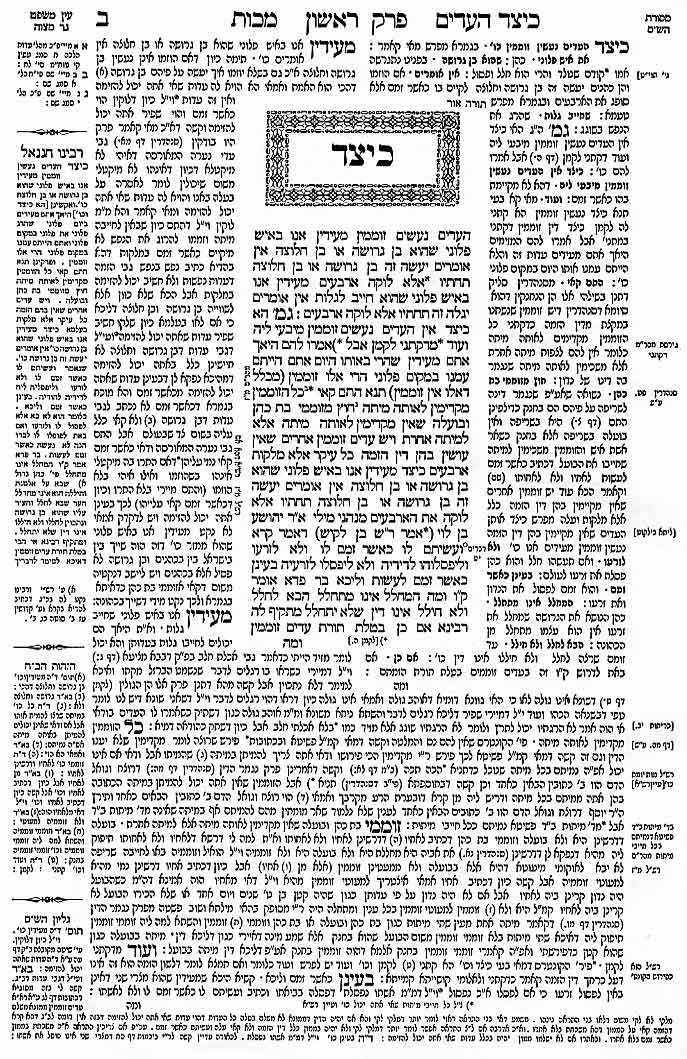
Talmud - Killing Gentiles

Killing Gentiles Is Forbidden
Written by Gil Student

The Accusation:
Jews May Rob and Kill Non-Jews, Sanhedrin 57a . When a Jew murders a Gentile ("Cuthean"), there will be no death penalty. What a Jew steals from a Gentile he may keep.

Minor Tractates. Soferim 15, Rule 10. This is the saying of Rabbi Simon ben Yohai: Tob shebe goyyim harog ("Even the best of the gentiles should all be killed").

Robbing gentiles is absolutely forbidden and is dealt with in a separate section. Here we will demonstrate that in no way does the Talmud permit or encourage killing gentiles. Rather, it strictly forbids killing anyone, Jew or gentile.

The Text:
Talmud Sofrim 15:10

R. Shimon ben Yochai taught: Kill [even] the good among the gentiles.
While this passage seems to advocate the genocide of all non-Jews, it must be remembered that this is a single passage extracted from a thorough study. Without seeing it in its original context, a simple reading is both incorrect and unsound scholarship. Let us look at the full original passage as recorded in a number of places.

The original teaching is as part of a study of the book of Exodus. At this point, the Jews have left Egypt but have not yet crossed the Sea of Reeds. The Egyptian people, after suffering through ten long and difficult plagues, have decided to pursue the Jewish people rather than let them go.

Mechilta, Beshalach 2 (on Exodus 14:7)

[Exodus 14:5-7 "It was told to the king of Egypt that the people had fled; and the heart of Pharoah and his servants became transformed regarding the people, and they said, 'What is this that we have done that we have sent away Israel from serving us?' He harnessed his chariot and attracted his people with him.] He took six hundred elite chariots [and all the chariots of Egypt, with officers on them all."]
From whom were the animals that drove the chariots? If you say they were from Egypt, doesn't it say (Exodus 9:6) "and all the livestock of Egypt died [from the fifth plague]"? If you say they were from Pharoah, doesn't it say (Exodus 9:3) "[Moses said to Pharoah]: Behold, the hand of G-d is on your livestock that are in the field"? If you say they were from the Jews, doesn't it say (Exodus 10:26) "And our livestock, as well, will go with us- not a hoof will be left"? Rather from whom were they, from the Egyptians who feared G-d [and were not affected by the plagues]. We now see that the livestock of the G-d-fearers that escaped the plague caused great hardship for the Jews [by being used for chariots to pursue them]. From here R. Shimon [ben Yochai] said: Kill [even] the good among the gentiles.

From the above teaching we see that R. Shimon ben Yochai was discussing a case of war. The G-d-fearers among the Egyptians allowed their animals to be used in battle against the Jews. Presumably, these people went along with their animals and drove the chariots. We now see that the G-d-fearers, the "good" among the gentiles, were doing battle with the Jews. To this R. Shimon ben Yochai said that, when in battle, do not try to spare the lives of those opposing soldiers who are fine, upstanding people. Kill any enemy soldier, regardless of their character. This contextual approach to understanding R. Shimon ben Yochai's statement is how the post-Talmudic literature has read this statement [see Tosafot, Avodah Zarah 26b sv Velo; Maimonides, Mishneh Torah, Hilchot Avodah Zarah 10:1]. Reading R. Shimon ben Yochai's teaching as a single-sentence imperative to kill all gentiles is simply wrong and is not how Jewish scholars have ever understood it.

Maimonides, Mishneh Torah, Hilchot Rotze'ach 2:11 and the commentary of R. Yosef Karo, Kessef Mishneh

A Jew who killed a righteous gentile is not executed in a court of law as it says (Exodus 21:14) "If a man shall act intentionall against his fellow..." [and a gentile is not considered a fellow] and even more so that he is not executed for killing an unrighteous gentile.
What our teacher Maimonides meant when he wrote that he is not executed in a court of law is that he is nevertheless punished by Heaven.

The above passage in Maimonides shows that there is a discrepancy between the treatment of a murderer of a Jew and a gentile. The Bible says that a murderer is only executed if he kills his "fellow" and by being parts of very different communities a gentile is not the "fellow" of a Jew. Is this murder forbidden? Absolutely. However, biblical fiat declares that this murder is not a capital punishment. However, rather than allowing this murderer to receive a minor punishment, his punishment is left to Divine providence. G-d will punish this sin appropriately because it is out of the court's hands.

While it is understandable that Jewish literature has been relatively quiet about something as obvious as the prohibition against killing gentiles, the following sources are just some of those who say it explicitly: Tosafot, Avodah Zarah 26b sv. Velo; Maimonides, Mishneh Torah, Hilchot Rotze'ach 2:11, Hilchot Avodah Zarah 10:1; R. Yoel Sirkes, Bayit Chadash, Yoreah Deah 158; Taz, Yoreh Deah 158:1; Beit Meir, Even HaEzer 17:3; R. Yosef Babad, Minchat Chinuch, 93:2; R. Avraham Yishayahu Karelitz, Chazon Ish, Bava Kamma 10:16.


http://www.angelfire.com/mt/talmud/

Talmud - Tricking Gentiles

Cheating Gentiles Is Forbidden
Written by Gil Student

The Accusation:
O.K. to Cheat Non-Jews, Sanhedrin 57a .

This is perhaps one of the worst lies stated. The Talmud and post-Talmudic literature absolutely and unequivocally forbid lying to anyone, whether Jew or gentile. It is forbidden to cheat or to profit from lying. Consider the following passage:

Talmud Chullin 94a

As Shmuel said: It is forbidden to deceive anyone, even an idolatrous gentile.
This statement is affirmed in Maimonides' famous legal work the Mishneh Torah (Hilchot Deiot 2:6) and in the Shulchan Aruch (code of law - Choshen Mishpat 228:6). The concept is evident throughout Jewish literature. A few other places where it can be found as law are: Rabbi Yom Tov ben Avraham Alashbili, Chiddushei HaRitva, Chullin ad. loc.; Rabbi Yehudah HaChasid, Sefer Chasidim, 51; Rabbi Eliezer from Metz, Sefer Yerei'im, 124; Rabbi Elazar Azkiri, Sefer Chareidim, 29:20; Rabbi Yehudah Rosannes, Derech Pekudecha, 2:36:2; Rabbi Moshe from Coucy, Sefer Mitzvot HaGadol (Smag), 1:74, 2:155; Rabbi Yonah from Gerona, Sha'arei Teshuvah (Gates of Repentance), 3:184; Rabbi Shmuel Eidels, Chiddushei Maharsha - Chiddushei Aggadot, Chullin ad. loc.

There is, perhaps, no clearer denunciation than the following of Maimonides in his commentary to the Mishnah:

Maimonides, Commentary to the Mishnah, Keilim 12:7

And similiarly, lies, tricks, subterfuges, cheatings, and circumventions of gentiles are forbidden. They said [as quoted above] 'It is forbidden to deceive anyone, even an idolatrous gentile' and even more so when it can lead to the desecration of G-d's name. For that is a great sin and imbues in a person bad traits. And all these wicked actions G-d explained that He will be disgusted with them and with those who perform them, as it says: (Deuteronomy 18:12) "For anyone who does these is an abomination of G-d."
With this in mind, let us approach the text in question.

Talmud Bava Kamma 113b

Shmuel said: Their mistakes are permitted. Like when Shmuel bought from a gentile a golden bowl (with the seller thinking it was bronze) for four zuz and accidentally paid him one zuz less.
The Talmud is not stating that it is permissible to cheat a gentile. We saw above that the Talmud specifically forbids that. What the Talmud is saying is that normal business relations is for each party of a transaction to be responsible for their side of the deal. If Shmuel found a cheap bowl and, after accidentally underpaying, the seller did not count his money, then Shmuel was not obligated to correct the seller. The seller was negligent and Shmuel did not have to correct his mistake. For one's brothers and relatives one must go beyond the standard practice of business relations and correct all mistakes - return lost change, explain all misunderstandings, etc. However, for a business relation with whom there is mutual respect and understanding but nothing more, one conducts business by following convention.

In case the preceding has been unclear, let me restate it. A Jew is not obligated to correct a gentile's business mistakes. The Jew may not trick the gentile but if the gentile has been careless then the sale is nevertheless valid.

The following are just a few sources who state explicitly that the Talmud was only referring to accidental mistakes: Maimonides, Mishneh Torah, Hilchot Geneivah 7:8; Rabbi Mordechai Ashkenazi, Mordechai, end of Bava Batra; Chinuch, 258; Rabbi Shlomo Luriah, Yam Shel Shlomo, Bava Kamma 10:20; Rabbi Ephraim Navon, Machaneh Ephraim, Hilchot Gezeilah 4; Rabbi Yehoshua Falk, Sefer Me'irat Einayim, to Shulchan Aruch, Choshen Mishpat 283:6, 359:3.


http://www.angelfire.com/mt/talmud/
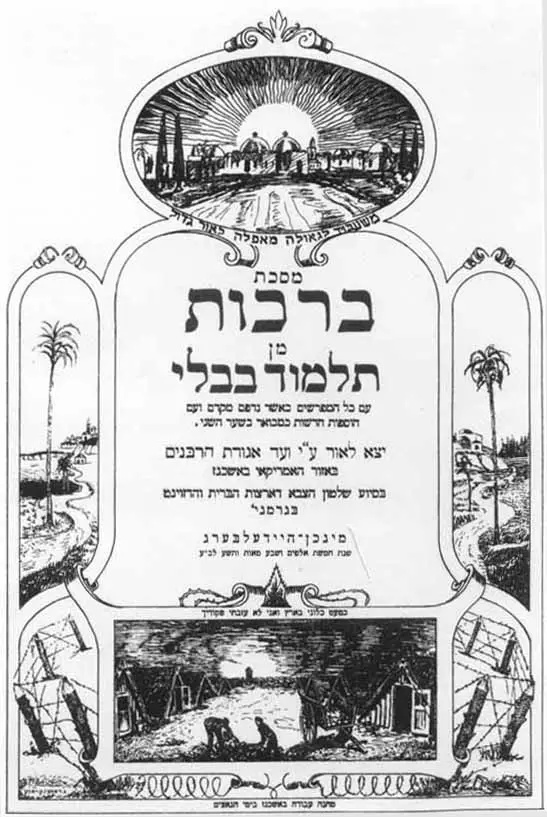
The Talmud Prohibits Jews From Withholding a Gentile's Wages

Paying Gentiles Wages - The Talmud prohibits Jews from withholding a gentile's wages
Written by Gil Student

The Accusation:
O.K. to Cheat Non-Jews, Sanhedrin 57a . A Jew need not pay a Gentile ("Cuthean") the wages owed him for work.

The Text:
Talmud Sanhedrin 57a

Rather this is referring to holding back a worker's wages [Leviticus 19:13]: A Cuthean to a Cuthean and a Cuthean to a Jew is forbidden; a Jew to a Cuthean is permitted.
Before discussing this particular passage from the Talmud it is important to note that the commandments regarding not withholding a worker's wages [see below] DO NOT touch upon the issue of whether a worker is paid; they deal solely with WHEN a worker is paid. The commandments specify that a worker must be paid within that day/night period and that the employer is prohibited from delaying payment. For example, a babysitter who watches children at night must be paid before sunrise of the next day. Similarly, a shoemaker who gives you your shoes during the day must be paid before sunset of that day (Talmud Bava Metzia 110b; R. Yisrael Meir HaCohen Kagan, Ahavat Chesed, 1:9:1-2). Even without these commandments, or if the time period has expired, a worker must still receive his wages. If not, the employer is guilty of theft (Talmud Bava Metzia 111a; Ahavat Chesed, 1:10:14). These commandments only determine WHEN an employee must be paid.

However, these only apply to a worker who has been too careless to pre-arrange a payment schedule. If a shoemaker states, or it is assumed, that he must be paid on delivery of the shoes then the commandments do not apply and he must be paid as arranged (Ahavat Chesed, 1:9:12). These commandments dictate that an employer should go beyond the legalities of a worker's agreement and take extra care of a neglectful or economically unempowered employee.

With that in mind, let us examine the relevant Talmudic passages. The above passage clearly states that the biblical prohibition against holding back a worker's wages during the night/day period following employment does not apply to Cutheans.

Who are the Cutheans? In 2 Kings 17:24-41 we are told that they were displaced by Assyrians from Babylonia to Israel and converted to Judaism out of fear of natural disaster. Regardless of their original intention, the Talmud considers them to have eventually become believing Jews [Tosafot Ketuvot 29a s.v. Ve'al]. However, in later Talmudic times they became a community of idolaters [Talmud Chullin 6a]. Because of their transgressions they were no longer treated as part of the Jewish community. In general, the Talmud uses the term Cuthean to refer to any idolaters, whether Jewish or gentile.

We therefore see that the Talmud states that the commandments prohibiting holding back a worker's wages do not apply to idolaters, Jewish or gentile. What remains unstated in this passage but is implicit in other passages is that an employer must still pay an idolater his fair wages. He only need not go the extra mile and pay him immediately if there was no pre-arranged payment schedule.

Talmud Geirim 3:2

And one transgresses with him [a righteous gentile] the prohibitions of aggrieving [Leviticus 25:17], of cheating [Leviticus 19:13], and of the sun not setting upon him [without paying his wages - Deuteronomy 24:15]. {For exact wording of text see Nachalat Ya'akov} Jerusalem Talmud Yevamot 8:1 (44b)

As we teach a Ger Toshav (righteous gentile) falls under the prohibition of aggrieving [Leviticus 25:17] - these are the words of Rabbi Yossi the son of Rabbi Yehudah
Mishnah Bava Metzia 111a

A Ger Toshav (righteous gentile) falls under the prohibition of "On that day you shall pay his wages" [Deuteronomy 24:15].
What we see unequivocably from the above passages is that the Talmud is not distinguishing between Jew and gentile regarding paying wages. Rather it is distinguishing between monotheist and idolater. The Torah requires maintaining an orderly society with debtors paying creditors and employers paying workers as pre-arranged. However, those are part of the Jewish/Ger Toshav society receive treatment beyond reasonable expectations and have provisions in case of negligence. Nowhere are gentiles discriminated against and even idolaters maintain their basic right to be paid for their labor.


http://www.angelfire.com/mt/talmud/
Talmud - Theft From Gentiles

The Talmud forbids stealing from gentiles
Written by Gil Student

The Accusation
Jews May Steal from Non-Jews, Baba Mezia 24a. (Affirmed also in Baba Kamma 113b).

The passage in Bava Metzia 24a does not deal with theft but with returning lost objects with which we will deal in a separate section. However, before we deal with Talmudic texts let us look at the conclusions drawn in post-Talmudic legal works.

Shulchan Aruch (Code of Jewish Law) Choshen Mishpat 348:2

Anyone who steals even a minor amount violates the prohibition of [Leviticus 19:11] "You shall not steal" and is required to repay [the amount stolen] whether one steals from a Jew or a gentile.

Shulchan Aruch Choshen Mishpat 359:1

It is forbidden to rob or to cheat even a minor amount from either a Jew or a gentile.
R. Shlomo Gantzfried, Kitzur Shulchan Aruch (Abridged Code of Jewish Law), 182:1

It is forbidden to rob or to steal even a minor amount from either a Jew or a gentile.
Maimonides, Mishneh Torah, Hilchot Gezeilah 1:2

And it is biblically forbidden to steal even a minor amount; even a gentile - it is forbidden to steal from him or to cheat him. And if you stole from him or cheated him you must return the stolen money or object.
Sefer HaChinuch, 259

Maimonides of blessed memory wrote that if one lies in his measures and thereby overcharges even to an idolatrous gentile one violates a negative commandment and must return the money. Similarly, it is forbidden to mislead the gentiles in calculating prices as it says [Leviticus 25:50] "he shall make a reckoning with his purchaser" [see below] even if he is subjugated to your authority; even more so if the gentile is not subjugated to your authority and it says [Deuteronomy 25:16] "For an abomination to the Lord, you G-d, are all who do this."

Now that we have seen that it is unequivocably forbidden by Jewish law to steal from a gentile, let us visit the relevant Talmudic texts.

The Text:
Talmud Bava Kamma 113a-b

And who permits stealing from a gentile [which is implied in an earlier case]? Doesn't it say [in a baraita]: R. Shimon said that R. Akiva taught this when he came from Zephirin: From where do we know that theft from a gentile is forbidden [Leviticus 25:48] "After he [a Jew] has been sold [as a slave to a gentile] he shall have a redemption." We see from here that the Jewish court cannot take him away and he will leave his gentile owner. Maybe [after being redeemed the Jewish slave will go free and] the gentile will have to collect his money on his own - therefore it says [v. 50] "he shall make a reckoning with his purchaser" - he will be scrupulous with his purchaser… Rava said: There is no contradiction [between this teaching and the earlier case]. Here [in this teaching] we are speaking about theft and here [in the earlier case] we are speaking about annulling a loan.
There are a number of important points in this passage. First, we see that stealing from a gentile is undeniably forbidden. The Talmud emphasizes this by explaining a difficult verse in Leviticus. As we have seen, this passage has been accepted throughout the post-Talmudic literature. Another important point is that annulling a loan from a gentile is permitted. Normally, a loan is witnessed and documented to make it legally effective. When this is not done, a Jew is still obligated to take pity on his lender despite the lack of legal proof. Even though the lender was careless and neglected to properly document his business dealing, a Jew must go beyond the letter of the law and have mercy on his hapless colleague. However, this brotherly act need only extend to this borrower's extended family. A Jew is only obligated to go beyond the letter of common business law for his Jewish brothers and cousins. Those who are not part of his extended family, part of his organic nation, are treated fairly and respectfully but do not receive the special treatment reserved for his family.

Going back to the prohibition of stealing from a gentile, there is a debate regarding this prohibition. Some scholars contend that this prohibition is biblical, as seems evident from the derivation from biblical verses [see Maimonides, Mishneh Torah, Hilchot Geneivah 1:1, 7:8, Hilchot Gezeilah 1:1; R. Yechezkel Landau, Noda BiYehudah I Y"D 81; R. Yom Tov Algazi, Hilchot Bechorot 2:17; R. Chaim of Volozhin, Responsa Chut Hameshulash, 14, 17; R. Ephraim Navon, Machaneh Ephraim, Hilchot Gezeilah, 3; R. Yair Bachrach, Chavot Yair, 79; R. Tzvi Ashkenazi, Chacham Tzvi, 26]. Others believe that theft from gentiles is biblically permitted but the rabbis, using their own authority, prohibited this act for all Jews [see Rashi, Sanhedrin 57a; R. Nissim of Gerona, Chiddushei HaRan, Sanhedrin 57a]. However that may be, we see that Jewish law clearly forbids stealing from anyone whether Jew or gentile.

Tanna Devei Eliyahu 16

I once sold to a gentile four korin [28 bushels] of dates and I measured it out evenly for him in a dark room. He said to me: G-d rules over the heavens and you know how much you measured for me. However, since I measured in a dark room I [accidentally] gave him three seahs [0.7 bushels] too little. After he paid me I purchased a jar of oil and placed it in the same place where I sold the dates to the gentile. The jar burst and the oil spilled out [as a divine punishment]. I said to him: My son, it says [Leviticus 19:13] "You shall not cheat your fellow and you shall not steal…" Your fellow is like your brother and your brother is like your fellow. You learn from here that it is forbidden to steal from a gentile because it is theft, and it need not be said that theft from your brother is forbidden.

Not only does Jewish law forbid theft from a gentile, the rabbis were particularly concerned about Jews appearing to be an unlawful people thereby defaming both the Jewish nation and their G-d. This sentiment is evident in the following passages.

Tosefta Bava Kamma 10:8

It is worse to steal from a gentile than from a Jew because of desecration of [G-d's] name.
Jerusalem Talmud Bava Metzia 2:5 (7a)

R. Chaninah told this story: Some rabbinic scholars bought one pile of wheat from some gentile soldiers. [The scholars] found in it a bundle of money and returned it to [the soldiers]. [The soldiers] said "Blessed is the G-d of the Jews."
Midrash Devarim Rabbah 3:3

Once, Rabbi Shimon ben Shetach bought a donkey from an Arab. His students went and found a precious stone hanging around [the donkey's] neck. Rabbi said to him [Proverbs 10:22] "It is the blessing of G-d that enriches." R. Shimon ben Shetach said to him "I bought a donkey. I did not buy a precious stone." He went and returned it to the Arab and the Arab said "Blessed is the G-d of Shimon ben Shetach." Jerusalem Talmud Bava Metzia 2:5 (7a)

R. Shmuel ben Sustrai went to Rome when the empress had lost her bracelet and he found it. A decree was proclaimed in the region that anyone who returned it within 30 days would be paid such and such; anyone who returned it after 30 days would be beheaded. He didn't return it within 30 days but after 30 days. She said to him "Weren't you in the region?" He replied "Yes." She said to him "Didn't you hear the proclamation?" He replied "Yes." She said to him "What was it?" He replied "Whoever returns it within 30 days will receive such and such; whoever returns it after 30 days will be beheaded." She said to him "And why didn't you return it within 30 days?" He replied "So that you wouldn't say that I did it because of fear of you; rather I did it out of fear of G-d." She said to him "Blessed is the G-d of the Jews."


http://www.angelfire.com/mt/talmud/

The Talmud Does Not Consider Gentiles to be Animals

Gentiles Are Human - The Talmud does not consider gentiles to be animals
Written by Gil Student

The Accusation:
Non-Jews are Not Human Baba Mezia 114a-114b. Only Jews are human ("Only ye are designated men").

The idea that only Jews are human and not gentiles runs contrary to a number of fundamental Jewish principles. According to the Talmud, gentiles ARE human and the complicated texts quoted to prove the accusation are misinterpreted, as we shall see.

The Texts:
Talmud Bava Metzia 114b

Rabbi Shimon ben Yochai said: The graves of gentiles do not cause ritual impurity in a dwelling as it says (Ezekiel 34:31) "Now, you [Israel] are My sheep , the sheep of My pasture, you are Man (Adam)…" You [Israel, the subject of the verse] are called Man (Adam) and gentiles are not called Man (Adam).
Talmud Keritot 6b

One who uses the official anointing oil [that has been consecrated] to smear on an animal or vessels is innocent of violating the holiness of the oil, to smear on gentiles or corpses is innocent. Certainly an animal and vessels as it say (Exodus 30:32) "It shall not be smeared on flesh of man (Adam)…" and an animal and vessels are not man. One who smears on corpses is also innocent since it is dead it is called a corpse and not a man. However, why is one who smears on gentiles innocent? They are men! No, as it says (Ezekiel 34:31) "Now, you [Israel] are My sheep , the sheep of My pasture, you are Man (Adam)…" You [Israel, the subject of the verse] are called Man (Adam) and gentiles are not called Man (Adam).
The relevance of the first passage is that causing ritual impurity in a dwelling is derived from Numbers 19: 14 "This is the teaching regarding a man (Adam) who would die in a tent…" Since the Talmud learns from Ezekiel that the term for man, Adam, only applies to Jews the verse regarding ritual impurity must also only refer to Jew who are called Adam.
Similarly, the second passage learns from Exodus 30:32 that only one who smears on a man (Adam) is liable. Since only Jews are called Adam, only one who smears on a Jew is liable.

There are those who infer from these passages that the Talmud considers gentiles to be sub-human. After all, if the Talmud says that gentiles are not called man they must be considered sub-human [for some reason the suggestion that they are super-human is never offered].

Here are two other passages which seem to contradict the above passage. After quoting them we will reconcile all of the passages and show that the Talmud does not consider gentiles to be sub-human.

Talmud Gittin 47a

A gentile has the ability to purchase land in Israel in order to dig holes and caves as it says (Psalms 115:16) "As for the heavens, the heavens are the Lord's; but the earth He has given to mankind (Bnei Adam=sons of Adam)."
Talmud Avodah Zarah 3a

Rabbi Meir would say: How do we know that even a gentile who engages in the study of Torah is like a Jewish high priest? We learn from the verse (Leviticus 18:5) "which man (HaAdam=the man) shall do [i.e. study] and by which he shall live [in the afterlife]."
We see from Gittin that the Talmud considers the phrase Bnei Adam (sons of man) to refer also to gentiles. We see from Avodah Zarah that the Talmud considers the term HaAdam (the man) to refer also to gentiles. Clearly, gentiles are considered human. Why then does the Talmud in Bava Metzia understand that gentiles are not considered Adam (man)?
The explanation is that these are different terms and only a superficial reading would render the term Adam in Bava Metzia as man. Gentiles are absolutely considered human as biology clearly dictates; there are no physiological differences between Jews and gentiles. All people are ultimately descended from the same ancestors, Noah and Adam.

However, the Jews, as a unified nation, are one organic entity. We are obligated to treat each other as close family members and are responsible for each other's actions.

When the Talmud sees the Hebrew word Adam it sees an allusion to Adam of Genesis 1-5 who was at one time the only person. The Talmud understands this as referring to the Jewish people who are an organic unit like one person. Gentiles do not have this organic national bond with each other and are therefore excluded from this concept.

Other terms referring to people, Bnei Adam (sons of Adam) or HaAdam (the man), are understood to refer to the species homo sapien of which gentiles are obviously members just as Jews are.

Thus, with regard to ritual impurity and holy oil, which are uniquely Jewish concepts, the Talmud sees an exclusion to all those who are not part of the organic Jewish nation. With regard to practical matters such as the purchase of land or individual matters such as spiritual status, gentiles are included. An understanding of all of the relevant passages in the Talmud shows that Gentiles are considered human but not Jewish and the accusations against the Talmud are false.

See also Tosafot Yevamot 61a s.v. Ve'Ein; Ra'avan #317; R. Israel Lifshitz, Tiferet Yisrael (Boaz), Avot 3:14; R. Tzvi Hirsch Chajes, Hagahot Maharatz Chajes, Yevamot 61a.


http://www.angelfire.com/mt/talmud/

Where Do Gentiles Fit Into the Jewish World View?

Gentiles - Where do gentiles fit into the Jewish world view?
Written by Gil Student

Maimonides, Mishneh Torah, Hilchot Teshuvah 3:4 based on Tosefta Sanhedrin 13:1; Talmud Sanhedrin 105a

Righteous gentiles have a place in the world to come.
Jerusalem Talmud Peah 1:1

It says (Job 37:23): "With justice and an abundance of kindness, He does not deal harshly." G-d does not withhold reward from gentiles who perform His commandments.

In the Jewish worldview all gentiles who are ethical monotheists will achieve salvation. Judaism does not denigrate gentiles and does not see them as condemened to eternal damnation. Rather we see them as fellow human beings, from other nations, searching for G-d and for meaning in life. Judaism wishes them well with their search and celebrates those who succeed in becoming ethical monotheists. Jews are obligated in many rituals and ceremonies and those Jews who fail to fulfill these rituals are considered sinners. Gentiles, however, are not obligated in these commandments and are only obligated to be ethical monotheists. Those who fulfill this obligation receive their full reward in the world-to-come.

There are three main categories of gentiles [see R. Yom Tov ben Avraham Alshevili, Chiddushei HaRitva, Makkot 9a n.].
The first category is the gentile who fulfills his obligations as an ethical monotheist. This person is generally called a Ben Noach (or Noachide) meaning a proud descendant of the biblical Noah. In the Jewish tradition Noah and his sons were commanded to fulfill seven commandments which amount to ethical monotheism [see Aaron Lichtenstein, The Seven Laws of Noah]. Those gentiles who observe these commandments are considered righteous gentiles. They are, however, not Jews and are not considered part of Jewish society. They are righteous people and recognized for their accomplishments. However, they remain part of the human brotherhood but not part of Jewish society.

There are those who go beyond this step and approach a Jewish court and, in exchange for entering Jewish society, they vow to observe their commandments and be ethical monotheists. Such a person is called a Ger Toshav. By pledging that he will fulfill his obligation to be an ethical monotheist he enters Jewish society. He is not a convert and does not become Jewish. In fact, he can worship any monotheistic religion he chooses. He is, however, a righteous gentile and is gladly received into the Jewish community. He is welcome to live in Jewish neighborhoods (should he so choose), is supported by Jewish charities (if he so needs), and is considered part of the fabric of Jewish society in many ways [see Talmud Pesachim 21b; Talmud Avodah Zarah 65b; Nachmanides, Additions to Book of Commandments, 16; Maimonides, Mishneh Torah, Hilchot Zechi'ah Umattanah 3:11, Hilchot Melachim 10:12; Ra'avad of Posquieres, Comments to Mishneh Torah, Hilchot Issurei Biah 14:8]. Both the Ben Noach and the Ger Toshav are righteous gentiles. However, the Ben Noach has not entered Jewish society and perhaps does not wish to. Therefore, he is treated like a stranger. He is respected as a righteous human being, one who is fulfilling his divine purpose in the world. However, he is not part of the Jewish community.

It is of these two categories of gentiles that the Talmudic literature states:
Midrash Bamidbar Rabbah 8:2

(Psalms 146:8) "G-d loves the righteous." G-d said: 'I love those who love Me and so it says (1 Samuel 2:30) "For I honor those who honor Me." They love Me so I love them in return.' Why does G-d love the righteous? Because righteousness is not an inheritance or a family trait. You find that priests are from a priestly family and Levites are from a levitical family as it says (Psalms 135:19-20) "O house of Aaron bless G-d! O house of Levi bless G-d!" If someone wants to become a priest [from the family of Aaron] or a Levite he cannot because his father was not a priest or a Levite. However, if someone wants to become righteous even if he is a gentile he can because it is not a family trait as it says (ibid.) "O those who fear G-d bless G-d!" It does not say the house of those who fear G-d but those who fear G-d. It is not a family trait rather on their own they chose to fear and love G-d. Therefore, G-d loves them.

Midrash Sifra, Acharei Mot 9:13

(Leviticus 18:5) "Which man shall carry out and by which he shall live." Rabbi Yirmiyah would say: We see from here that even a gentile who fulfills his laws is like a [Jewish] high priest. He would also say: (2 Samuel 7:19) "And that would be fitting for priests, Levites, and Israelites" is not what it says rather "and that would be fitting for great men - O Lord G-d." He would also say: (Isaiah 26:2) "Open the gates so the priests, Levites, and Israelites may enter" is not what it says rather "Open the gates so the righteous nation, keeper of the faith, may enter." He would also say: (Psalms 118:20) "This is the gate of G-d; priests, Levites, and Israelites" is not what it says rather "This is the gate of G-d; the righteous shall enter through it." He would also say: (Psalms 33:1) "Sing joyfully, O priests, Levites, and Israelites" is not what it says rather "Sing joyfully, O righteous, because of G-d." He would also say: (Psalms 125:4) "Do good, G-d, to the priests, Levites, and Israelites" is not what it says rather "Do good, G-d, to good people." We see from here that even a gentile who follows his commandments is [as righteous as the Jewish] high priest.

The third category is of the gentile who is not an ethical monotheist. He is violating the covenant G-d made with Noah and his descendants and will be punished for those sins. It is with these people that Judaism has a very ambivalent attitude. On the one hand, they are acting contrary to G-d's purpose in the world. For this reason, Judaism tries to distance Jews from them. On the other hand, they are people created in G-d's image and must be respected as such. The compromise is that their positive traits, examples of which we will shortly see, are recognized and respected. However, their negative traits are never fully forgotten and full societal integration with such people is discouraged.

Talmud Semachot 1:8

Rabbi Yehudah said: [The euology of a gentile is] Alas! The good, alas! The faithful who eats the fruit of his own labor. [The sages] said to him: What then did you leave for the worthy? He replied: If he [the gentile] was worthy why should he not be lamented in this manner.

Professor Saul Lieberman, Greek in Jewish Palestine, p. 77

The virtues enumerated in this eulogy are purely secular; there is no trace of religion in them. The man was good, faithful and enjoyed the fruits of his labor. The Gentiles spoken of is a heathen; he is neither a semi-proselyte nor a Christian; no mention is made of his fear of G-d... The Rabbis understood the heathen society and credited it with the virtues it was not devoid of.

Talmud Avot 4:3

[Ben Azzai] would say: Do not regard anyone with contempt, and do not reject anything, for there is no man who does not have his hour and nothing that does not have its place.

Talmud Avot 3:10

[Rabbi Chaninah ben Dosa] would say: Whoever is pleasing to his fellow creatures is pleasing to G-d; but whoever is not pleasing to his fellow creatures, G-d is not pleased with him.

Talmud Avot 3:14

[Rabbi Akiva] would say: Beloved is man who was created in the divine image. An extra amount of love is given to him because he was created in the divine image as it says (Genesis 9:6) "For in the image of G-d He made man."

Those gentiles who have the status of Ger Toshav, who have requested acceptance into Jewish society and have pledged obedience to their commandments, are treated almost like Jews. Those who have the status of Ben Noach because they have not requested acceptance are respected but are not treated like brethren. They receive letter-of-the-law treatment because to treat them beyond that would be to detract from our brothers. What has a Ger Toshav gained if a Ben Noach is treated the same? What extra connection is there between fellow Jews and within the entire Jewish/Ger Toshav society if everyone is treated extra specially?

Consider the case of a family. My brother needs to borrow money and knows that if he asks me I'll give him the special interest-free family package. This type of family treatment solidifies us as a unit and increases love between us. I don't hate everyone else because I treat my brother specially but I have an agreement that my family receives special treatment. Now, what if a stranger off the street knocks on my door and I give him also my special interest-free family loan? It loses its specialness and there is no difference between my bond with my brother and my bond with some guy off the street. Should I treat every human being equally or should I treat everyone properly and reserve extra-special treatment for my family?

The same applies within the Jewish/Ger Toshav society. All members, both Jewish and gentile, are joined together as a community united in its single goal of worshipping the one G-d. While we treat all human beings with the respect due to someone created in the divine image, those within the Jewish/Ger Toshav society get slightly better treatment. They are handled above and beyond the letter of common human interaction.

There are those who point out these differences in treatment and wish to demonstrate that Judaism is anti-gentile. Quite the opposite. Judaism is one of the few religions that recognizes that even those outside its faith can be saved and allows them into its community. Righteous gentiles have a place in the world to come and can choose to join Jewish society if they wish. If they decline this invitation then they are given the full respect that these righteous people deserve. We shall show that the differences in treatment are reasonable and that all gentiles are treated honestly and respectfully.


http://www.angelfire.com/mt/talmud/
Related Posts Plugin for WordPress, Blogger...

My Videos Bar

Breaking News